How Tall Is a Giraffe? The Headline Numbers
The tallest land animal, measured ground to ossicones.
The giraffe (Giraffa camelopardalis) is the tallest land animal on Earth. Adult males typically stand between 4.8 and 5.5 metres (15 ft 9 in to 18 ft 1 in) tall, measured from the ground to the top of the ossicones — the skin-covered horn-like knobs on their heads. Females are noticeably smaller, at 4.3 to 4.8 metres (14 ft 1 in to 15 ft 9 in). Male giraffes can weigh up to 1,360 kg (3,000 lb), females up to 830 kg (1,830 lb).
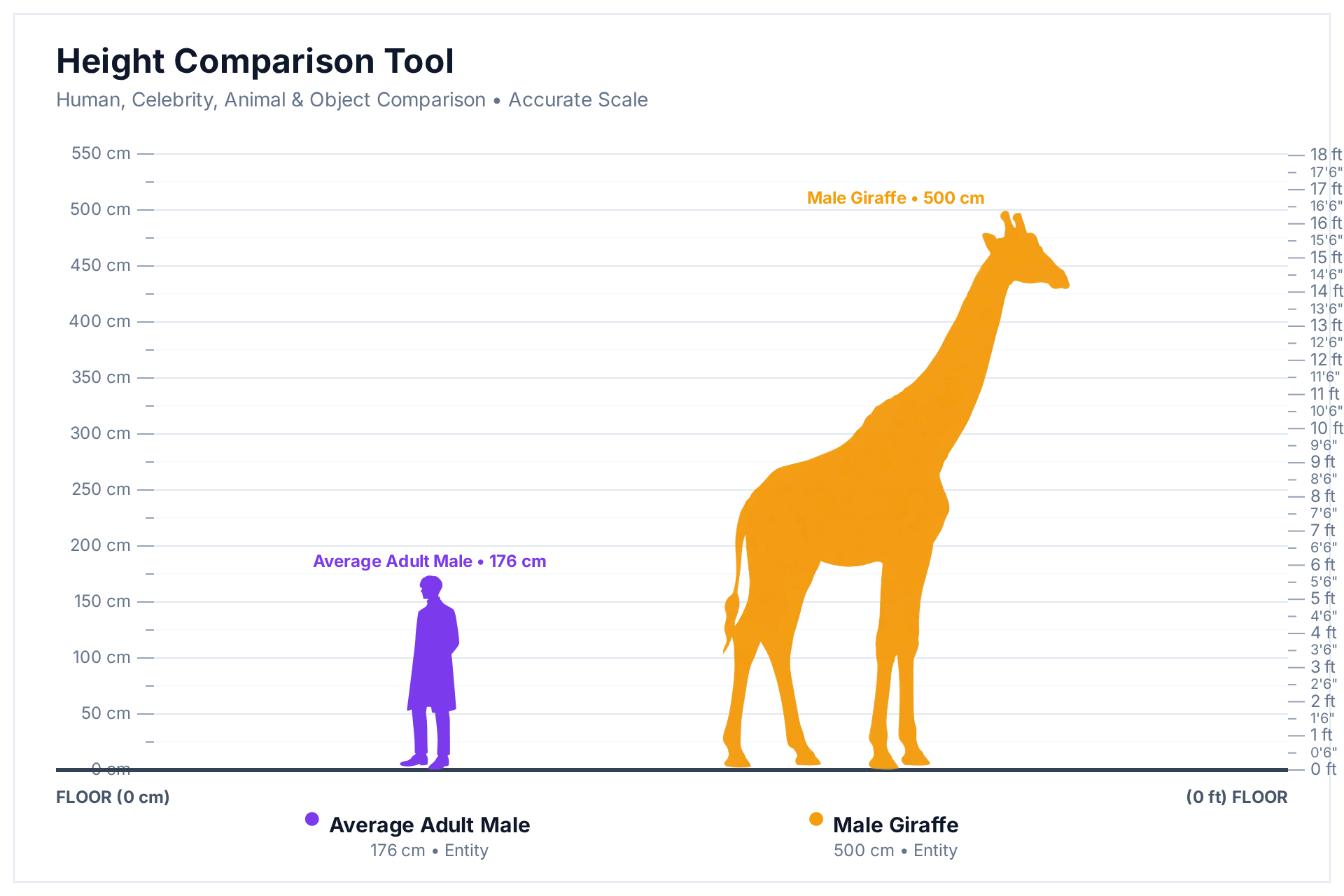
For context, the tallest giraffe in the 500 cm range is nearly three times as tall as an average adult man (176 cm / 5 ft 9 in). Put differently, the top of an average man's head reaches only about 32% of the way up a large bull giraffe — roughly to the level of the animal's lower chest, below its belly.
There are four recognized species — including the Masai, reticulated, northern, and southern giraffes — and their heights vary slightly by region, with Masai and Rothschild's bulls among the tallest at around 18 feet.
Just as horses are measured at the withers, giraffe height is taken from the ground to the highest fixed point of the head — the tips of the ossicones. A giraffe can stretch its head even higher to browse, but ossicone-tip height is the scientific baseline.
Where the Height Lives: Neck, Legs, and Seven Vertebrae
Each of the giraffe's major parts is human-scale on its own.
A giraffe's height is built from two extraordinary columns. The neck alone is about 1.8 metres (6 feet) long — and the legs are also about 1.8 metres (6 feet) long, each. That means a single giraffe leg is longer than most adult humans are tall, and the neck by itself would clear an average woman's head by roughly 18 cm.
Remarkably, the giraffe's neck contains only seven cervical vertebrae — exactly the same number as in the human neck. Each vertebra is simply enormously elongated (up to ~28 cm) and articulated with highly flexible joints, with anchor muscles at the base holding the column upright.
This is also why the commonly shown giraffe silhouette can look almost human-like in its proportions: it is roughly 40% legs, 40% neck, and only 20% torso, whereas a human is mostly torso and legs with a short neck.
A Baby Giraffe Is Taller Than You
Giraffe calves are born standing up — literally.
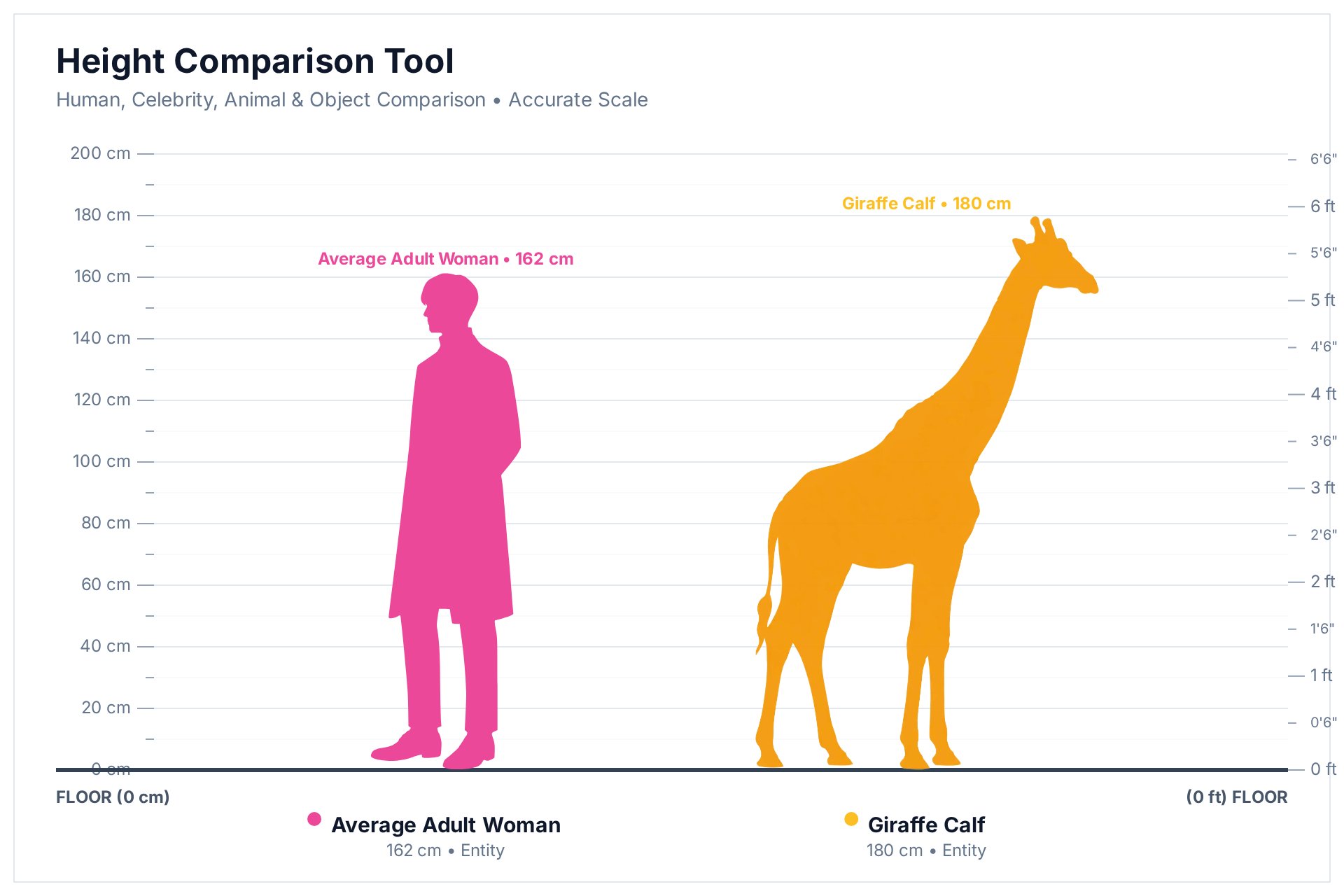
A newborn giraffe calf stands about 1.8 metres (5 ft 11 in) tall and weighs roughly 56–82 kg (125–180 lb). It is born while the mother is standing, so the calf drops roughly 1.5 metres to the ground — a fall that helps clear its airways and stimulates its first breaths.
Most calves stand within an hour of birth and can run within a few hours, which is critical because the young are vulnerable to lions, leopards, and hyenas. Only about 25 to 50% of calves survive to adulthood in the wild.
Here is the striking comparison: a newborn giraffe calf, minutes old, is already taller than an average adult woman (162 cm / 5 ft 3.8 in) and about the same height as an average adult man (176 cm). By age one, calves have typically grown to 2.7–3.7 m (9–12 ft).
Dogs and Cats at Giraffe Scale
Your pets, redrawn to a giraffe-sized ruler.
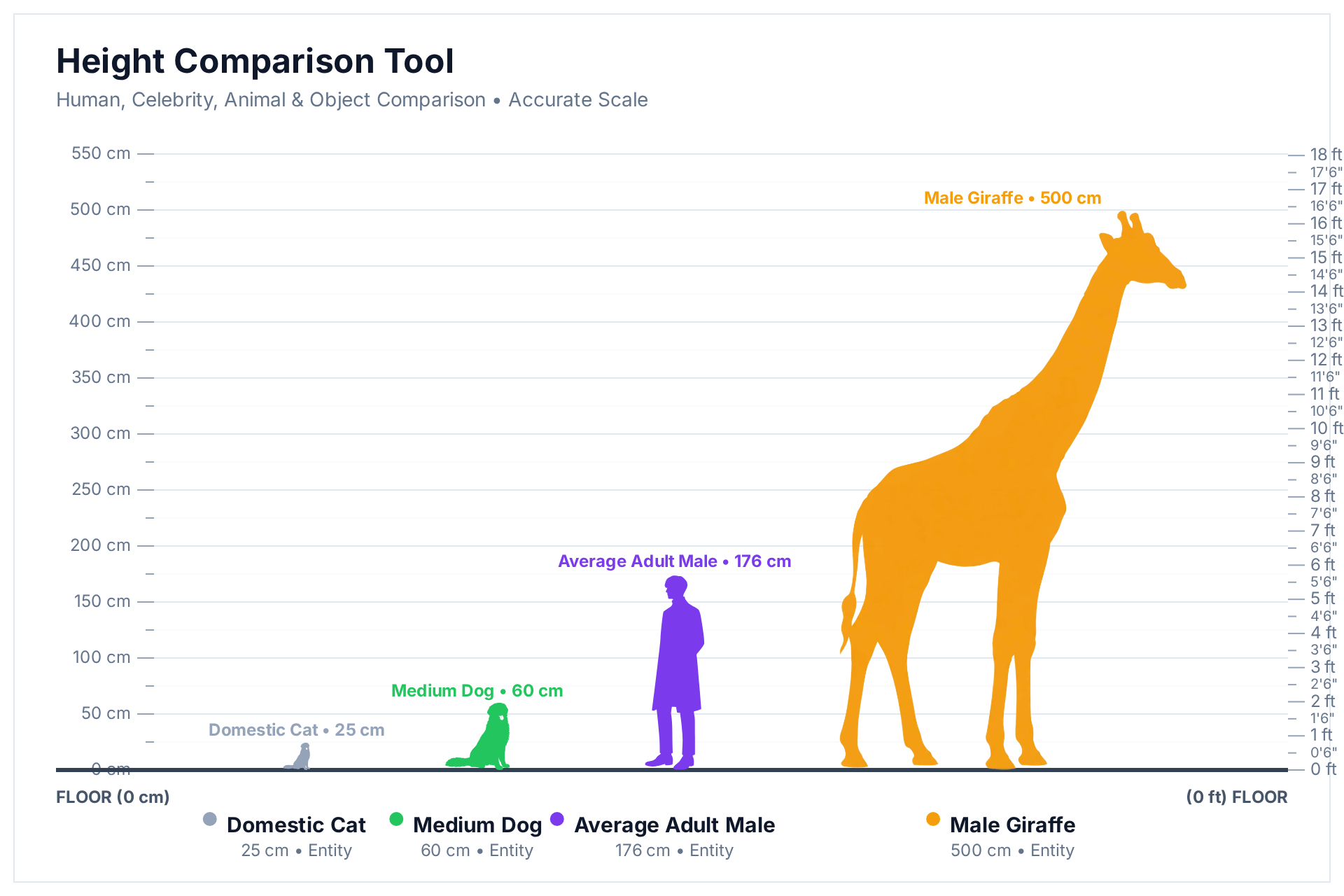
Domestic animals shrink to near-invisibility next to a giraffe. A typical domestic cat stands about 25 cm (9.8 in) at the shoulder — one twentieth the height of a 500 cm giraffe. A medium-sized dog like a Labrador at roughly 60 cm (23.6 in) is barely one eighth of the giraffe's height.
Dog breeds vary enormously: a Chihuahua may stand only 15 cm at the shoulder, while a Great Dane — one of the tallest dog breeds — can reach about 90 cm at the shoulder, which is roughly where a giraffe's ankle sits.
This range is why visual comparison matters more than a single number: the difference between a 25 cm cat and an 86 cm Great Dane feels huge at human scale, but on a 5-metre ruler both are simply small.
Why Being 5 Metres Tall Is an Evolutionary Advantage
Food no one else can reach, and a watchtower over the savanna.
Height is the giraffe's feeding strategy. Their 6-foot necks let them browse acacia leaves 5 metres up, a food source no other land animal — not even elephants — can reach, so giraffes face almost no competition for it. They spend 16 to 20 hours a day feeding.
Height is also surveillance. Excellent eyesight from 5 metres up lets giraffes spot lions and hyenas from far away, and they serve as an early-warning system for other herbivores grazing below them.
The giraffe is classified as Vulnerable on the IUCN Red List, with wild populations declining by roughly 30% since the 1980s to about 111,000 individuals, driven by habitat loss, poaching, and human conflict — a sobering footnote for the world's tallest land animal.