The Ladder: Wolverine at 5'3" to Thor at 6'6"
Thirty-eight centimetres separate the shortest and tallest human-shaped heroes — and the Hulk does not count.
Here is the whole genre in one chart: Wolverine at 160 cm, the average US man at 175 cm, Spider-Man at 178 cm, Batman and Captain America level at 188 cm, Cyclops at 191 cm and Thor at 198 cm. The human-shaped ladder runs 38 cm from bottom to top, and almost every major hero in Marvel and DC sits inside it. That is the first surprise of this topic. For characters who fly, lift tanks and punch through walls, the height range is strikingly ordinary: the tallest is a head taller than the shortest, and the middle of the ladder — Spider-Man at 178 cm — is a height you would not look twice at on a train.
The Hulk is the deliberate exception, which is why he is not in the chart. His handbook baseline is 244 cm (8'0"), but sources list anything from 213 cm to 243 cm depending on the era and how angry he is, and some versions run taller still. A single bar for the Hulk would be a fiction, so he is flagged in the table and left out of the visual. Include his 244 cm baseline and the spread becomes 84 cm; exclude him, and the honest number is 38 cm. Thanos, at 201 cm, is the only other figure above Thor, and he is a villain — the heroes themselves top out at 198 cm.
Look at the clustering and a pattern emerges. Nine of the fourteen names in the table sit between 183 cm and 198 cm — the 6'0" to 6'6" band. That is not an accident of anatomy; it is an editorial choice. Comic-book heroes are drawn tall because tall reads as heroic, and the handbooks then wrote the drawings down as numbers. The two heroes who break the pattern are the two most interesting characters in the genre: Spider-Man, who is ordinary on purpose, and Wolverine, who is short on purpose. Both are the subject of the next two sections.
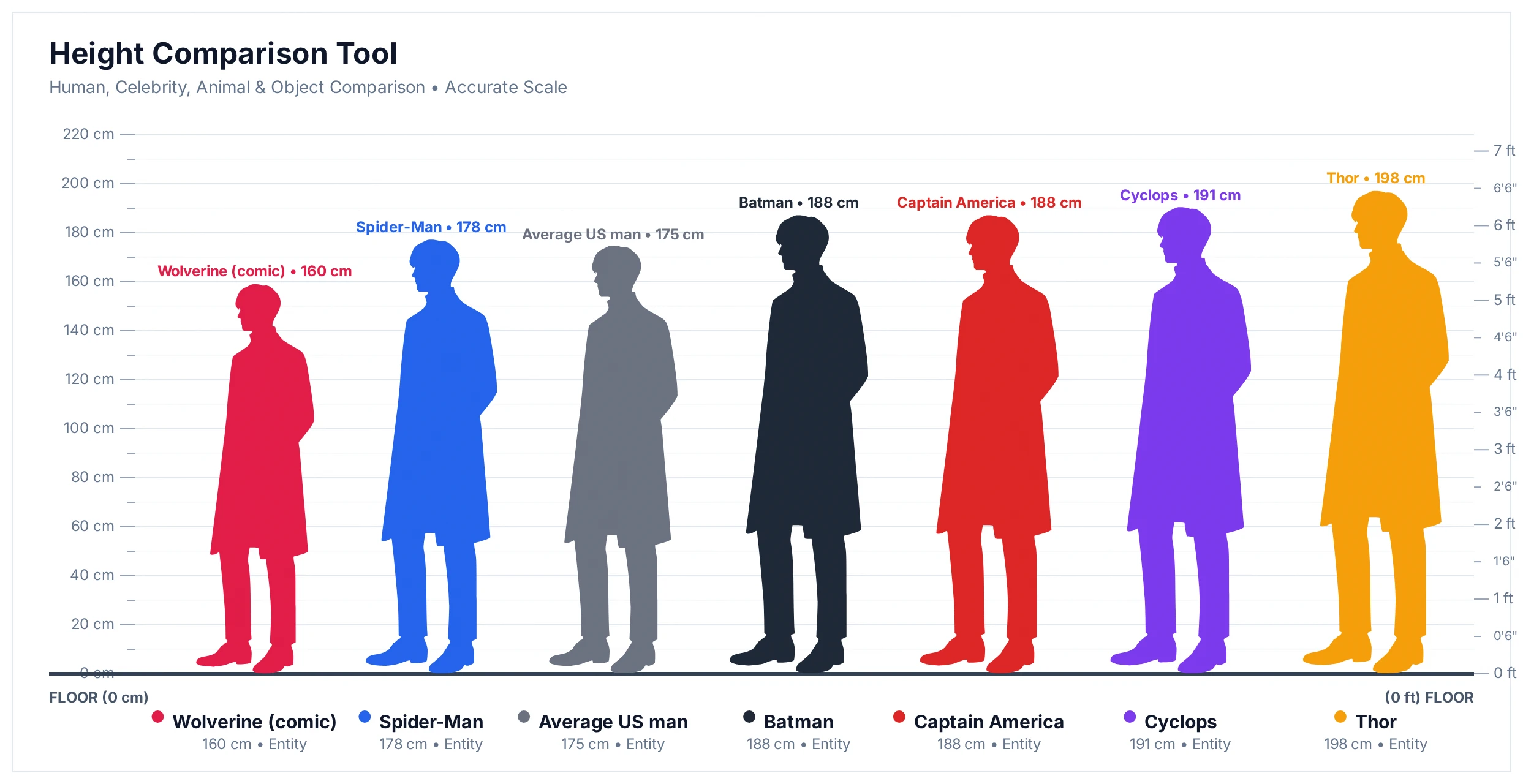
Wolverine 160 cm to Thor 198 cm is 38 cm — the human-shaped spread. Add the Hulk at his 244 cm baseline and it becomes 84 cm, but his height varies with his rage, so the 38 cm figure is the one to quote.
Wolverine Is 5'3": The Shortest Major Hero — and the Biggest Casting Gap
Comic Logan is 160 cm. Hugh Jackman is 188 cm. Nobody else in the genre comes close to that mismatch.
Wolverine is 5 feet 3 inches (160 cm) in the comics — the shortest major Avenger or X-Man, 15 cm below Spider-Man and 28 cm below Captain America. The figure has been consistent since his debut in The Incredible Hulk #181 in 1974, and the 2004 Official Handbook to the Marvel Universe: X-Men states it plainly. It is not a joke the writers play once and forget; it is the character. Logan is short, stocky and feral, built like the animal he is named after, and his height is part of why he fights the way he does: he goes for the legs, he gets underestimated, and he does not care.
Then Hollywood cast Hugh Jackman. Jackman is 6 feet 2 inches (188 cm) — 28 cm taller than the character, almost a full foot — and he played Wolverine for 24 years across ten films, from X-Men in 2000 to Deadpool & Wolverine in 2024. It is the largest actor-versus-comic gap in the genre, and fans noticed on day one. Stan Lee himself said he had wanted Bob Hoskins — 5'4" (163 cm), the star of Who Framed Roger Rabbit — for the role. The filmmakers worked around it for two decades: shooting Jackman at unusual angles, framing him from the waist up, and putting his co-stars in platform soles, as Wikipedia notes. A minority of listings put Jackman at 6'3" (191 cm), which would make the gap 31 cm; the consensus, including Wikipedia, is 6'2" (188 cm) and a 28 cm gap, and that is the figure this article uses.
The joke finally landed in 2024. Deadpool & Wolverine includes a comics-accurate short Logan — a variant Deadpool finds in a bar, visibly much shorter than the Wolverine audiences know — played by professional bodybuilder Luke Bennett, who is 4'11" (150 cm), with Jackman's face and voice added digitally. It took 24 years and a multiverse gag for the short Wolverine to appear on screen at all. That is how thoroughly the casting had rewritten the character's silhouette: a generation of filmgoers grew up believing Wolverine was tall, and the comics had to wait for a joke to correct the record.
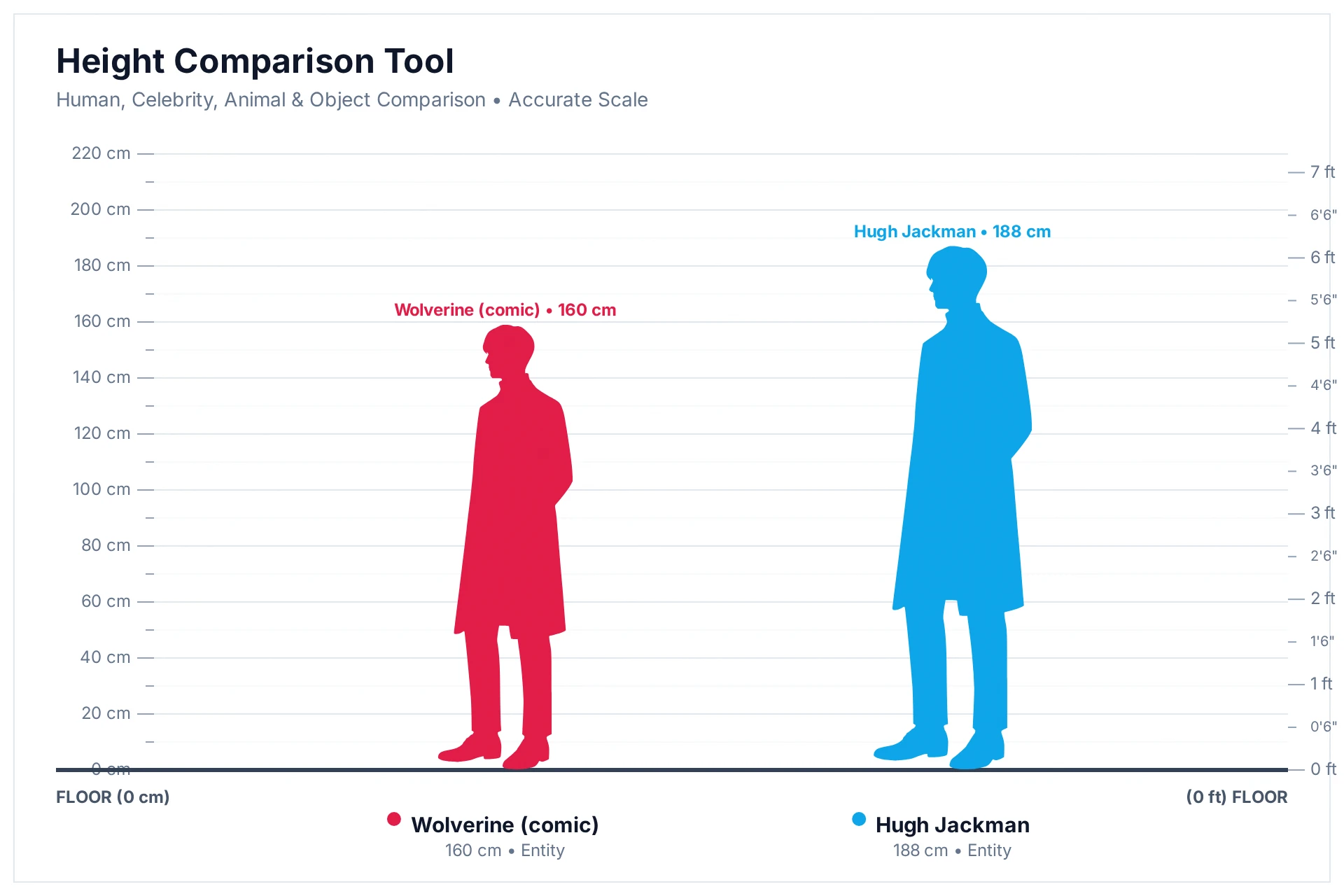
Comic Wolverine: 5'3" (160 cm). Hugh Jackman: 6'2" (188 cm). Gap: 28 cm. Some listings say 191 cm for Jackman (a gap of up to 31 cm), but 188 cm is the consensus.
Spider-Man Is the Ordinary One — and That Is the Point
At 178 cm he is 3 cm above the average US man. Every other Avenger-scale hero is at least 7 cm taller.
Peter Parker is 5 feet 10 inches (178 cm) in Earth-616 continuity, the main Marvel universe — a figure consistent since his debut in Amazing Fantasy #15 in 1962, and confirmed in Marvel Legacy: The 1960s Handbook. He is 3 cm above the average US man (175 cm), 10 cm below Captain America and 20 cm below Thor. Put him on the chart next to the average man and the two figures are almost level; the 3 cm difference is the width of a thumb. He is the only Avenger-scale hero at an average height, and that is deliberate. Spider-Man was designed in 1962 as the hero a reader could be: a teenager from Queens with homework, money worries and a height nobody would notice.
The chart makes the point better than any paragraph. Spider-Man at 178 cm, the average man at 175 cm, Iron Man out of armour at 185 cm and Captain America at 188 cm: the gap from Peter Parker to the average man is 3 cm, and the gap from Peter Parker to Captain America is 10 cm. He is closer to you than to his own teammates. That ordinariness is also why the height question follows him everywhere — "how tall is Spider-Man" is one of the most searched superhero height queries, because people keep checking whether the most relatable hero is secretly tall. He is not, and the answer is the appeal.
One variant deserves a single line, not a second baseline. In the Ultimate universe — the separate continuity that ran from 2000 — Peter Parker is 5'5" (165 cm), shorter than the average man. It is a different character in a different universe, and it should not be averaged into the 178 cm figure or quoted as though it were the same Spider-Man. The 178 cm Earth-616 figure is the one the handbooks, the rankings and this article use.
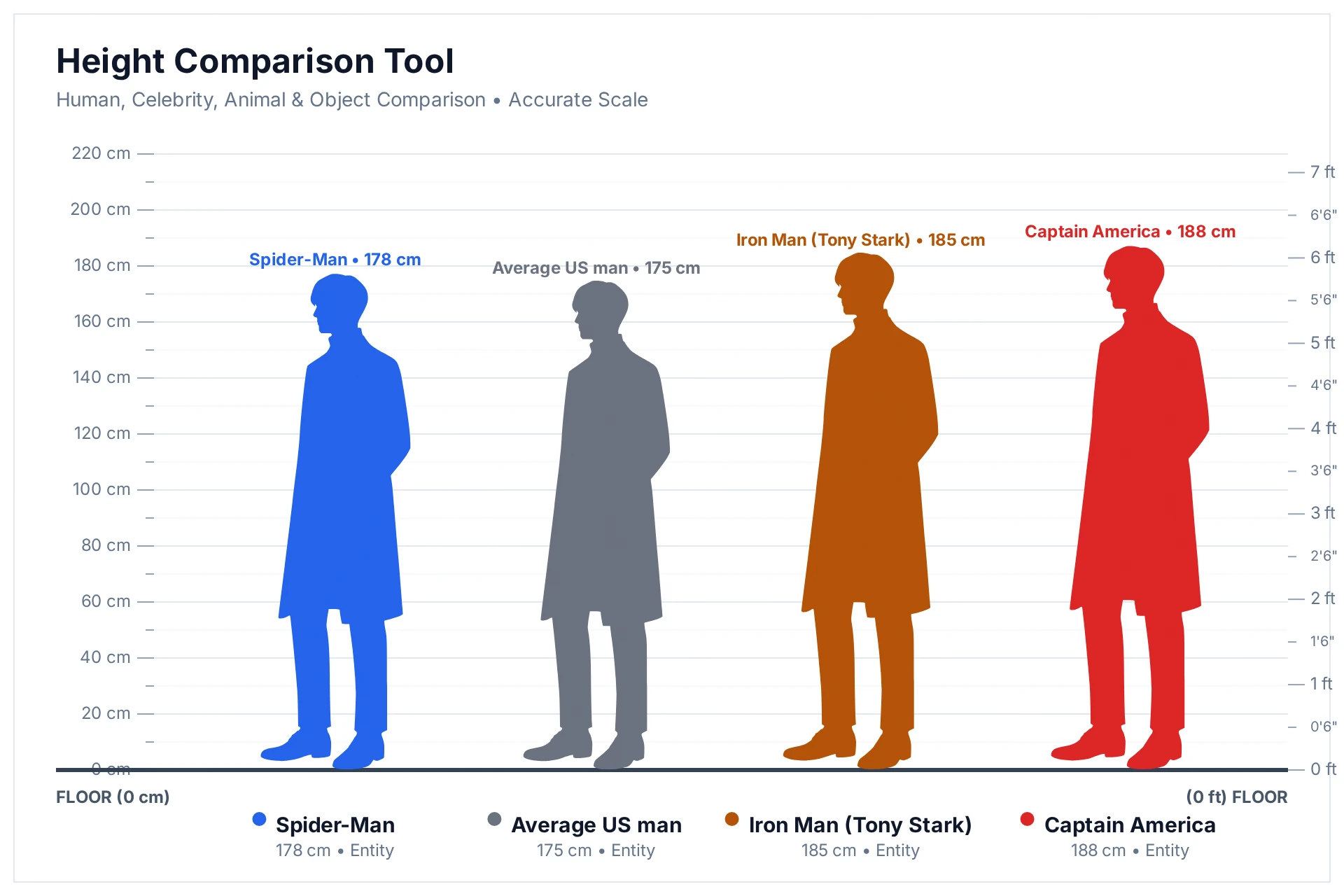
Spider-Man is 178 cm; the average US man is 175 cm. A 3 cm gap is the whole design of the character — the hero who is your height, not a god's.
Comic Canon vs the Actors: Almost Everyone Is Shorter on Screen
The pattern runs one way — until you reach Dwayne Johnson, who matches Black Adam exactly.
Put the characters next to the actors and a clear pattern appears: almost every actor is shorter than the comic character they play. Thor is 198 cm in the comics; Chris Hemsworth, who plays him, is 190 cm — 8 cm shorter. Iron Man is 185 cm out of armour; Robert Downey Jr. is 174 cm on the site's baseline — 11 cm shorter, and 24 cm shorter than the armoured suit at 198 cm. Superman is 191 cm; Henry Cavill is a reported 185 cm — 6 cm shorter. Captain America is 188 cm; Chris Evans is a reported 183 cm — 5 cm shorter. Spider-Man is 178 cm; Tom Holland is a reported 173 cm — 5 cm shorter. Black Widow is 170 cm; Scarlett Johansson is 160 cm on the site's baseline — 10 cm shorter. The gaps run 5 to 11 cm, and they all run the same way: the actor is the smaller figure.
There are two exceptions, and they are both instructive. The first is Batman: the comic character is 188 cm and Ben Affleck, who played him, is a reported 192 cm — 4 cm taller, the only DC hero whose actor overshoots. The second is the Wolverine case from the previous section, which is not a 5 cm rounding difference but a 28 cm rewrite. And then there is the exact match, which is why the chart below is worth a look: Black Adam is 196 cm in the comics, and Dwayne Johnson is 196 cm. Zero gap. Johnson is the only actor on the list who is precisely the height of his character — the visual punchline of the whole comparison, two figures of identical height standing side by side.
Why does the pattern run one way? Partly because comic-book heroes are drawn taller than any plausible cast — the handbooks codified heroic proportions, not human ones — and partly because casting optimises for presence, voice and box office, not for a tape measure. A 5 to 11 cm shortfall is invisible on screen: camera angles, footwear and framing absorb it, and audiences do not carry a ruler into the cinema. The shortfalls only become visible when you draw them to scale, which is what the chart does. The lesson is the same one the Tom Cruise article reached from the other direction: the screen image is constructed, and the construction has a measurable size.
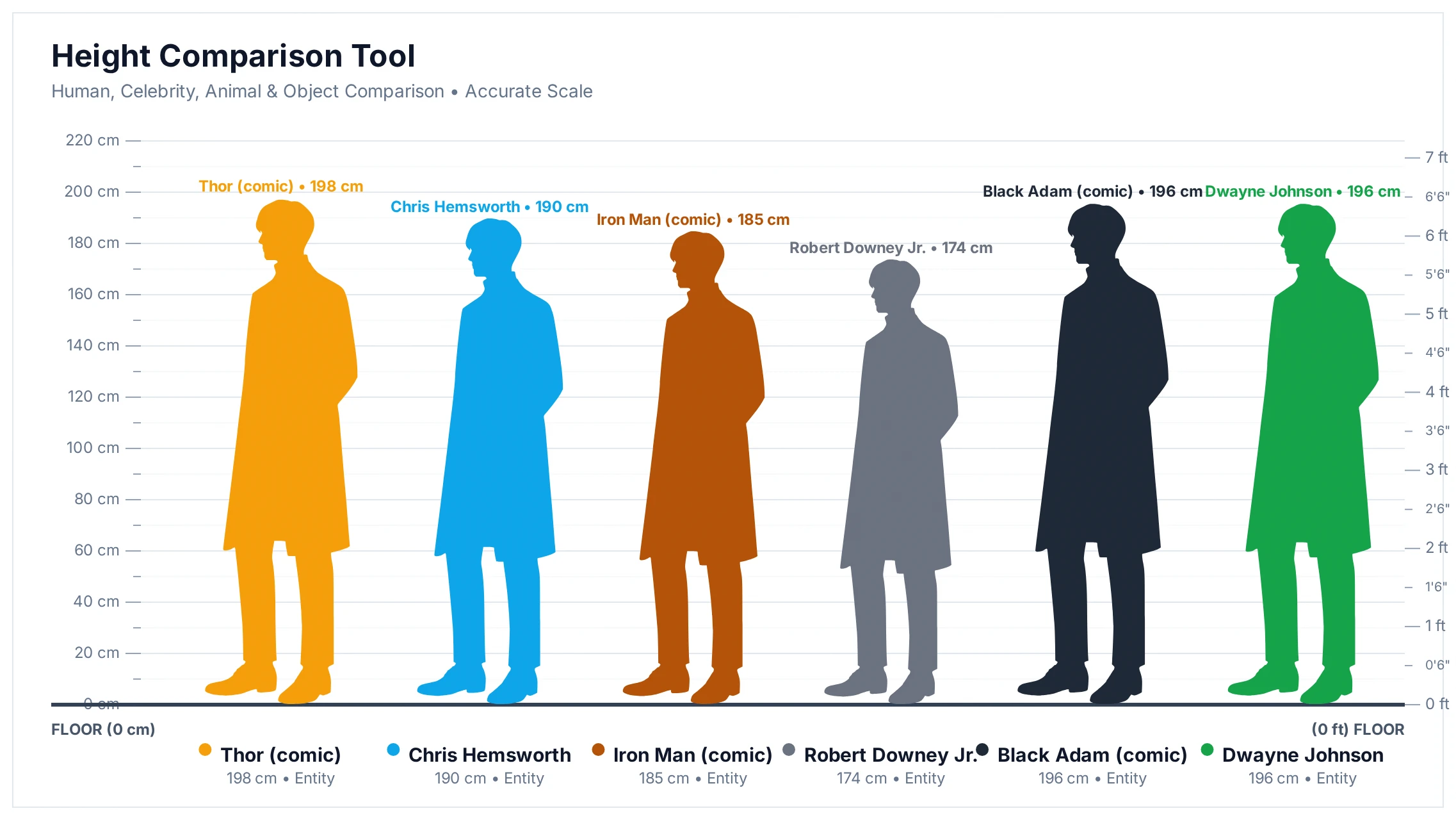
Black Adam: 196 cm. Dwayne Johnson: 196 cm. Gap: zero. He is the only actor in this article who is precisely the height of his character.
Superman, Batman, Wonder Woman: Only 8 cm Apart
The flagship hero is not the giant the posters suggest. His two partners are nearly his height.
Superman is 6 feet 3 inches (191 cm) — confirmed in JLA: Secret Files #1 in 1997 and Superman: Secret Files in 1998. That is tall by any human standard, but it is not the towering figure the posters imply, and inside his own universe he is barely the tallest of the three. Batman is 6'2" (188 cm), just 3 cm below him, and Wonder Woman is 6'0" (183 cm), 8 cm below him. Draw the DC trinity to scale and the three figures are nearly level; the gap from Superman's head to Wonder Woman's is the width of a hand. Some sources, including Dexerto, list Superman at 192 cm — but 6'3" is 190.5 cm, so 191 cm is the correct rounding, and this article uses it.
The surprise deepens when you cross universes. Superman at 191 cm is shorter than Thor at 198 cm by 7 cm, and shorter than Thanos at 201 cm by 10 cm. Aquaman, at 193 cm, is 2 cm taller than Superman. Even Starfire, at 6'4", has an inch on him, and Cyborg is 3 inches taller. The Man of Steel is, by the genre's own numbers, a mid-table hero for height — an alien with super-strength, flight and heat vision who is only 4 cm taller than Batman, a man with no powers at all and a great deal of money. The poster image of Superman towering over everyone is a framing choice, not a measurement.
That is worth saying because it corrects a common assumption: that the flagship character must be the biggest. DC has never needed Superman to be the tallest, because his scale comes from what he can do, not how tall he stands. Batman at 188 cm and Wonder Woman at 183 cm are drawn to look like his equals, and the numbers agree with the drawings for once. The trinity works as a visual unit precisely because the three heights are so close — and the chart shows it in a way a table of numbers never quite does.
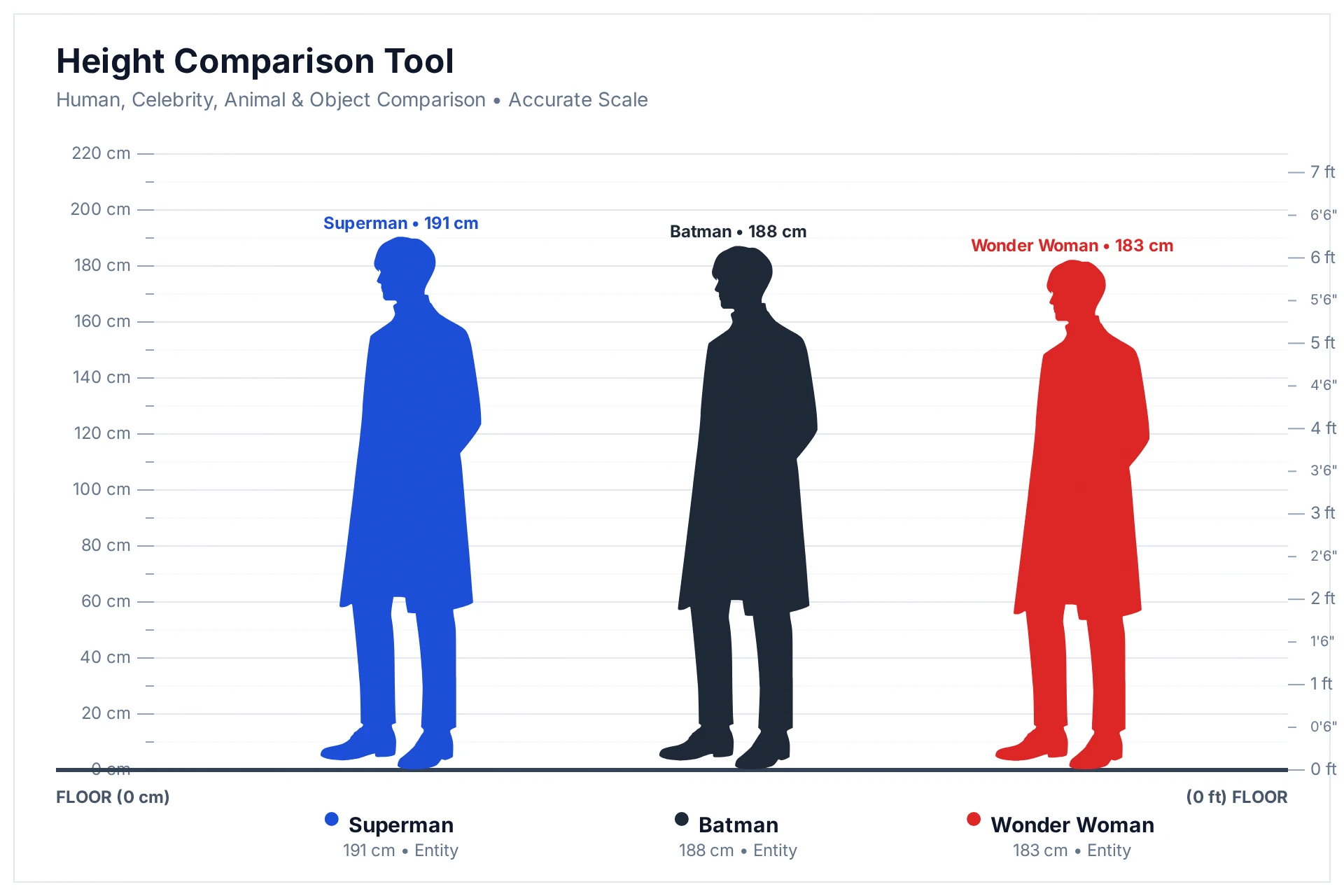
Superman is 191 cm and Batman is 188 cm — a 3 cm gap. Their perceived size difference is almost entirely build, costume and how artists frame them.
Why the Numbers Are Slippery: Handbooks, Artists and Reboots
These heights are editorial guidelines. Say so once, early, and the rest of the article earns its credibility.
Every number in this article comes from the same kind of source: Marvel's Official Handbook of the Marvel Universe and the equivalent DC character bibles, cross-checked across two independent rankings — Calqora and ComparingHeights — that agree on almost every figure. That is the best evidence available, and it is not the same as a measurement. The handbooks are editorially approved reference numbers, and Marvel itself notes that they have been known to change from comic to comic. Artists draw to look right, not to measure right, and reboots shift figures without announcement. Cyclops is the live example: his handbook figure is 191 cm, but the 2025 X-Manhunt connecting covers drew him at roughly 6'5". The handbook did not change; the drawing did.
That slipperiness is why this article shows ranges and disagreements instead of hiding them. Hugh Jackman is 188 cm by consensus, with a minority of listings at 191 cm — so the gap to Wolverine is 28 cm, with a note that some sources would make it 31 cm. Superman is 191 cm, not the 192 cm some outlets print, because 6'3" converts to 190.5 cm. The Hulk is a range, not a number. Tom Holland is 173 cm as a reported figure, traced to a GQ profile from November 2021, with lower photo-based estimates in circulation — and the article labels it reported rather than pretending it was measured. A listicle that prints comic heights as though they were taken with a stadiometer is overstating its evidence; this one does not.
None of that makes the numbers useless. The ladder is stable where it matters: Wolverine is the shortest major hero in every ranking, Thor is the tallest human-shaped hero in every ranking, Spider-Man is average in every ranking, and the actor gaps all run the same way in every ranking. The figures are good enough to compare, to visualise and to argue about — which is what people come here to do. Use them as the handbooks intend: a reference, drawn to scale, with the caveats attached.
Quote them as handbook figures: "Wolverine is listed at 5'3" (160 cm) in the comics." Never as measurements — nobody has ever put a tape measure to a fictional character.