The Gap, Drawn to Scale: 2, 5, 10 and 15 cm
Five centimetres is the gap everyone recognises. Fifteen is the one that stops a room.
Start with the chart, because words understate centimetres. The same woman — 175 cm, or 5 feet 9 inches — stands next to three men: 170 cm, 165 cm and 160 cm. The gaps are 5, 10 and 15 cm, or roughly 2, 4 and 6 inches. At 5 cm the difference is clearly visible when the two stand side by side, and it is the gap this whole article keeps coming back to: it is the Zendaya–Tom Holland gap, the Sophie Turner–Joe Jonas gap, and the most common size of woman-taller gap in the research. At 10 cm the difference is obvious at a glance from across a room. At 15 cm it is striking — the shorter partner’s head top sits around the taller partner’s chin, nearly a full head shorter — and it is also rare, which the next section explains.
Below 5 cm, the picture changes. A 2 cm gap — under an inch — is barely noticeable barefoot: the tops of the two heads look level in most photographs, and the difference disappears entirely into posture, hair and camera angle. That matters because the majority of real woman-taller couples live in this band. The peer-reviewed study in the next section found that when the woman is taller, the gap is usually small — and the chart shows why that band never makes headlines: a 2 cm gap does not photograph. The couples that go viral are the 10 and 15 cm ones, which are the exception, not the rule.
The other reason to trust a drawn-to-scale chart over a photograph is that photographs lie about height in three systematic ways: camera angle (a lens tilted up flatters the nearer figure), footwear (see the heels section below), and posture (one person slouching, the other standing tall). The chart has none of those. Both figures stand on the same floor, at the same scale, with no lens and no shoes — which is why a 5 cm gap here looks like 5 cm, while the same 5 cm in a red-carpet photo can look like nothing or like a foot, depending on who is wearing what.
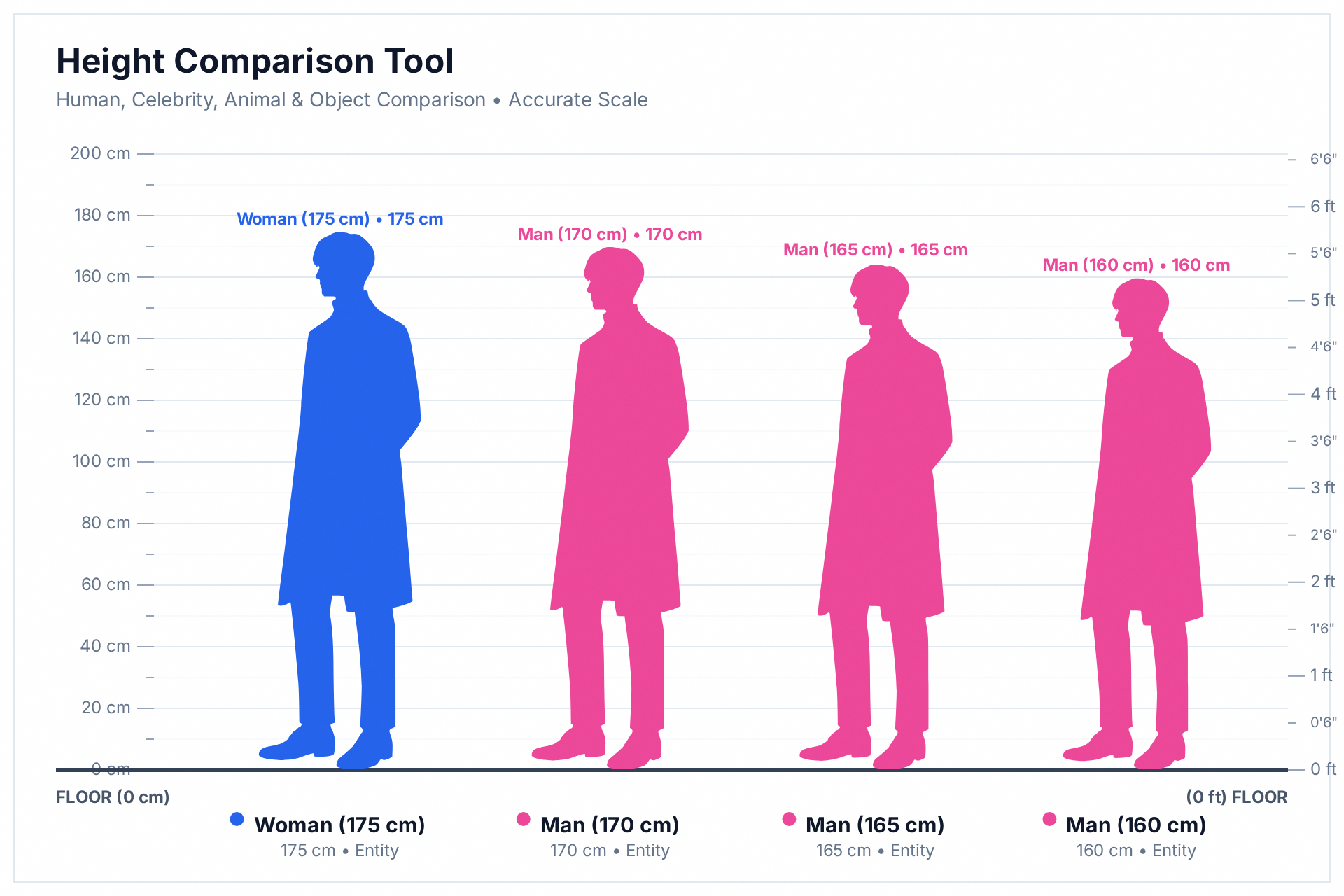
2 cm — barely noticeable · 5 cm — clearly visible, the famous band · 10 cm — obvious at a glance · 15 cm — striking, and rare. Most real woman-taller couples sit at 5 cm or less.
How Common Is a Taller Wife? About 1 Couple in 25
Uncommon, not unusual — and the research says the gap is usually small when it happens.
The best numbers come from a peer-reviewed study that is hard to argue with. Stulp, Buunk, Pollet, Nettle and Verhulst (2013), published in PLOS ONE, analysed the parents of the UK Millennium Cohort Study — almost 19,000 children born in 2000–01, and more than 10,000 couples. In those couples the man was taller in 92.5% of cases, the woman was taller in 4.1%, and the two were the same height in 3.4%. The average height difference was about 14 cm. A US analysis of the Panel Study of Income Dynamics by sociologist Philip Cohen found almost the same thing in 2009: among 4,600 married couples, only 3.8% had a taller wife, with the average husband at 5′11″ and the average wife at 5′5″. A later look at the 2017 wave of the same US data put the figure at about 3% taller wife, 4% same height and 93% husband taller — roughly 1 couple in 25 where the wife is the taller one.
Two details in the UK study are worth more than the headline number. First, the preference for a taller man barely moves the needle: if couples paired up at random, the man would be taller 89.8% of the time — the real figure is 92.5%, a shift of less than three percentage points. The authors’ own conclusion is that mating preferences for height translate into actual pairings only modestly; most of the pattern is just arithmetic, because men are taller than women on average. Second, couples where the man was much taller than the woman — more than 25 cm — were also rarer than chance would predict, which the authors read as a “male-not-too-tall” norm: women prefer a taller partner, but not too much taller.
And when the woman is taller, the gap is usually small. In the UK data, couples where the woman was taller by more than 10 cm made up just 0.6% of all couples — less than half the 1.3% that random pairing would produce. So the 15 cm chart in the first section is not just striking, it is genuinely scarce: fewer than 1 couple in 100 has the woman taller by that much. One old figure deserves a warning label rather than a citation: a 1980 study of British and American couples reported only 1 woman in 720 taller than her partner — a number that says more about 1980s sampling and rounding than about real couples, and which the modern studies have superseded.
UK (Stulp et al., 2013): man taller 92.5%, woman taller 4.1%, same height 3.4%. US (Cohen, PSID 2009): taller wife 3.8%. Woman taller by more than 10 cm: 0.6% of couples.
The Percentile Reality Check: She Is Usually Exceptional, He Is Usually Ordinary
The phrase “tall woman, short man” smuggles in a judgement the numbers do not support.
Take the pairing everyone pictures: a woman of 5′10″ (178 cm) with a man of 5′8″ (173 cm). The first number is extraordinary and the second is not. US adult averages from CDC NHANES data put men at 175.3 cm (5′9″) and women at 161.5 cm (5′3.6″), with standard deviations of roughly 7.4 cm for men and 7.1 cm for women. Run the normal approximation on those figures and a 178 cm woman sits around the 99th percentile for US women — taller than about 99 women in 100. A 173 cm man sits around the 36th percentile for US men — shorter than average, but well inside the ordinary middle of the distribution, closer to the median than to the bottom. These are approximations, not false precision, but the shape of the answer is robust: she is exceptional, he is ordinary.
That asymmetry is the honest frame for the whole topic, and it is why this article keeps saying “taller woman” rather than “short man”. A genuinely short man — say 5′4″ (163 cm) — sits around the 4th percentile for US men, and a pairing of a 178 cm woman with a 163 cm man would be a 15 cm gap, the rare end of the chart in the first section. But the pairing people actually see, search for and photograph is usually a very tall woman with a man of average height. The man is not short; the woman is tall. The chart below makes the same point visually: the 178 cm woman clears the average man (175 cm) by just 3 cm, while she towers 17 cm over the average woman (161 cm).
It also explains why the search interest exists at all. A 5′10″ woman is rare enough that her height is a talking point wherever she goes, and a partner 5 cm shorter than her is common enough that the pairing keeps happening — the two distributions overlap heavily in the 170–180 cm band, where a tall woman and an average man meet. If you are the woman in such a pairing, the useful comparison is not “am I too tall?” but “how tall am I, exactly?” — the site’s own guide to what counts as tall for a woman puts 5′9″ and above firmly in tall territory, and 5′10″ around the 99th percentile. If you are the man, the useful comparison is the same chart: 173 cm is 2 cm under the average man, not a height that needs explaining.
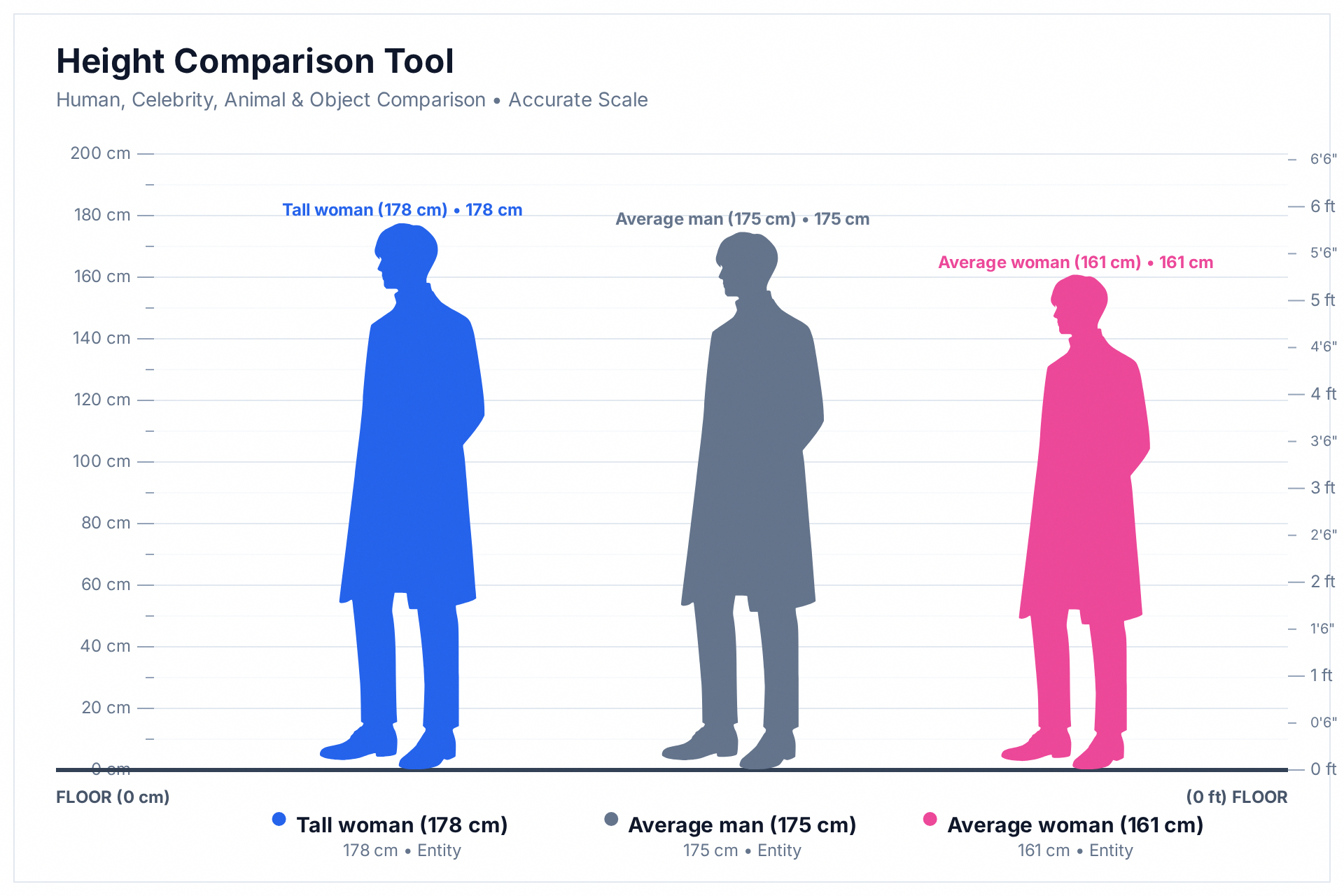
A 5′10″ (178 cm) woman is around the 99th percentile for US women. A 5′8″ (173 cm) man is around the 36th percentile for US men. “Tall woman, average man” is the accurate label.
The Heels Factor: How Footwear Flips the Gap
Most viral photos of woman-taller couples are heel photos. Barefoot, the same couple often looks level.
Here is the single biggest reason the gap looks larger in photographs than it is: heels. A 2-inch heel adds about 5.1 cm of effective height; a 3-inch heel adds about 7.6 cm; a 4-inch stiletto adds about 10.2 cm. The arithmetic is just inches times 2.54, but the visual consequence is large. The chart below shows one woman, 170 cm barefoot, next to a 173 cm man. Barefoot she is 3 cm shorter than him — the pair looks level, and in most photos nobody would comment. In 3-inch heels she stands at 177.6 cm effective height, 4.6 cm taller than him — and suddenly the same two people are a “tall woman, short man” photograph. One pair of shoes swings the comparison by 7.6 cm, from shorter to taller.
That swing explains most of the famous images. Red carpets, premieres and award shows are heel events: the women are routinely in 3- to 4-inch heels while the men are in flat dress shoes, so the photographed gap is the barefoot gap plus 7–10 cm. Zendaya and Tom Holland are the textbook case — the next section gives their barefoot numbers — and Sophie Turner’s red-carpet photos next to Joe Jonas routinely showed a bigger gap than the barefoot 5 cm, because she was frequently photographed in heels. None of that makes the photos fake; it makes them a comparison of footwear as much as of people. The honest question to ask of any such photo is: what were they wearing on their feet?
The practical rule is simple. A woman needs heels taller than the barefoot gap to overtake her partner: if she is 3 cm shorter barefoot, a 2-inch heel (5.1 cm) already puts her ahead by about 2 cm, and a 3-inch heel puts her ahead by nearly 5 cm. If she is already taller barefoot, even a modest heel makes the gap conspicuous — a 5 cm barefoot lead becomes a 10 cm lead in 2-inch heels. And the reverse is true too: in trainers or flats, most woman-taller couples in the 2–5 cm band look level. When this article’s charts say “barefoot”, they mean it — every figure is a barefoot height, and the heels chart labels the effective height separately so the two are never confused. (One labelling note: the tool rounds the 177.6 cm effective height to 178 cm in its pill label; the figure name on the chart gives the exact 177.6 cm.)
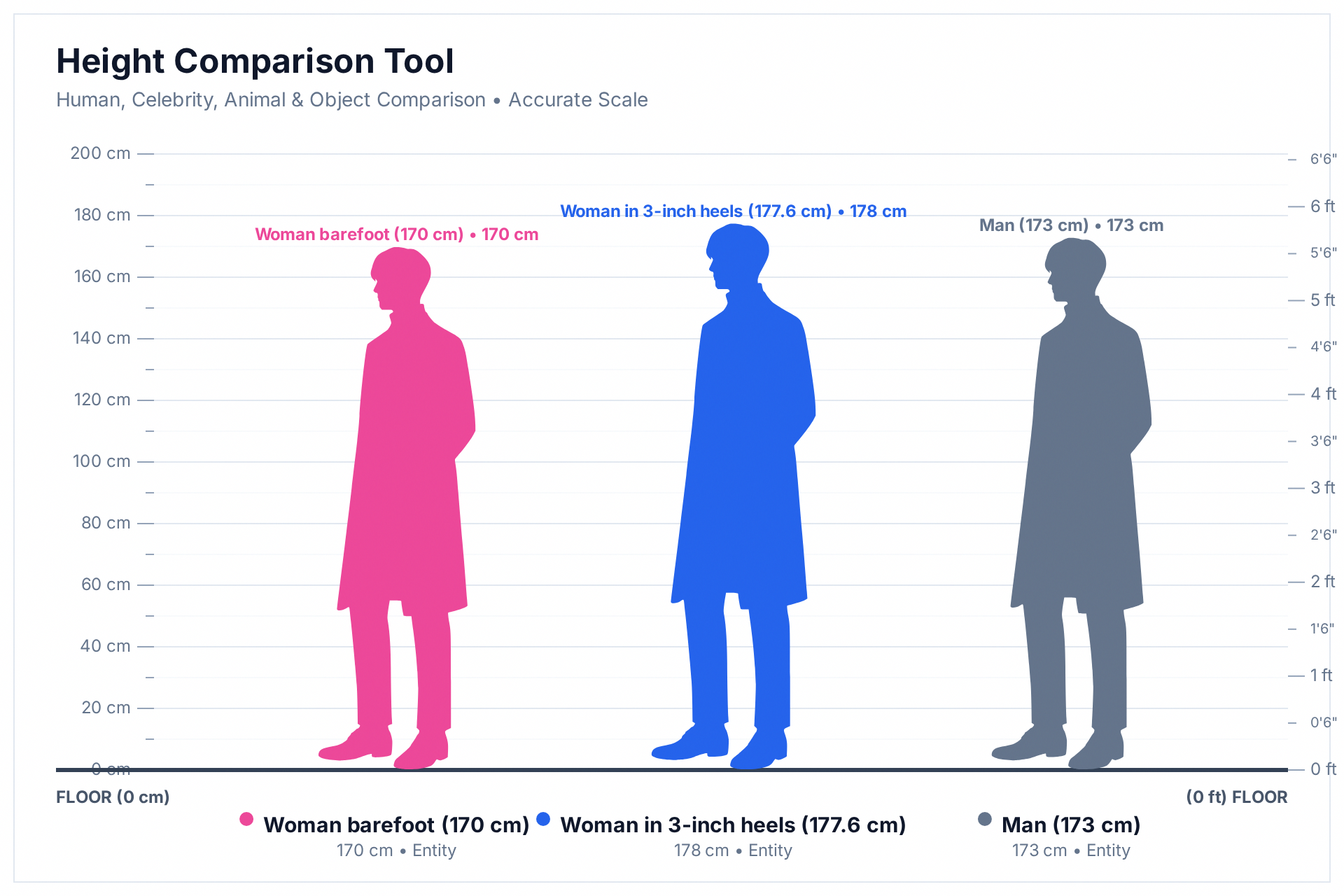
2-inch heel ≈ 5.1 cm · 3-inch heel ≈ 7.6 cm · 4-inch heel ≈ 10.2 cm. A woman needs heels taller than the barefoot gap to overtake her partner.
Famous Examples: Zendaya & Tom Holland, Sophie Turner & Joe Jonas
Both famous gaps are exactly 5 cm — the visible-but-modest band from the first chart.
The defining example of the era is Zendaya and Tom Holland. Zendaya’s reported height is 5′10″ (178 cm) — a figure she has stated herself, answering “5′10” in WIRED’s Autocomplete Interview — and Tom Holland is reported at 5′8″ (173 cm) in GQ’s November 2021 profile. The barefoot gap is about 5 cm, or two inches, and both of them addressed it publicly on SiriusXM in December 2021 while promoting Spider-Man: No Way Home, calling the expectation that the man must be taller a “stupid assumption”. Zendaya’s answer is the one worth quoting: “This is normal too. My mom is taller than my dad.” Holland added that every actress screen-tested for the MJ role was taller than him. One honest caveat: Zendaya’s exact height is disputed — CelebHeights estimates her at around 5′8.5″ (174 cm), which would shrink the gap to about 1 cm — so this article uses her reported 178 cm with the range shown, and the dedicated Zendaya vs Tom Holland article coming later in this series will give the dispute its full treatment.
The second example is Sophie Turner and Joe Jonas, the former couple whose height difference was a running red-carpet talking point for years. Turner is reported at 5′9″ (175 cm) — she has claimed 5′9¾″ in interviews, and CelebHeights lists her at 5ft 9 — while Joe Jonas is reported at 5′7″ (170 cm). The barefoot gap is again about 5 cm, two inches, but the photographed gap often looked much larger, because Turner was frequently photographed in heels next to him. The two examples together make the article’s point neatly: both famous gaps are exactly 5 cm, both sit in the most common band of real woman-taller couples, and both looked bigger in photographs than they are barefoot.
Why do these two pairings get searched so much, when 4% of all couples look the same way? Partly because both couples talked about it openly instead of letting the photographs do the talking, and partly because both women are famous enough that their heights are public facts. But there is a quieter reason too: both gaps are the same size, and that size — 5 cm — is the largest gap that still reads as ordinary. A 2 cm gap is invisible and a 15 cm gap is rare; 5 cm is the gap you can see, photograph and argue about, which is exactly why it dominates the search results. Use the tool at the top of this page to put yourself in the picture: add your height next to Zendaya and Tom Holland, and see whether you would clear her 178 cm, match his 173 cm, or fall somewhere in between.
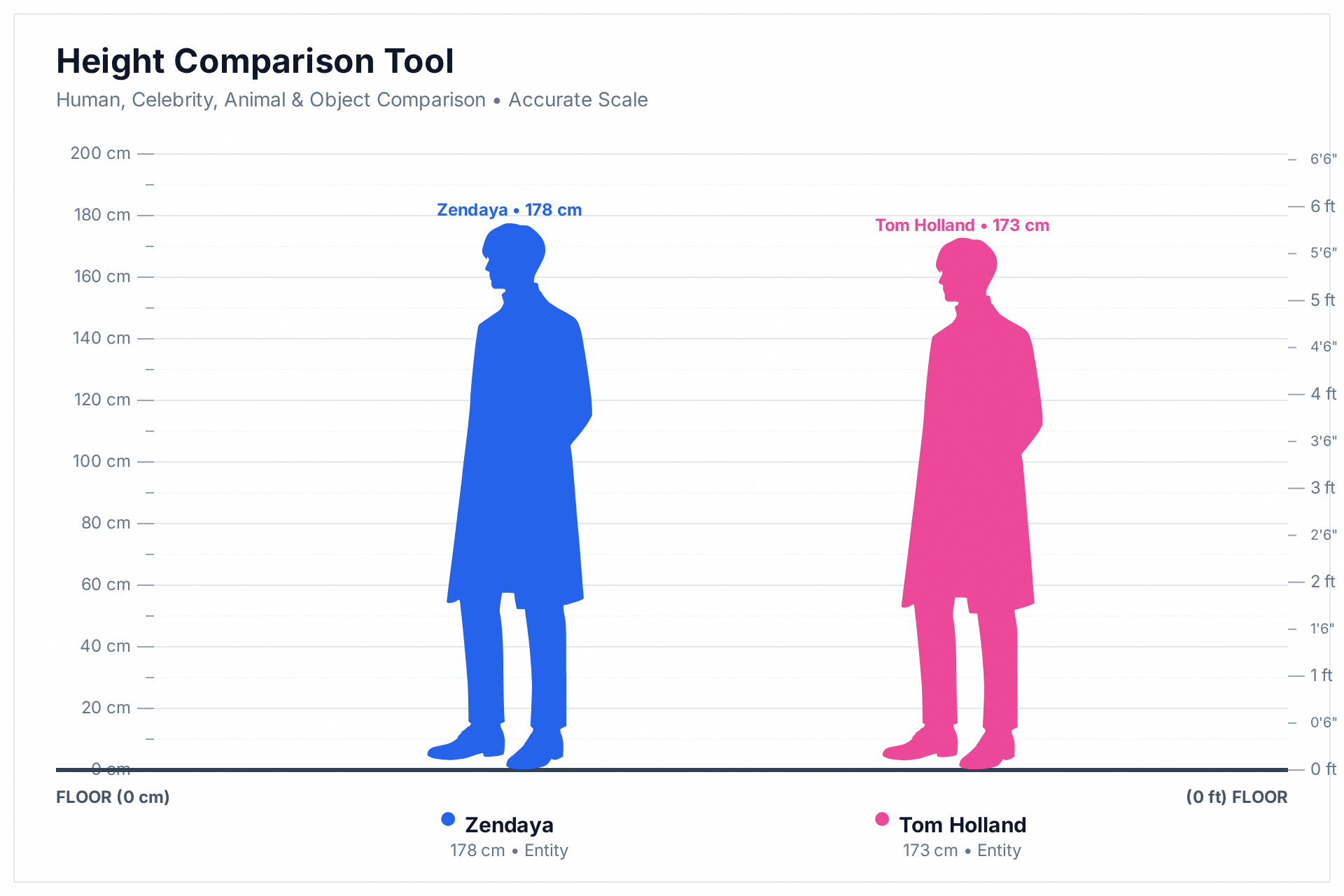
Zendaya–Holland: 178 vs 173 cm. Turner–Jonas: 175 vs 170 cm. Both gaps are 5 cm — visible, ordinary, and the most common size of real woman-taller gap.