The Number: 5'7" (170 cm) — Reported, Not Measured
The honest answer starts with a caveat, not a figure.
Tom Cruise — born Thomas Cruise Mapother IV on 3 July 1962 — is reported at 5 feet 7 inches (170 cm). That is the consensus across IMDb, Wikipedia, Height & Tall, HeightProfiles and the celebrity profile databases, and it is the baseline this article uses throughout. But it is important to say what that figure is: a reported listing, not a measurement. Cruise has never publicly confirmed a height, and no documented barefoot medical measurement of him exists on the record. Any article that prints 170 cm as though it were taken with a stadiometer is overstating its evidence.
The one specialist source that estimates rather than lists puts him a fraction higher. CelebHeights, which estimates heights by comparing photographs against people and objects of known height, lists Cruise at 5'7¾" (172.1 cm) barefoot, and YourNextShoes agrees at 5'7¾". That is unusual: for most stars whose height is debated, the specialist estimate comes in below the listing. For Cruise it comes in slightly above. So the fair statement — and the one this article keeps — is a range: about 170–172 cm, with 170 cm as the baseline because that is what the overwhelming majority of published listings say. The gaps in the rest of this article are computed from that 170 cm baseline, and where a co-star's height is itself disputed, the range is shown rather than hidden.
That discipline matters because the Cruise height debate is four decades old and almost entirely argued in quarter-inches. Fan and analyst estimates put his barefoot height anywhere from about 5'6" to his listed 5'7" — but nobody credible puts him at 5'8" or above, and nobody credible puts him below 5'7". The range is narrow, the consensus is stable, and the interesting question was never really the number. It is why the number needed forty years of work to arrive at.
Tom Cruise: 5'7" (170 cm) reported, with a credible range of 170–172 cm. No verified barefoot measurement exists. Anything more precise than that is pretending.
Why Was the Number Ever in Doubt? The 5'9" Years
In the 1980s, the official figure was two inches taller. It drifted down in public — and never drifted back.
If the consensus is so settled now, why does anyone still ask? Because the number used to be different. In the 1980s, when Top Gun made Cruise a global icon, studio press kits and casting records listed him at 5'9". An early audition form that surfaced publicly reportedly listed him at 5'7" — but the figure the industry put in front of the public was 5'9", and in a 1988 interview Cruise himself said he was 5'9" and 147 lbs. For a leading man in an era when leading men were expected to be tall, two inches of PR was cheap insurance.
The listings drifted down over the following decades — 5'8", then 5'7" — as photographs, red-carpet comparisons and height-tracking communities made the taller figure impossible to sustain. Modern consensus has settled at 5'7", and the drift itself is the story: it shows a number that was managed before it was measured. The 5'9" claim still circulates in gossip pages and old profiles, which is why search results for Cruise's height still mix the two figures, and why a first-time searcher can reasonably come away confused.
There is a second reason the debate never dies: every new Mission: Impossible or Top Gun release puts Cruise back on red carpets next to taller co-stars, and every new photograph restarts the argument. The F1 premiere in June 2025 did exactly that — Cruise photographed next to Brad Pitt, ten centimetres his senior, with the two men standing near eye-to-eye thanks to footwear and framing. A photograph like that does not settle the debate; it is the debate, in a single frame. The sections that follow explain how the frame is built.
How Hollywood Makes Him Look Tall: Lifts, Angles and Blocking
The techniques are an open secret. The chart shows what they are worth.
The first tool is the shoe. Cruise is fond of Cuban heels and discreet height-boosting insoles — lifts inserted under the heel that add an estimated 2–3 inches, taking him from 170 cm barefoot to roughly 175–178 cm on a red carpet. That is why he can stand near eye-to-eye with a 5'11" Brad Pitt in photographs: the gap is not closed, it is dressed. The chart below makes the arithmetic visible — barefoot Cruise at 170 cm, the average US man at 175 cm, and Cruise in lifts at about 176 cm, effectively erasing the gap to the average man entirely. Robert Downey Jr., the other famously short action star, uses the same trick in Marvel films, and the same logic applies: two to three inches of shoe is the difference between “noticeably shorter” and “about the same”.
The second tool is the camera. Careful angles — shooting slightly from below, keeping Cruise in the foreground — flatter the nearer figure, and directors have spent forty years framing him that way. The third is blocking: keeping Cruise on the higher step, on a raised platform, or simply positioned closer to the lens than his co-stars. And the fourth is casting and positioning — co-stars chosen or placed to flatter, and red-carpet photos staged so the height comparison is never the clean side-by-side shot that would settle it. None of this is an accusation; it is craft, and Cruise is famously good at the craft. The point is that the screen image is a constructed one, and the construction has a measurable size: about 5–8 cm of shoe and framing.
It is worth saying plainly that there is nothing to mock here. Cruise has spent four decades as the definitive movie star — three Oscar nominations, films grossing over $10 billion worldwide — while being shorter than the average man, and the industry's effort to hide a perfectly ordinary height is the interesting story, not the height itself. The illusion works because audiences want it to work: a 5'7" action hero who does his own stunts is more impressive, not less, for the gap between the man and the myth.
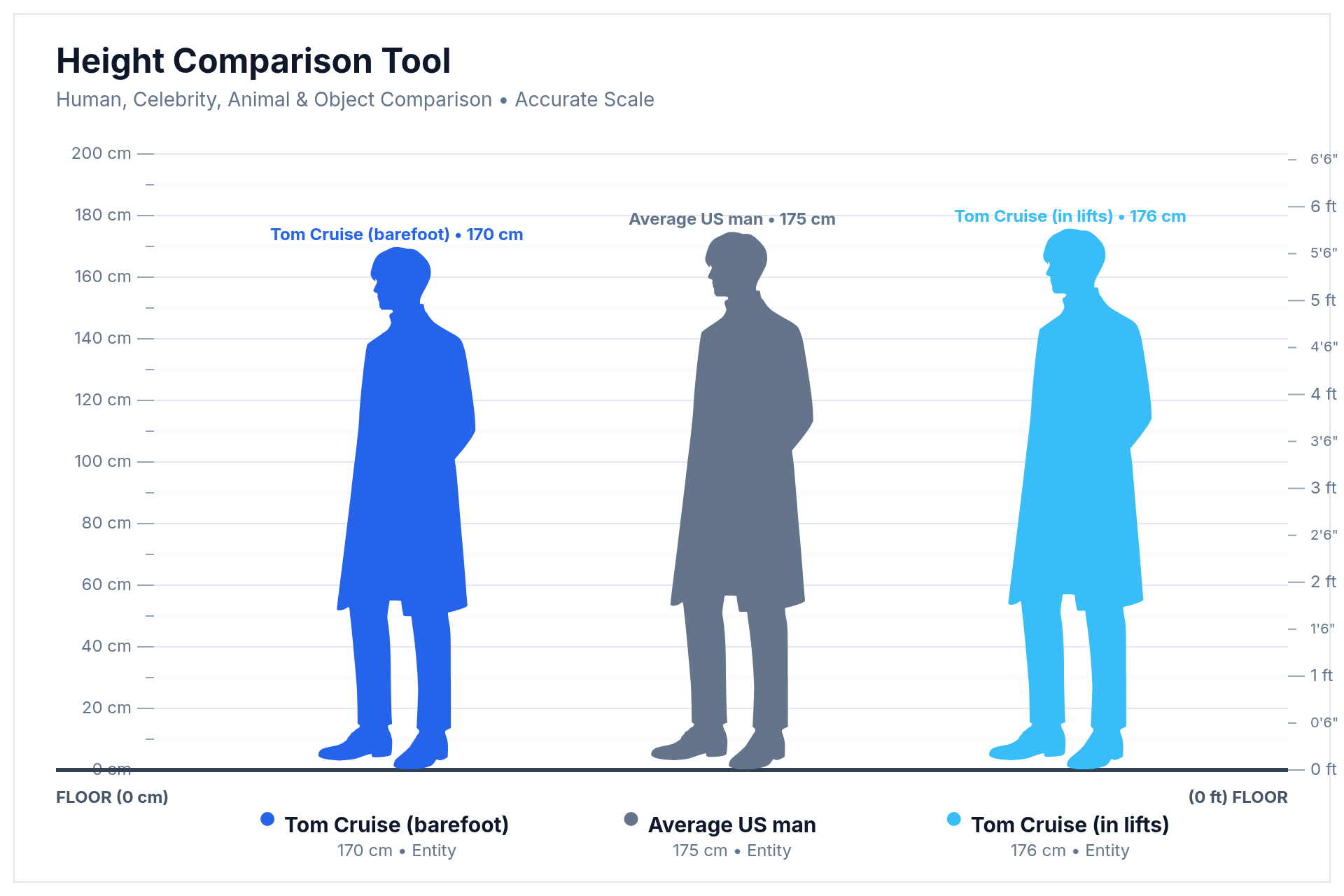
Lifts and Cuban heels: about 2–3 inches (5–7.6 cm). Camera angle and blocking: the rest. Barefoot, the gaps in the next section are what they are.
The Co-Star Gaps: The Hollywood Ladder, Drawn to Scale
From 4 cm to 26 cm — every famous comparison on one chart.
Here is the whole story in one chart: Tom Cruise at 170 cm, the average US man at 175 cm, Brad Pitt at 180 cm, Henry Cavill at a reported 185 cm, Chris Hemsworth at 190 cm and Dwayne Johnson at 196 cm. The gaps run from 5 cm to 26 cm, and each one has its own history. The smallest famous gap is the one nobody talks about: Robert Downey Jr., the site's other short action star, at a site baseline of 174 cm — just 4 cm taller than Cruise, though the specialist trackers put RDJ closer to 172 cm, which would make the two men effectively the same height. Either way, the two shortest leading men in modern blockbusters are within a couple of centimetres of each other, and both rely on the same footwear.
The 10 cm gap to Brad Pitt is the one people actually argue about, because the two men are photographed together so often — most recently at the F1 premiere in June 2025, where lifts and framing had them near eye-to-eye. On the reported figures the gap is 4 inches, and it survives every plausible correction to either man's height: Pitt is the taller man, and not by a margin that footwear or camera angles can explain away. Pitt's own figure is disputed at the margins — CelebHeights has argued for a barefoot 5'10"–5'10.5" rather than the listed 5'11" — but even at the low end of both ranges the gap is roughly 9–10 cm. Ten centimetres is the distance from the top of Cruise's head to around Pitt's brow, and on a shared baseline it is unmistakable.
Then the ladder climbs. Henry Cavill at a reported 6'1" (185 cm) is 15 cm taller — though here too the trackers quibble, with CelebHeights debating 6'0" to 6'0.5" — and Chris Hemsworth at 6'3" (190 cm) is 20 cm taller, a full head and shoulders. Dwayne Johnson at 6'5" (196 cm) is 26 cm taller, the biggest gap on the chart and the same 26 cm as the Jack Reacher gap in the next section, which is no coincidence: Johnson's billed height is exactly the book Reacher's height, and he was reportedly in the running for the role. Stand Cruise next to Johnson and the chart stops looking like a comparison of leading men and starts looking like a comparison of weight classes.
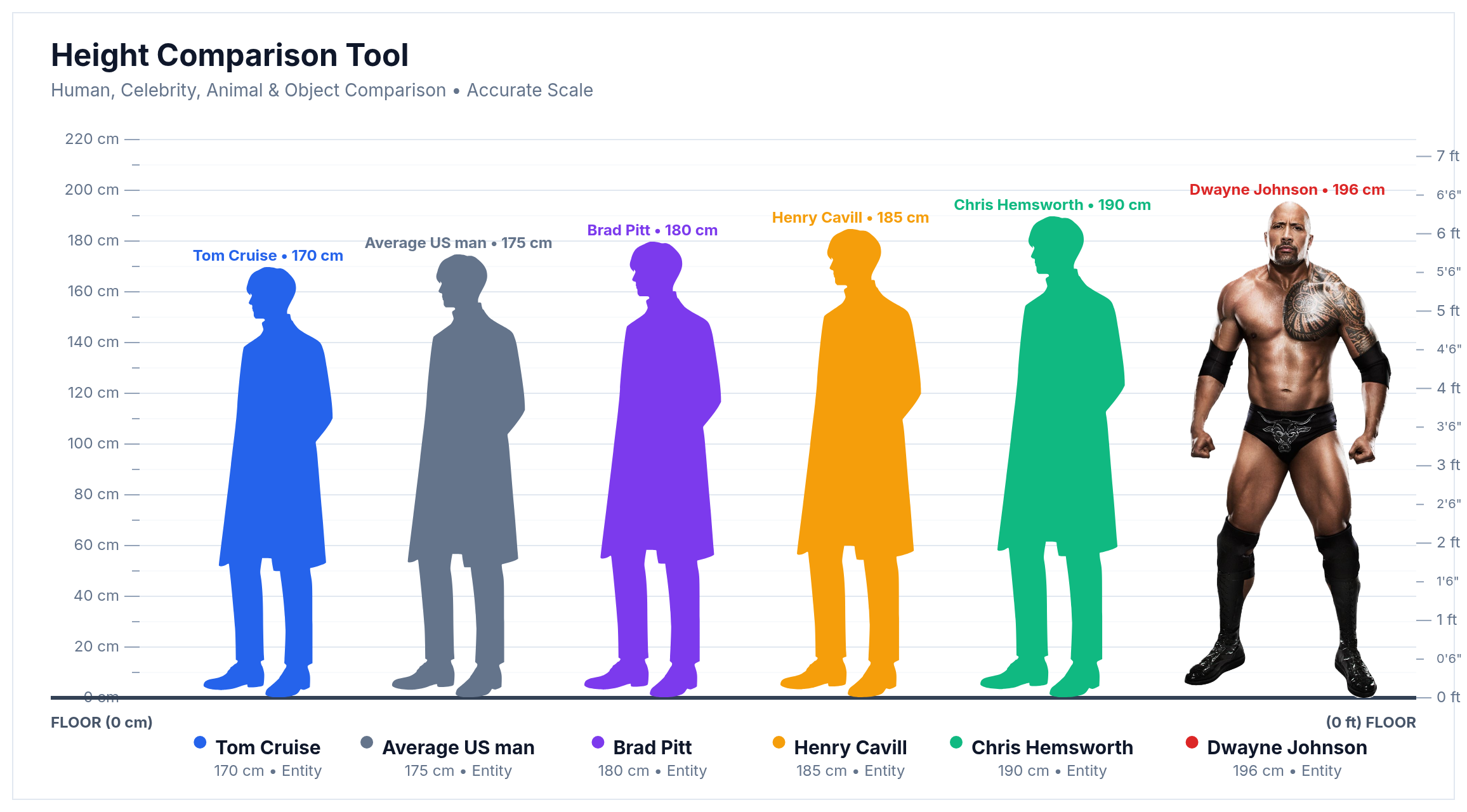
Cruise vs Pitt: 10 cm on the reported figures, roughly 9–10 cm on every plausible correction. No amount of lifts or camera work closes a 4-inch gap — it only hides it in photographs.
Jack Reacher: The 26 cm Casting Gap Fans Never Forgave
The book character is 6'5" and 250 pounds. Cruise is 5'7". Lee Child eventually agreed with the fans.
No single role explains the Cruise height debate better than Jack Reacher. In Lee Child's novels, Reacher is a blond, 6 ft 5 in (196 cm) tall, 250-pound ex-military drifter — a behemoth whose size is central to how he dominates and intimidates everyone in the room. Cruise played him in two films, Jack Reacher (2012) and Jack Reacher: Never Go Back (2016), standing 26 cm — more than ten inches — shorter than the character, and with brown hair where the books insist on blond. Fans noticed immediately, and they never really stopped noticing.
Child defended the casting at the time, arguing that Reacher's size in the books was “a metaphor for an unstoppable force” which Cruise portrayed in his own way, and that no actor existed who combined Cruise's talent with the character's exact physical frame. He later changed his mind in public. By 2018 he was telling the BBC that Cruise “didn't have that physicality”, and in a 2026 interview he put it bluntly: Cruise was “completely and utterly wrong for the character” externally, even though he captured the internals well. Child exercised a contract clause giving him a veto over any Reacher film after the second one, and the role went to television — where Alan Ritchson, at 6'2", plays a far more book-accurate Reacher, and the height objection largely evaporated.
The chart below is the casting gap drawn honestly: Cruise at 170 cm next to a 196 cm figure labelled for the book character. It is the same 26 cm as the gap to Dwayne Johnson, which is the detail that makes the story sting — Johnson, at exactly the book character's height, was reportedly in the running for the role. The Reacher episode is the purest form of the Cruise height story: not a man who is short, but an industry that decided the man mattered more than the measurement, and a readership that disagreed.
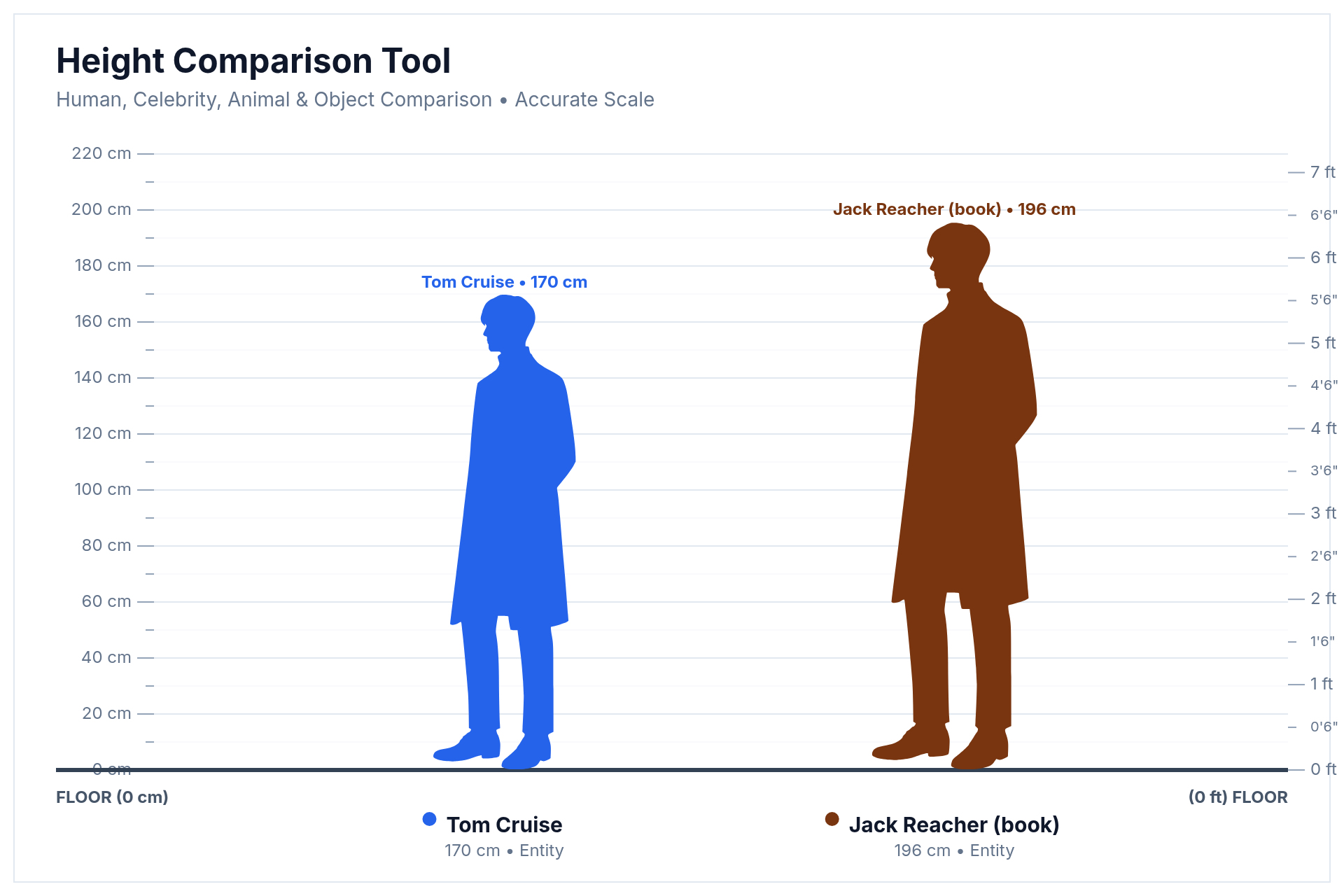
“Reacher’s size in the books is a metaphor for an unstoppable force.” — Lee Child, defending the casting in 2012. By 2026 he called Cruise “completely and utterly wrong for the character” externally.
The Three Taller Wives — and the Percentile Reality Check
All three of Cruise's wives were taller than him. The most famous gap is 10 cm — and the most famous quote about it is a joke.
The tabloid fixture of the 1990s and 2000s was simple: every one of Tom Cruise's three wives was taller than him. Mimi Rogers, his first wife, is reported at 5'8"–5'9" (173–175 cm). Nicole Kidman, his second wife, is 5'11" (180 cm) — a 10 cm gap that defined a decade of red-carpet photographs. Katie Holmes, his third wife, is 5'9" (175 cm), a 5 cm gap. The Kidman gap is the one that entered the language: after the divorce in 2001, Kidman went on the Late Show with David Letterman and, asked what the split meant for her, answered: “Well, I can wear heels now.” The chart below draws that marriage to scale — Cruise at 170 cm, Kidman at 180 cm, the 10 cm gap that a decade of photographs tried to hide.
Kidman's own height has its own honest complication, and it runs in the opposite direction to Cruise's. Told as a teenager that she was “too tall” to have a career, she used to claim 5'10½" at auditions; on the Radio Times Podcast in 2024 she corrected the record: “I say I'm 5ft 10 1/2in but I'm really 5ft 11in.” The specialist trackers list her slightly lower, at 5'10½" (179 cm), so the gap to Cruise is 9–10 cm on any reading — this article uses the site's published 180 cm baseline, consistent with the site's couples and tallest-female-celebrities articles. The symmetry is the point: he spent his career being listed taller than he is, and she spent hers being listed shorter.
So how short is 170 cm, really? Run the percentile maths on CDC NHANES data — US men average 175.3 cm with a standard deviation of about 7.4 cm — and 170 cm lands around the 20th–25th percentile for US men: shorter than roughly three men in four, but well inside the ordinary range, and 5 cm under the average man rather than dramatically below it. The site's shortest-celebrities article says the same thing, and it is worth repeating here because it reframes the whole topic: Cruise is short, but not remarkably so. What is remarkable is the forty-year industry effort to make a 5 cm deficit invisible — the lifts, the angles, the blocking, the casting — and the fact that audiences keep asking about it anyway. Four decades as the definitive movie star, three Oscar nominations, and films grossing over $10 billion worldwide, all at 170 cm. The camera adds ten pounds and, with enough effort, three inches.
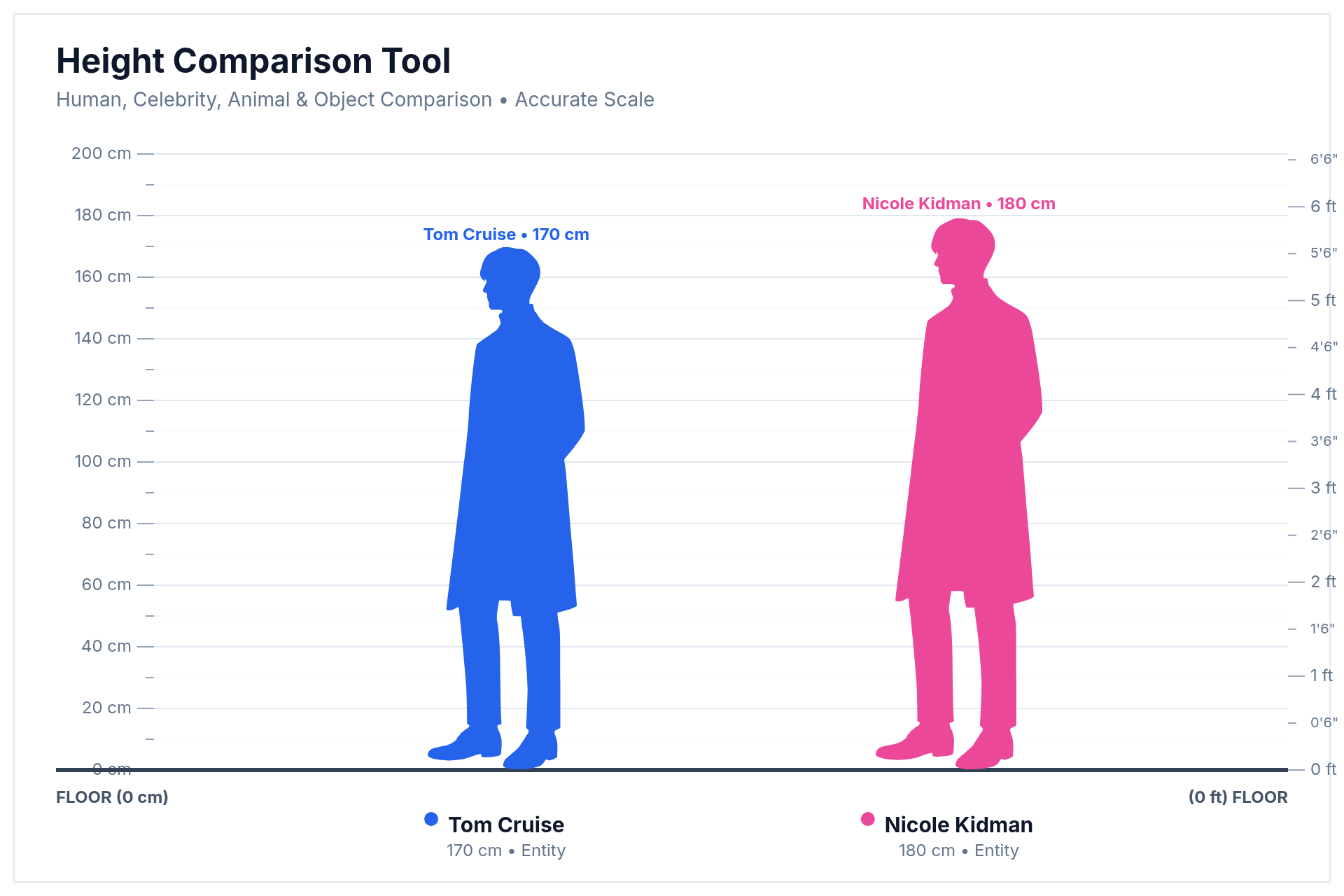
170 cm is around the 20th–25th percentile for US men — shorter than about three men in four, but an ordinary height. The story is the effort to hide 5 cm, not the 5 cm.