The Short Answer: 330 Metres, or 1,083 Feet
The Eiffel Tower is 330 metres (1,083 feet) tall, measured from the ground on the Champ de Mars to the very tip of the broadcasting antenna on its summit. That makes it the tallest structure in Paris, about as tall as an 81-storey building, and — to put it in the most human terms possible — roughly 189 average adults stacked head to toe.
It is worth pausing on that number, because the Eiffel Tower is one of the most misquoted heights on the internet. Search for it and you will find 300 m, 312 m, 324 m and 330 m, all presented as “the” height. They are all real measurements; they just measure different things, or the tower at different dates. The rest of this article untangles them, then puts the tower next to a human, its own floors, and the world’s other famous landmarks so you can actually feel the scale rather than just read a number.
One more framing device before we start: the tower’s base is a square 125 m (410 ft) on each side. You could lay about 71 average men head to toe along one side of that square. The tower is not just tall — its footprint is a city block in its own right, and its four legs splay outward so widely that the arch between them comfortably frames the streets passing underneath.
330 m (1,083 ft) to the antenna tip is the current, correct headline figure — confirmed by the tower’s own operator and by Wikipedia. Use 300 m only when you mean the iron structure without any antenna.
Why You See 300 m, 312 m, 324 m and 330 m
The tower has literally grown taller since 1889 — one antenna at a time.
When Gustave Eiffel’s company finished the tower for the 1889 Exposition Universelle, the ironwork itself stood exactly 300 m (984 ft) tall. Before it took Eiffel’s name, it was known simply as the 300-metre tower. On inauguration day, 31 March 1889, a large flagpole flying the French flag took the total to a little over 312 m (1,024 ft) — the first of many additions to the summit.
Broadcasting then took over as the tower’s second career, and each new generation of aerial added height. A television antenna in 1949 and further equipment in 1957 took it past 320 m; the arrival of digital terrestrial television in 2000, with a new UHF antenna, took it to 324 m (1,063 ft). That 324 m figure is the one most older guidebooks and websites still print, which is why it refuses to die — it was correct for 22 years.
The current figure dates to 15 March 2022, when a helicopter airlifted a new 6 m antenna for digital radio (DAB+) onto the pinnacle, lifting the tower from 324 m to 330 m (1,083 ft) in a single morning. So the rule of thumb is simple: 300 m is the iron, 324 m is the pre-2022 tip, and 330 m is the tower as it stands today. Any source still quoting 324 m is simply out of date.
There is a second, subtler reason for confusion: architectural height versus tip height. Skyscraper rankings often quote the Empire State Building as 381 m to its roof and 443 m to its antenna tip, and the same distinction applies in Paris. The Eiffel Tower’s “architectural” height is 300 m; its tip height, the figure everyone actually means when they ask how tall it is, is 330 m.
1889: 300 m of iron (312 m with flagpole) · 1957: past 320 m with TV aerials · 2000: 324 m with digital TV antenna · 2022: 330 m with new digital radio antenna.
The Eiffel Tower vs a Human: 189 People Stacked
At true scale, a person standing at the base barely reaches the first rivets.
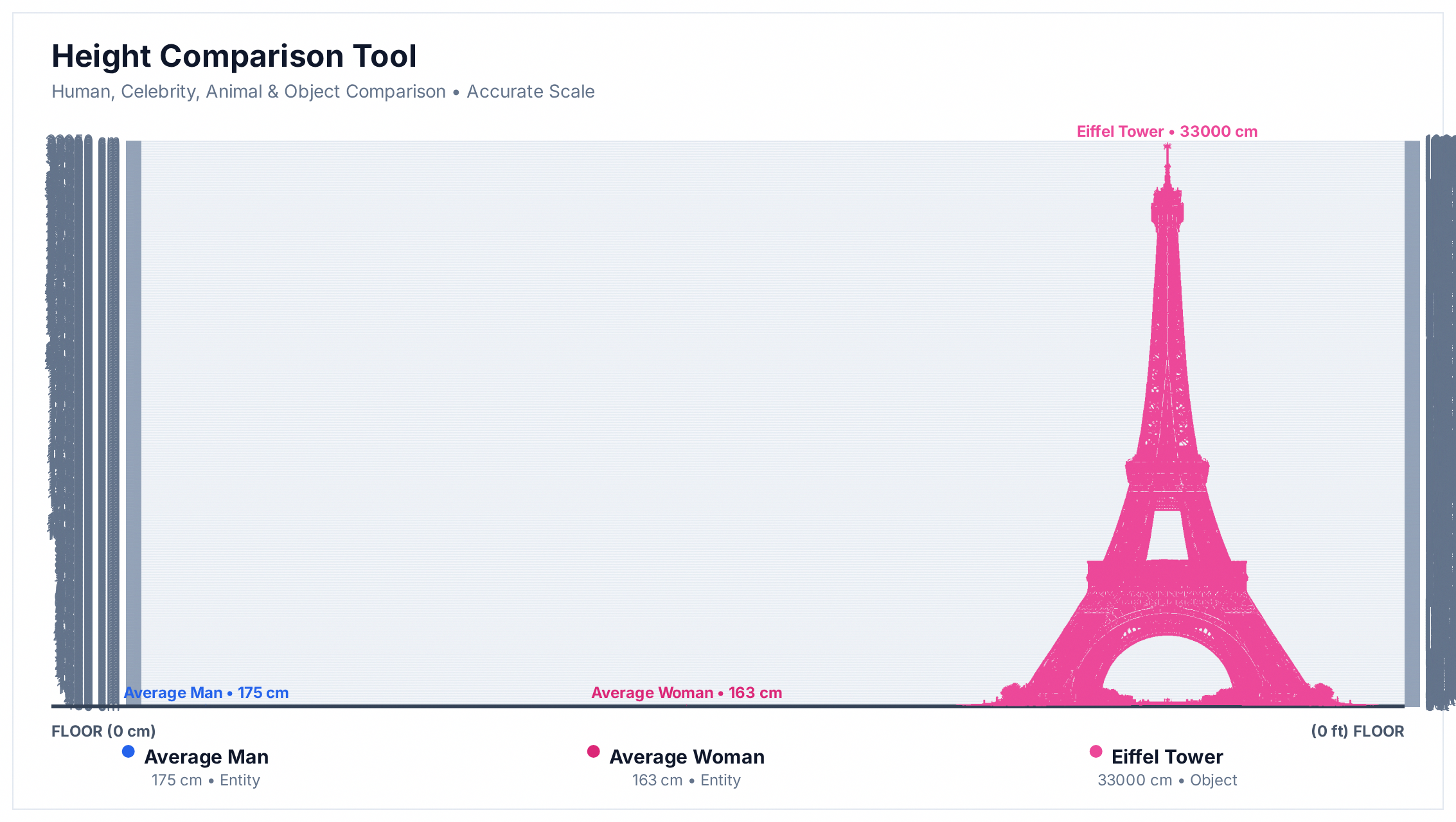
Stack average adults of 175 cm head to toe and you need about 189 of them to reach the 330 m tip — about 202 women of 163 cm. That is not a crowd; it is a human column taller than a 60-storey building, and it still only matches one Parisian landmark. Turn it around and the tower is about 189 times the height of the person standing beneath it, which is why photographs taken from the Champ de Mars are so deceptive: the camera compresses a height difference so extreme that the human eye struggles to hold both scales at once.
The chart below draws it honestly. The two human figures at the base are the average man (175 cm) and average woman (163 cm) used throughout this site. On a chart scaled to fit the whole tower, they are barely visible — a sliver at the foot of the ironwork. That invisibility is the point: most height comparisons flatter the human by cropping the landmark, but at true scale we are, quite literally, ankle-high.
It helps to climb the tower in human-sized steps. The first floor, at 57 m, is already about 33 average men stacked. The second floor, at 115 m, is roughly 66 people high — and its observation deck looks out over rooftops that themselves took centuries to build. The summit, at 276 m, is around 158 people up, and even there you are still 54 m — about 31 more people — short of the antenna tip sparkling above you.
Inside the Tower: Floors, Steps and 18,038 Pieces of Iron
The tower was built in just over two years, from 1887 to 1889, from 18,038 wrought-iron pieces held together by about 2.5 million rivets. The puddled iron alone weighs 7,300 tonnes, and with lifts, shops and antennas the total weight comes to roughly 10,100 tonnes — about the weight of 1,400 adult elephants, if you want a second absurd comparison for free.
Visitors climb through three levels. The first floor at 57 m (187 ft) has a glass floor section that lets you look straight down at the ant-sized crowds below. The second floor at 115 m (377 ft) is the classic viewing level, with restaurants and the best framing of the Paris skyline. The summit at 276 m (906 ft) is reached by lift, not by foot — although the full stair climb from the ground to the top is 1,665 steps, a climb attempted every year by athletes in the tower’s vertical race.
The tower also breathes with the seasons. In summer heat, the iron expands and the tower grows by up to about 15 cm, then shrinks back in the cold — a reminder that even a “fixed” height is a living measurement. It was also, briefly, the tallest structure on Earth: from its completion in 1889 until New York’s Chrysler Building overtook it in 1930, a 41-year reign that no other structure of its era came close to matching. It was originally intended to stand for only 20 years before being dismantled; it survived because it turned out to be a superb radio antenna, a job it still does today.
The tower was meant to be dismantled after 20 years. It survived because its height made it the perfect radio mast — the same antennas that saved it are the reason it now measures 330 m instead of 300 m.
Eiffel Tower vs Other Landmarks: Who Actually Wins?
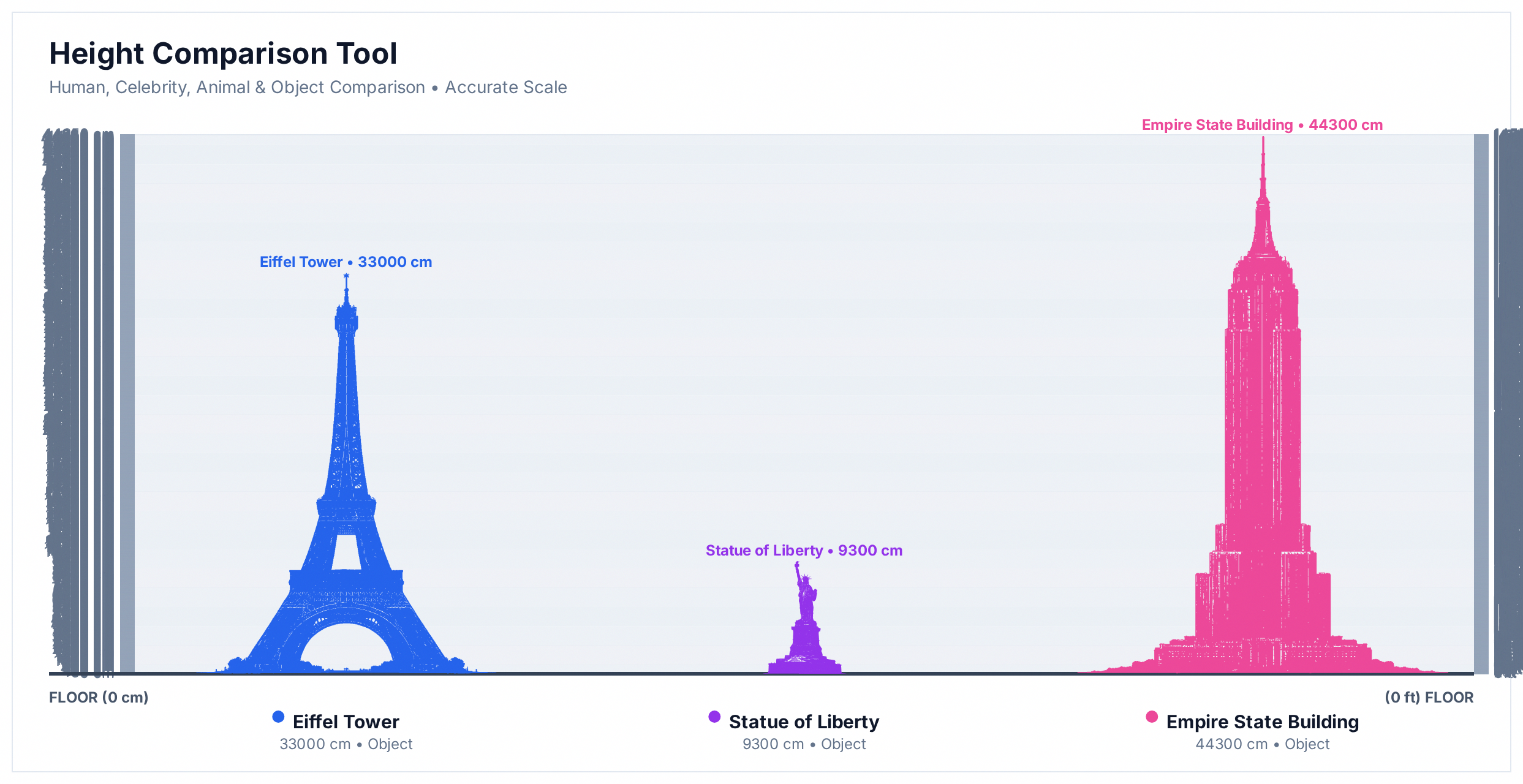
Against the Statue of Liberty, the contest is not close. The statue measures 93 m (305 ft) from the ground to the tip of its torch — the copper figure itself is only 46 m, with the pedestal making up the rest. The Eiffel Tower is about three and a half Statues of Liberty tall, a fitting margin given that Gustave Eiffel himself designed the statue’s internal iron framework. The two French gifts to the world, in other words, share an engineer as well as a continent-spanning friendship.
The Empire State Building is the nearest real rival among classic landmarks: 381 m to its roof and 443 m (1,454 ft) to its antenna tip, making it 113 m taller than the Eiffel Tower. That gap is itself roughly a 30-storey building — so while the two icons photograph as peers, the New Yorker wins by a clear margin. And both are dwarfed by the Burj Khalifa in Dubai, at 828 m (2,717 ft), which is about two and a half Eiffel Towers stacked end to end; the Paris tower reaches only 40% of the Burj’s height.
Look backwards rather than upwards and the tower’s achievement sharpens. The Great Pyramid of Giza, the tallest human structure for more than 3,800 years, stands 138.5 m today (146.6 m when built) — less than half the Eiffel Tower. The tower more than doubled, in a single structure, what the ancient world’s greatest builders had achieved, and it did so in iron lattice rather than solid stone. The Washington Monument, at 169 m, reaches just over half the tower’s height. The chart below puts the closest rivals side by side at true scale.
See Where You Stand Next to the Tower
The chart is preloaded — add your height and take your place at the base.
The comparison tool at the top of this article is preloaded with the Eiffel Tower, an average man and woman, the Statue of Liberty and the Empire State Building, all drawn to true scale. Add your own height and the chart redraws instantly: stand yourself at the foot of the tower and see how many copies of you it would take to reach the second floor (about 66 for a 175 cm adult), the summit (about 158), or the antenna tip (about 189).
A few experiments worth trying. First, the landmark ladder: line up the Statue of Liberty, the Eiffel Tower and the Empire State Building, then add the Burj Khalifa at 828 m and watch the Paris tower shrink to a middle child. Second, the floor test: place yourself at 57 m, 115 m and 276 m in turn and feel how quickly “just one more floor” stops being a small step. Third, the honesty test: measure yourself barefoot in the morning — most people carry 2 to 3 cm of footwear optimism — and use that figure for the stack calculation.
And if this article gave you a taste for impossible scales, the rest of the blog goes further in both directions: our human-versus-elephant and human-versus-polar-bear comparisons bring the scale back down to living creatures, while the tallest-female-celebrities ranking shows what the very top of the human range looks like next to the rest of us. The tower, though, remains the benchmark — 330 m of iron that started as a temporary fairground attraction and ended up redefining what “tall” means.
Scroll to the visualiser, tap “add person,” enter your barefoot morning height, and see exactly how many of you it takes to climb the Iron Lady.