How Tall Is a Polar Bear Standing Up? The Headline Numbers
Three metres on two legs — barely a man's eye line on four.
When an adult male polar bear rears up on its hind legs, it reaches about 3 m (10 ft) tall, according to Polar Bears International. Exceptionally large males can push past 3.3 m (11 ft), per the National Wildlife Federation. This is the posture that produces the famous photographs: a wall of white fur and muscle rising well above a human observer. An average man is 175 cm (5 ft 9 in); the bear beats him by more than a metre and a quarter.
Bears do not spend their lives standing, though. On all fours — their natural stance — an adult polar bear stands 122–160 cm (4 ft 0 in–5 ft 3 in) at the shoulder, depending on sex and size. Polar Bears International puts the typical range at 1–1.5 m, and the San Diego Zoo's fact sheet lists up to 1.7 m. In other words, an average man standing beside a polar bear on all fours is taller than the bear's shoulder. The animal's enormous body length (2.4–3 m nose to tail in males, 1.8–2.4 m in females) is laid out horizontally, not vertically.
Weight follows the same extreme scale. Adult males typically weigh 350–700 kg (770–1,540 lb), while females weigh roughly 150–250 kg (330–550 lb) — about half. A pregnant female can reach 500 kg. So the bear that stands below your chin on all fours may still outweigh you five to one.
Bears rear up only briefly — to sniff, look around, or play — so the ~3 m standing figure is an estimate of a short-lived posture, not a standard measurement. Scientists measure bears at the shoulder on all fours, which is why serious sources always give both numbers.
Face to Face With a 3-Metre Polar Bear
A standing male is about 1.7× an average man.
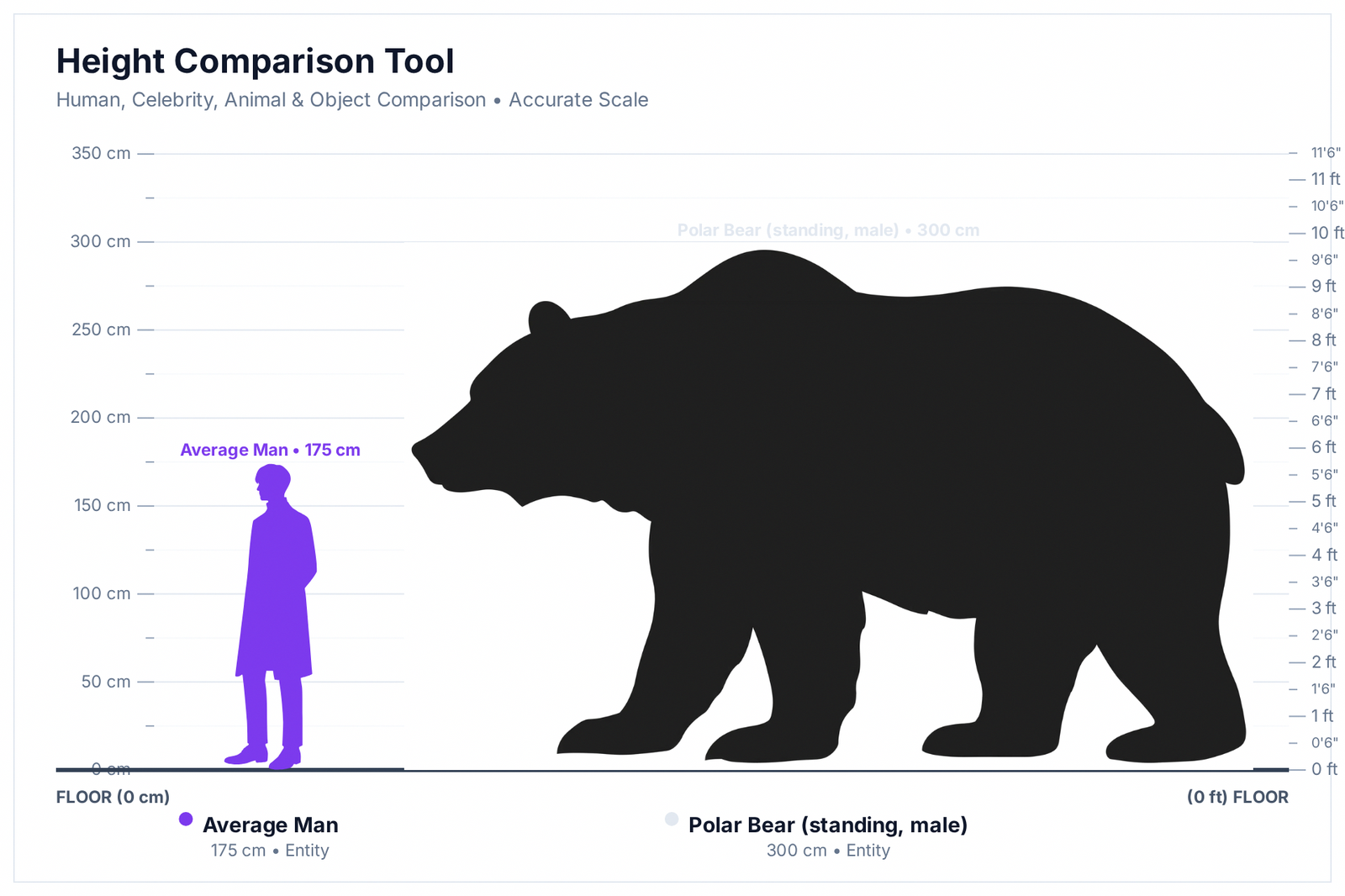
Put a 175 cm man next to a 300 cm standing male polar bear and the comparison becomes visceral: the bear's head is roughly 125 cm — a full head and chest — above the man's. The animal weighs 350–700 kg against the man's ~70–80 kg, a mass ratio of roughly five to ten. Its front paws, each about 30 cm (12 inches) across in an adult, are wider than a man's head.
Most people misjudge this comparison because they picture the bear on all fours, where its shoulder is lower than a human's chin. The standing figure is what matters for the encounter people imagine — and it is worth remembering that a polar bear rearing up is usually just trying to see or smell better, not threatening. Bears stand to gather information, not to pick a fight.
The chart below renders the face-to-face comparison at true scale. Note that the site's bear silhouette is a generic bear model standing in for a polar bear — the height bars are the data that matter.
Bears vs Sows: Polar Bears Are Extremely Dimorphic
Adult males are about twice the weight of females.
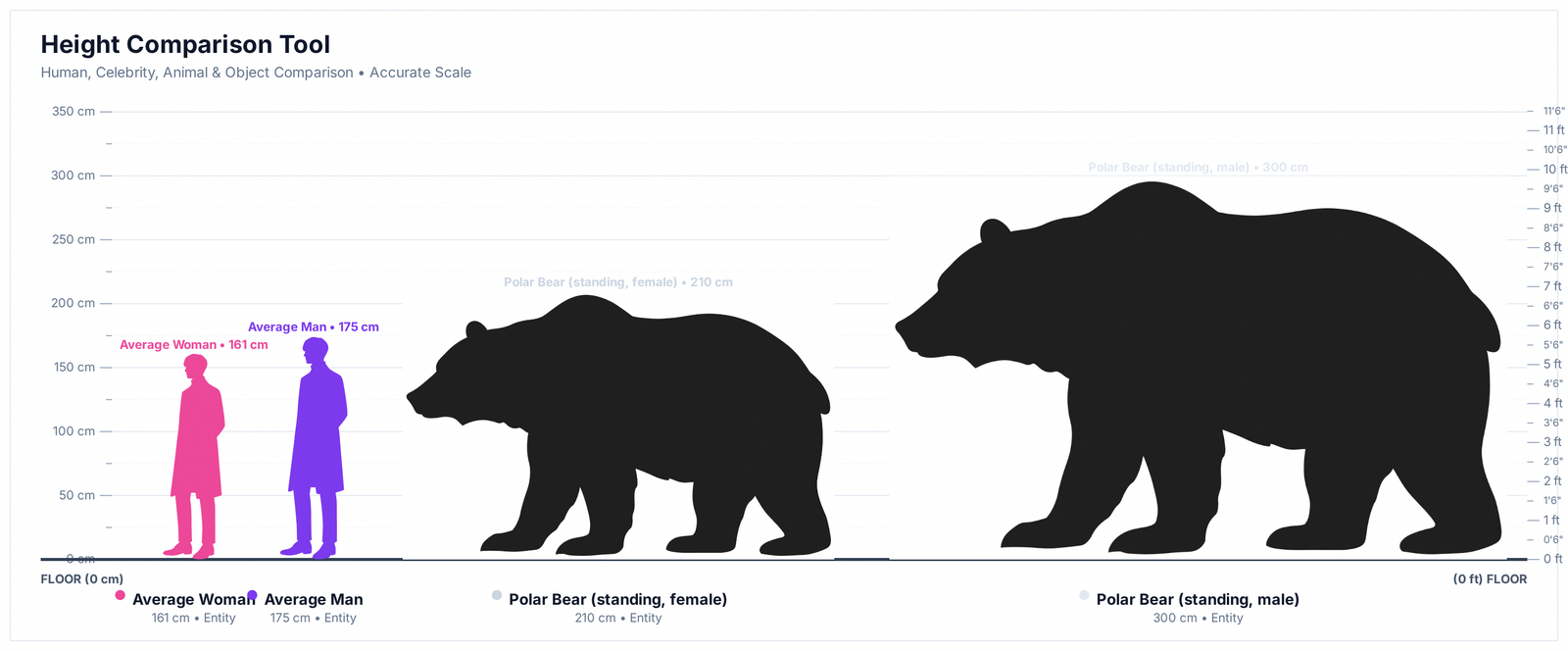
Few mammals show as stark a male–female size gap as the polar bear. Males measure 2.4–3 m in body length and weigh 350–700 kg; females measure 1.8–2.4 m and weigh 150–250 kg — roughly half the male's mass. Standing, the male reaches about 3 m while the female tops out around 2.4 m (7 ft 10 in). The polar bear is among the most sexually dimorphic of all mammals, surpassed only by the pinnipeds such as elephant seals.
Even the female, the 'small' sex, dwarfs a human. A 210–240 cm standing sow is 1.2–1.4 times the height of a 175 cm man and outweighs him several times over. The chart below places both sexes against average humans: the woman at 161 cm reaches only about half the male's height, and even the female bear stands a head and a half above her.
The dimorphism is ecological, not decorative. Larger males dominate mating competition and can fast for months while guarding females; females invest instead in raising cubs through long denning periods, emerging with cubs they must then defend and feed. Pregnancy can push a female's weight to around 500 kg — her fattest and most capable hunting form.
Why Scientists Measure Polar Bears on All Fours
Shoulder height is the reliable number.
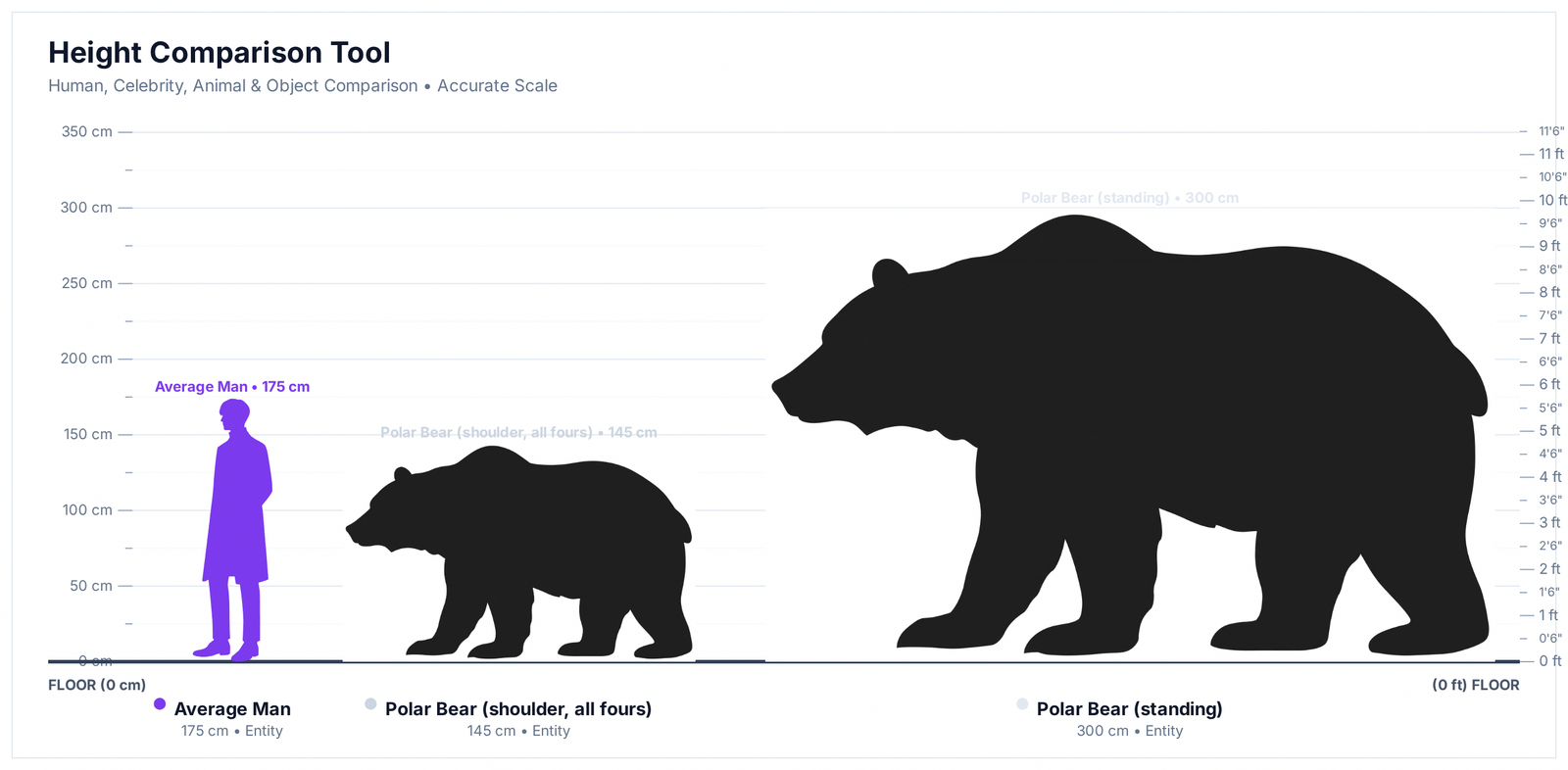
Field researchers do not wait for a polar bear to stand up before reaching for the measuring tape. Shoulder height on all fours — typically 1.2–1.6 m, up to 1.7 m in the largest — is the standard because it is the posture the animal holds all day. It is consistent, repeatable, and directly comparable across individuals and species. Standing height, by contrast, varies with how far the bear decides to stretch.
Bears stand for a handful of reasons: to see over obstacles, to catch a scent on the wind, to play — including ritualised mock fighting — and occasionally to intimidate. They walk on all fours because that posture spreads their immense weight evenly, and their powerful hind legs let them drag large prey like seals across the ice. A standing bear is a bear gathering information.
The chart below shows why the distinction matters visually: at 145 cm on all fours the bear's shoulder sits below the 175 cm man's chin, while the same bear standing at 300 cm looms nearly twice as tall as him.
The Biggest Polar Bear Ever Recorded: 3.39 Metres
The 1960 Kotzebue Sound giant — a record with a caveat.
The largest polar bear on reliable record was a male shot at Kotzebue Sound in northwestern Alaska in 1960. It reportedly weighed 1,002 kg (2,209 lb), and the mounted specimen stood 3.39 m (11 ft 1 in) tall on its hind legs. The figure is cited across wildlife records, from natural-history books to the World Record Academy, and the bear was photographed for a 1960 issue of Sports Illustrated — though one widely circulated photo used forced perspective that exaggerates its size further.
The caveat matters: 3.39 m is the height of a taxidermy mount, and mounted specimens can be stretched beyond the animal's living dimensions. It is an attributed record of an extraordinary individual, not a typical size. The typical large adult male standing at ~3 m is already far beyond anything a human frame approaches.
For perspective on just how exceptional that mount is: the tallest person in recorded history, Robert Wadlow, stood 272 cm (8 ft 11 in) — the 1960 bear was 67 cm taller than him, mounted or not.
Polar Bear vs Grizzly and Kodiak: Which Bear Is Biggest?
Polar bears share the crown — and out-stand the grizzly.
The polar bear is the largest terrestrial carnivore on the planet — a title it shares with the Kodiak bear, the giant brown-bear subspecies of Alaska. It is more than twice the size of the next contender, the Siberian tiger. Adult male polar bears at 350–700 kg outclass most grizzlies, which typically run 180–360 kg in males.
Standing on hind legs, a very large grizzly can reach almost 2.7 m (9 ft) — but most adult male grizzlies stand 6.5–8 ft (2–2.4 m) upright, and their shoulder height on all fours is only 0.9–1.5 m. Kodiak bears stand comparably to polar bears at up to about 3 m. So in a standing face-off, the polar bear out-towers the grizzly by a head or more.
That said, standing height is not the whole animal: on all fours a big male grizzly's shoulder can reach a 12-year-old's eye line, and all three species are lethally strong at any height. The size contest is for scientists and record books — at a safe distance.