The One Measurement That Never Changed: 10 Feet
A peach basket on a balcony rail set the height of every basketball hoop on Earth.
Ask how high a basketball hoop is and you get the most boring, most consistent answer in all of sports: exactly 10 feet (3.05 m), measured from the playing surface to the top of the rim. It is the same in the NBA, FIBA international play, the NCAA, the WNBA and high school basketball. A professional arena in Los Angeles, an Olympic court in Tokyo and a driveway hoop in Ohio are all aiming at the same horizontal line — the only thing that varies is how far away from it you shoot.
The reason for that eerie global consistency is pure historical accident. When James Naismith invented basketball in December 1891 at the Springfield YMCA, he needed somewhere to hang his peach baskets — and the gymnasium balcony rail happened to be 10 feet off the floor. He nailed the baskets to the rail, wrote it into his original 13 rules, and the number simply stuck. In more than 130 years of rule changes — shot clocks, three-point lines, goaltending rules — the rim height has never moved a single centimetre.
That rigidity is deliberate. A hoop height that everybody shares means skills transfer everywhere: a jumper grooved in Manila works in Madrid, and dunkers do not need to recalibrate when they change leagues. Coaches, equipment makers and arena builders have all optimised an entire sport around that one fixed altitude, which is exactly why it is so hard for most of us to appreciate how high 10 feet actually is until something forces a comparison.
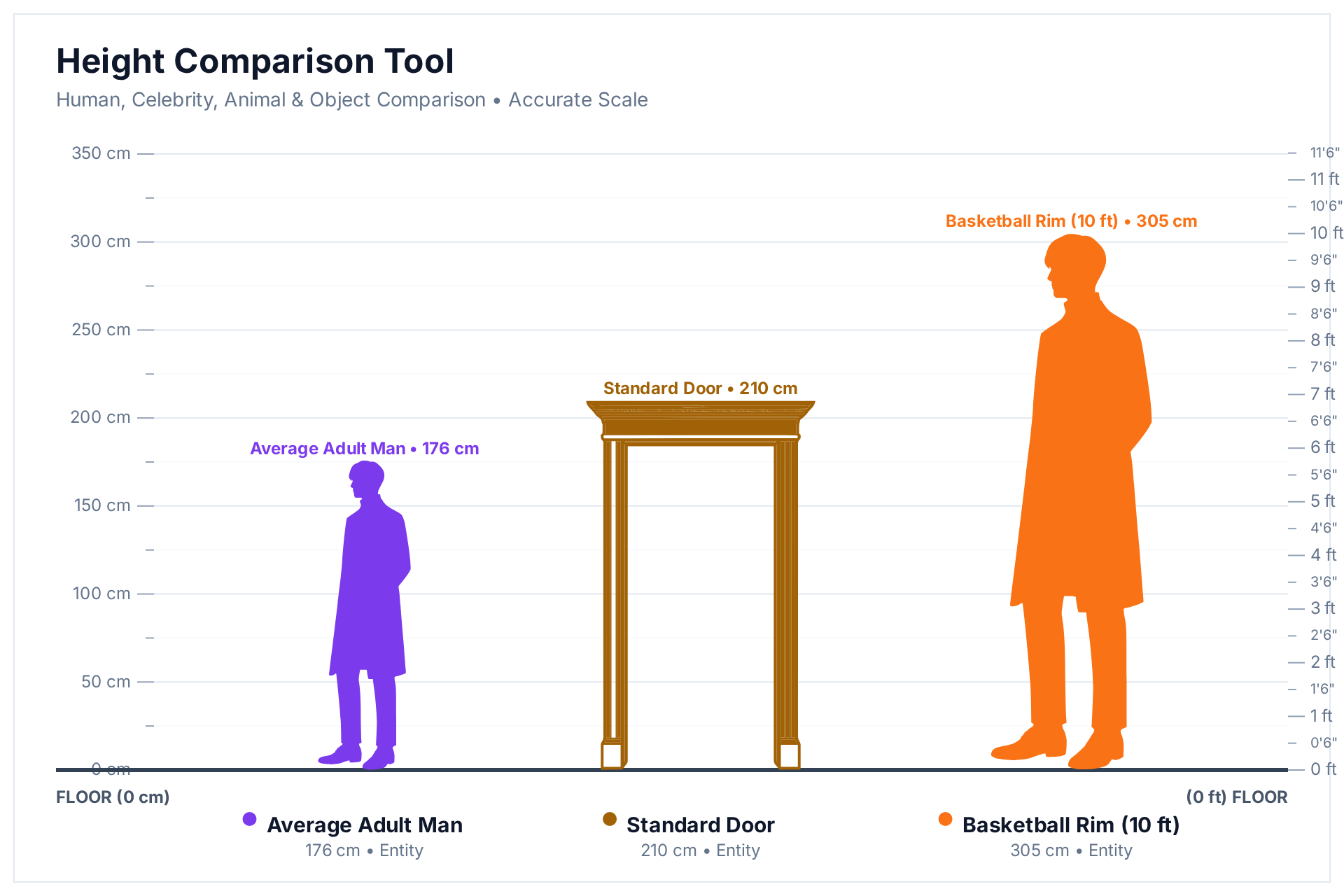
10 ft (3.05 m), playing surface to top of rim — identical across the NBA, FIBA, WNBA, NCAA and high school basketball. Youth hoops are the only common exception.
Anatomy of a Regulation Hoop: Rim, Net and Backboard
The rim gets the glory, but the backboard does most of the hidden measuring.
The rim itself is disarmingly simple: an 18-inch (45.7 cm) inside diameter ring of solid steel, mounted horizontally so its top edge sits exactly 10 feet up. It projects 6 inches (15.2 cm) out from the face of the backboard, and the net — usually white nylon cord about 15 to 18 inches long — hangs below it, there mainly to slow the ball and make a successful shot visible to everyone watching. A standard basketball is about 9.5 inches across, so the rim opening is roughly twice the ball’s width: tight enough to demand precision, generous enough that a clean shot drops straight through.
Behind the rim, the backboard carries most of the system’s hidden geometry. At the professional level it is a 72 × 42 inch (183 × 107 cm) rectangle of tempered glass, painted with the familiar inner “shooter’s square” — 24 by 18 inches — that gives bank shots their aiming reference. The bottom edge of the board sits 9 feet (2.74 m) above the court, which puts the top of the board at 13 feet (3.96 m). That 9-foot line is worth remembering: even the bottom of a regulation backboard is 98 cm above the head of an average adult man.
Every one of those secondary measurements is calibrated around the 10-foot rim. Move the rim down a foot without moving anything else and bank shots stop behaving the way players expect; the free-throw line’s 15-foot distance from the backboard face and the geometry of every layup angle quietly depend on the rim staying exactly where Naismith’s balcony rail put it. That is why adjustable home systems lower the whole assembly together — rim and board as one unit — rather than just dropping the ring.
Rim 18 in diameter and 10 ft high; backboard 72 × 42 in with its bottom edge at 9 ft; shooter’s square 24 × 18 in; net 15–18 in long; rim projects 6 in from the board face.
What 10 Feet Actually Means Next to a Human
Do the leap math and the famous height becomes personal very quickly.
Stand a 176 cm (5 ft 9.3 in) average adult man under a regulation rim and the numbers get humbling fast. His head tops out at 176 cm; his outstretched hand reaches roughly 224 cm on tiptoes. That leaves about 80 cm — more than two and a half feet of empty air — between his fingertips and the steel. Touching the rim demands a standing vertical leap of roughly 80 cm, and dunking needs a running leap comfortably past a metre. Most untrained adults jump nowhere near that high, which is the simple physical reason a dunk remains a feat even though 10 feet sounds like a friendly number.
Put it against the architecture of ordinary life and it reads even starker. A standard interior door frame tops out around 203 cm — the rim floats about a metre above the highest point of every doorway in your home. A full-size refrigerator, the biggest object in most kitchens, stands 168–183 cm tall: the rim sits another 120-plus cm above its top hinge. You can walk under a basketball rim without ducking; you could balance a second refrigerator on top of your head and still fall short of the steel.
The most useful comparison may be the car in your driveway. A typical sedan roofline is only 140–150 cm — you can comfortably see over it, and its roof sits somewhere around an adult’s waist or chest. The rim is more than twice that height. Stack two sedans on top of each other and you would just about be looking the rim in the eye. When people say 10 feet “doesn’t sound that high”, they are usually failing to imagine anything except a person — and the moment you compare it to things instead of people, the scale snaps into focus.
Add your own height in the comparison tool at the top of this article and read off your personal gap to the 10-foot line — it is the fastest way to feel this number.
Fridge, Sedan, Door: The Everyday Scale Ladder
Four familiar objects, one unbroken ladder from the ground to the rim.
Line up the objects and a clean ladder emerges: sedan (140–150 cm), then the refrigerator and the average man at almost exactly the same height (168–183 cm and 176 cm respectively), then the door frame at 203–210 cm, and finally the rim at 305 cm — nearly half a metre above everything else on the ladder. It is a pleasingly honest visualisation, because each rung is something you have stood next to a thousand times. The chart below renders it to scale.
The refrigerator pairing is the sleeper insight of the bunch. A standard full-size fridge — 66 to 72 inches depending on style, with counter-depth models reaching the top of that range — is essentially man-sized: about as tall as the average adult who opens it every morning. So “the rim is about one and three-quarter fridges high” is a unit anyone with a kitchen can picture, no tape measure required. The sedan, meanwhile, gives you the waist-high anchor: if you can see over your car’s roof, remember that the rim is more than twice that altitude.
The door is the anchor that matters most indoors. Because every doorway in a standard home peaks around 203 cm, you already own a perfectly calibrated 2-metre ruler in every room of your house. Next time you walk through one, picture the rim floating roughly a metre above the frame — a full arm’s length of nothing between the top of the door and the steel. That mental image is the whole point of visual comparison: abstract numbers become something your body already understands.
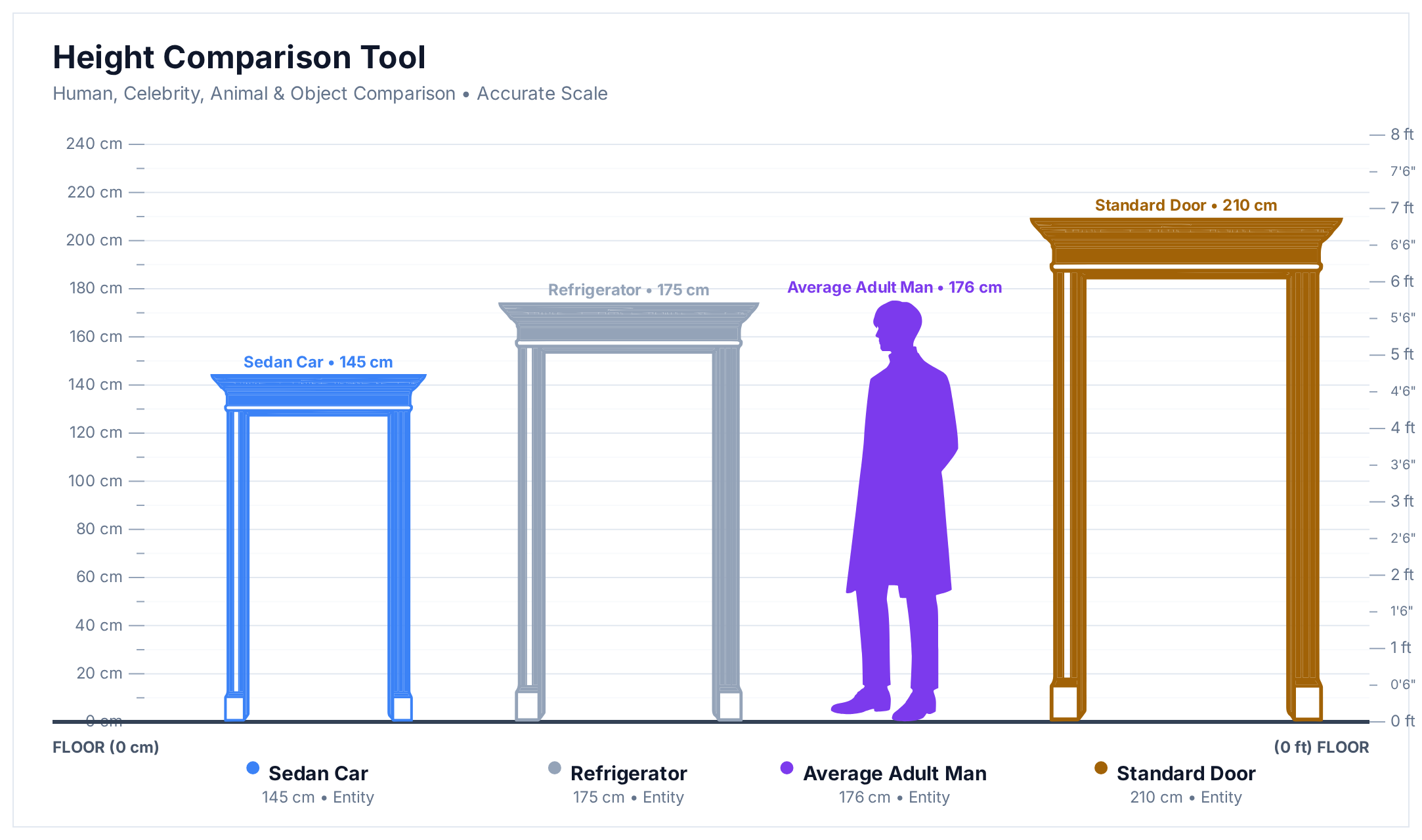
A 10-foot rim is about one-and-three-quarter refrigerators high, more than twice a sedan’s roofline, and roughly a metre above the top of a standard doorway.
The Exception: Youth Hoops and the Adjustable Rim
The only time the 10-foot rule is allowed to bend.
There is exactly one mainstream context where the 10-foot standard does not apply: youth basketball. Driveway and gym systems for young children are routinely lowered to 8 or 9 feet — and sometimes as low as 5 feet for the very youngest players — so that shooting form develops against a proportionally realistic target instead of a steel ring three metres in the sky. Nearly every home system sold today is adjustable for this reason, typically cranking between about 7.5 and 10 feet as kids grow.
The adjustment is always temporary. As players move through school levels, the rim climbs toward the regulation mark and stays there for the rest of their playing lives — high school, college, professional and international play all use the same 10-foot rim Naismith’s players shot at. The progression is one of the quiet proofs of the standard’s value: the target never changes, only the shooter does.
That permanence is also why the height is worth visualising against everyday objects rather than just memorising. “Ten feet” is a number everyone knows and almost nobody can feel — until it is rendered beside a fridge, a car and a doorway, at which point the oldest unchanging measurement in team sports finally looks as tall as it is.
Look for an adjustable system (roughly 7.5–10 ft range) and raise it as the player grows — but note the backboard itself also gets smaller on youth systems, which changes rebound behaviour even at full height.