The Exact Protocol, Step by Step
Clinics follow this sequence for a reason — every step removes one way to be wrong.
Find a flat stretch of floor — no carpet if you can avoid it — and a flat wall with nothing in the way at the bottom. Take off your shoes (and thick socks, if you want to be thorough), remove anything from your head that could interfere — hats, headbands, clips, tight plaits — and take off bulky clothing so you can see and feel your posture. You need three tools: something flat and rigid to rest on your head (a hardback book or a ruler), a pencil, and a rigid tape measure. Metal is best, because flexible sewing tapes stretch and sag, and a stretched tape is a lying tape.
Stand with your back to the wall, feet flat on the floor and heels touching the spot where the floor meets the wall. Stand up straight: legs straight, shoulders level, and as much of you as your body shape allows touching the wall — head, shoulders, buttocks and heels. Clinicians call these the four contact points, and they are the single biggest thing separating a real measurement from a guess, because they stop you leaning or shifting your weight without noticing. Look straight ahead, chin level, with your line of sight parallel to the floor — this puts your head in the clinical position (more on that below).
Now lower your flat headpiece until it rests firmly on the crown of your head, keeping it at a right angle to the wall — it must touch your head and the wall at the same time. If someone is helping you, their eyes should be level with the headpiece when they mark the wall, so there is no parallax; the mark goes where the underside of the headpiece meets the top of your head. Then measure from the floor straight up to the mark with your metal tape, and write the number down to the nearest 0.1 cm (a millimetre) or 1/8 of an inch. That is the precision clinical growth protocols use, and it is easily achievable at home.
Done this way, a home measurement lands within about a centimetre of what a clinic stadiometer would say — and repeat attempts in the same setup typically agree within about a centimetre too. The remaining error is almost always posture or a tilted headpiece, which is why the next two sections exist. Do it twice; if the two readings disagree, take a third and trust the pair that agree.
Measure twice, in the same spot, with the same method. If the readings differ, split the difference — or take a third and keep the two that agree.
Measure in the Morning: You Really Are Taller at Breakfast
Your spine is a stack of fluid-filled cushions — and they spend all night reinflating.
The discs between your vertebrae are filled with a gel-like substance that slowly loses fluid under the day’s load of gravity, sitting and standing. By evening each disc is a fraction thinner, and those fractions add up along the whole spine. Overnight, lying flat removes the pressure, the discs reabsorb fluid, and you regain the height — which is why your morning self is measurably taller than your evening self. It is not an illusion, and it is not posture; it is physiology.
How much taller? Two peer-reviewed stadiometer studies put a number on it: a University of Manchester study of 12 participants found an average overnight gain of 0.6 cm, and a study in the Annals of Human Biology found a similar average of 0.8 cm. Orthopaedic surgeons who measure patients daily cite a typical range of 0.5–1 cm, with younger and taller people — whose spines have more disc to compress — sometimes seeing up to about 1.5 cm. Treat the popular “1–2 cm” figure with scepticism; the measured data centres well under a centimetre for most adults.
Most of the day’s compression happens quickly — a large share of it within the first hour or two after you get up — so the exact minute you measure matters less than the consistency of it. The practical rule, echoed by every serious guide: always measure at the same time of day, and make it the morning if you can. That way you are comparing like with like, and the number you track over months or years is a real trend, not a timetable.
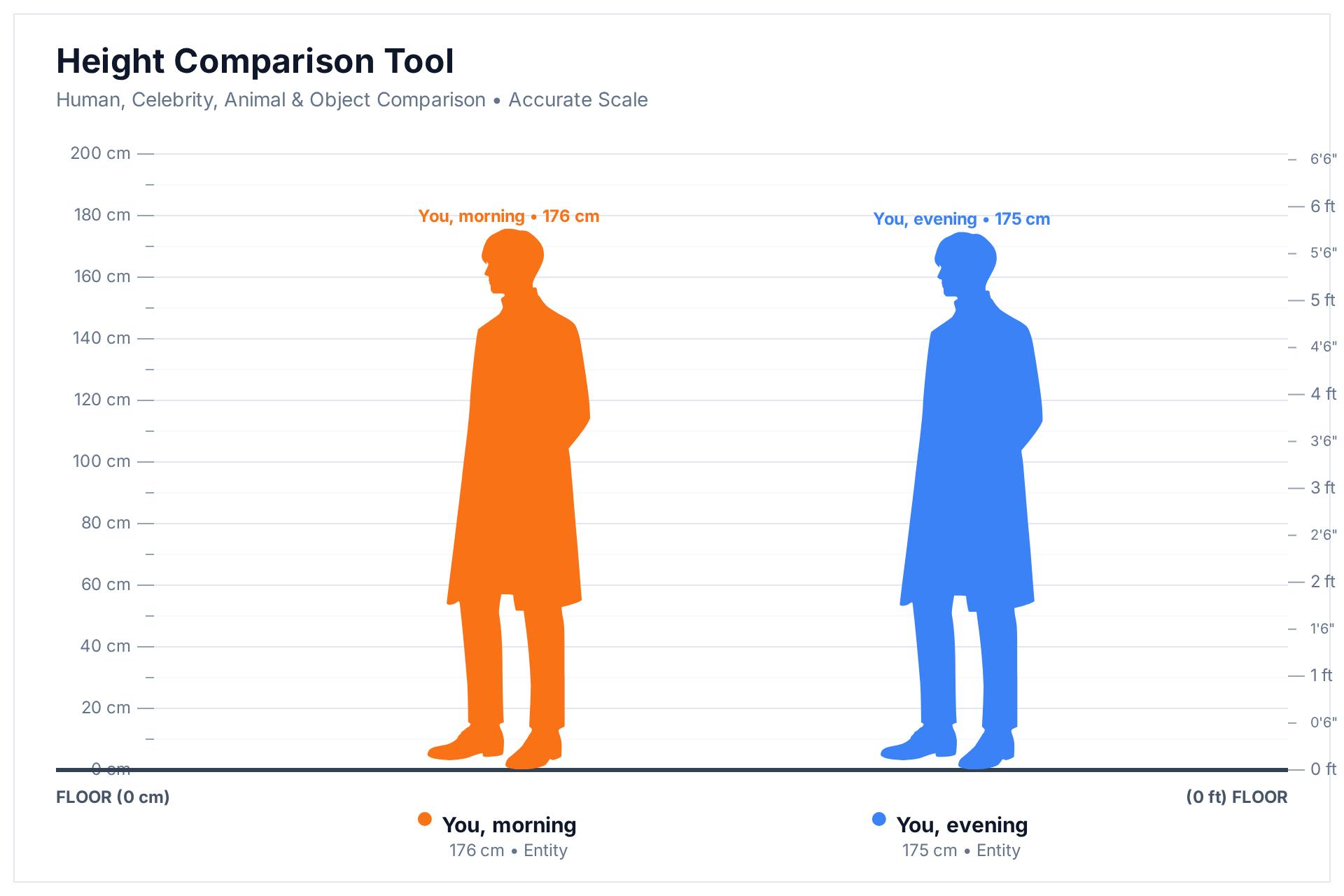
Peer-reviewed stadiometer studies measure an average overnight height gain of 0.6–0.8 cm. Morning minus evening ≈ 1 cm is the honest headline figure.
The Detail Everyone Gets Wrong: Head Position
Tilt your chin a little and you can “lie” by an inch without moving your feet.
Clinicians position the head using something called the Frankfort plane: an imaginary horizontal line running from the lower edge of the eye socket to the notch just above the opening of the ear canal. You do not need to memorise the anatomy — in practice it means exactly what the home protocols say: look straight ahead, chin level, line of sight parallel to the floor. When your gaze is level, your head is in the clinical position, and the crown of your head sits at its true highest point relative to the wall.
Get this wrong and the error is surprisingly large. Lifting your chin tips the crown of your head back and down; dropping it pushes the measurement point forward off the wall. Combined with slouching, a tilted head is why self-measurements so often come out an inch or more off — and it is almost always the culprit when someone “grows” two centimetres between attempts. Keep the headpiece honest: it must sit at a true right angle to the wall, resting flat on the crown, touching head and wall at the same time.
Two more details from the clinical protocol that cost nothing to copy. First, whoever reads the mark should have their eyes level with the headpiece — reading from above or below introduces parallax and shifts the mark. Second, hair: press it flat, undo buns and high ponytails, and remove hats entirely. The headpiece should compress the hair down to the skull, not sit on top of a hairstyle. A centimetre of hair is a centimetre of phantom height.
Line of sight level with the floor = head in the clinical position. If you can see the ceiling or your own toes, reset and start again.
Measuring Alone: The Cereal-Box Method
No helper? No problem — with two small adjustments you can do this solo.
A helper is the more accurate option, especially with children, who shift, lean or tilt their heads without realising it. If someone is available, have them hold the headpiece and make the mark while you simply stand correctly — your only job is posture. But most of us measure alone, and the solo method works fine with two adjustments.
First, swap the book for a cereal box or a similar light, rigid box. Its wide flat base is much easier to hold level on top of your head with one hand than a book, which wants to seesaw. Second, face a mirror if you have one: it lets you check that the box is parallel to the floor while you hold it. Mark the wall where the underside of the box meets the top of your head — or, if you can keep the box steady, step out from underneath it and make the mark with your free hand while the other keeps the box in place.
Then measure floor-to-mark with your tape exactly as before. Because solo attempts are the ones that drift, do it twice and compare: if the two marks agree, you are golden; if they do not, take a third. Solo error of half an inch to a full inch is common when technique is sloppy — which is precisely why the mirror and the repeat matter more than any gadget.
Cereal box instead of a book, mirror in front of you, mark twice. If the two marks disagree, a third attempt — and the two closest readings — settle it.
What Clinics Use Instead: The Stadiometer
The gold standard is beautifully simple — a ruler on the wall with a sliding headpiece.
When your height is taken at a doctor’s office, you stand against a device called a stadiometer: a long vertical ruler fixed to the wall, with a horizontal headpiece that slides down to rest on the top of your head. That is the entire instrument, and it is the gold standard for a reason — the vertical is guaranteed true, the headpiece is guaranteed level, and the four-contact-point stance is enforced by a trained measurer. It removes, by design, every error the home protocol fights manually.
The clinical procedure adds a few refinements worth knowing: the patient takes a deep breath and stretches up as tall as possible without lifting the heels (which straightens the spine), the headpiece is lowered until it firmly touches the crown, compressing the hair, and the measurer reads the scale with eyes level with the headpiece. The result goes straight into the medical record — and, for children, onto a growth chart, which is why clinics care so much about millimetres.
How far behind is a careful home setup? With a flat wall, a level headpiece and a metal tape, you can land within about a centimetre of a clinical reading — and repeat attempts in the same setup agree within about a centimetre too. Wall-mounted stadiometers for home use exist and cost well under a hundred dollars if you measure often. But the cheapest accuracy upgrade of all is free: measure the same way, in the same spot, at the same morning hour — then sanity-check the result against a known reference. A standard interior door frame is about 203–210 cm tall; plot your number next to one in our comparison tool and see whether the picture matches reality.
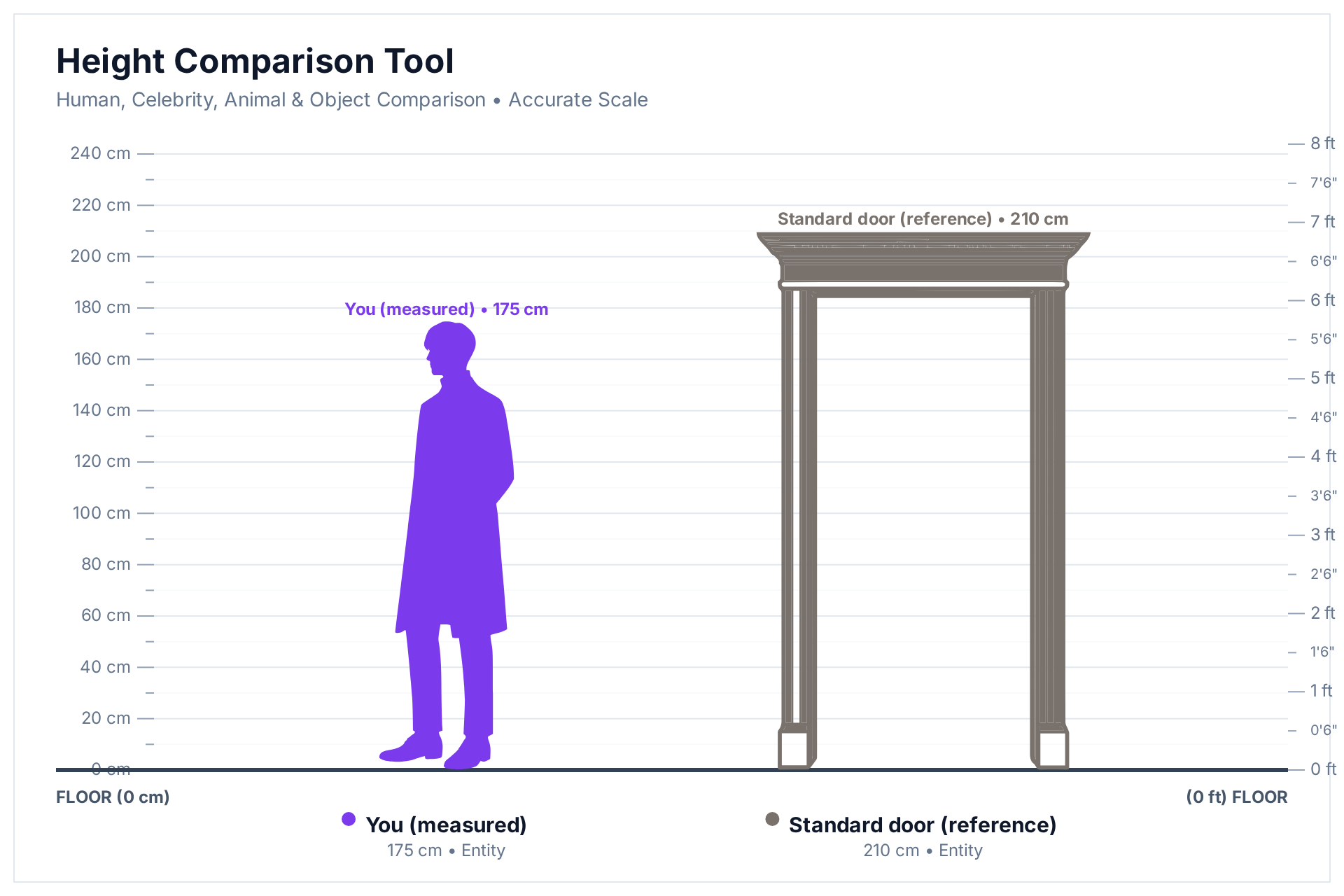
Plot your measured height against a standard 210 cm door in the HowHeight comparison tool. If the visual looks wrong, re-measure before you trust the tape.