The Position Ladder: 180 cm to 188 cm
Height rises as you move backwards down the pitch — goalkeepers sit a full eight centimetres above midfielders.
Analysis of World Cup 2018 squads puts the average professional soccer player at 5 ft 11 in (181 cm) — and the number barely moves across sources. SoccerPrime's tournament data and European league studies cluster between 180 cm and 182 cm, making soccer's average player a few centimetres taller than the average adult man (about 175 cm) but far shorter than the giants of basketball or volleyball.
The position averages tell the real story. Goalkeepers stand tallest at roughly 6 ft 2 in (188 cm) — World Cup research published in 2026 measured them at 189 cm, and a peer-reviewed 2026 study in the Indonesian Journal of Kinanthropology recorded 189.8 cm across its sample. Defenders average about 6 ft 0 in (183 cm), with centre-backs a shade taller than full-backs. Midfielders sit around 5 ft 11 in (180 cm) — the 2026 study measured 178 cm for midfielders, the shortest outfield group — and strikers average 5 ft 11 in (181 cm), though attacker figures vary most by competition.
That ladder is no accident. It maps directly onto what each position is asked to do, 90 minutes a week, for a decade. The next section breaks down the biomechanics behind each rung.
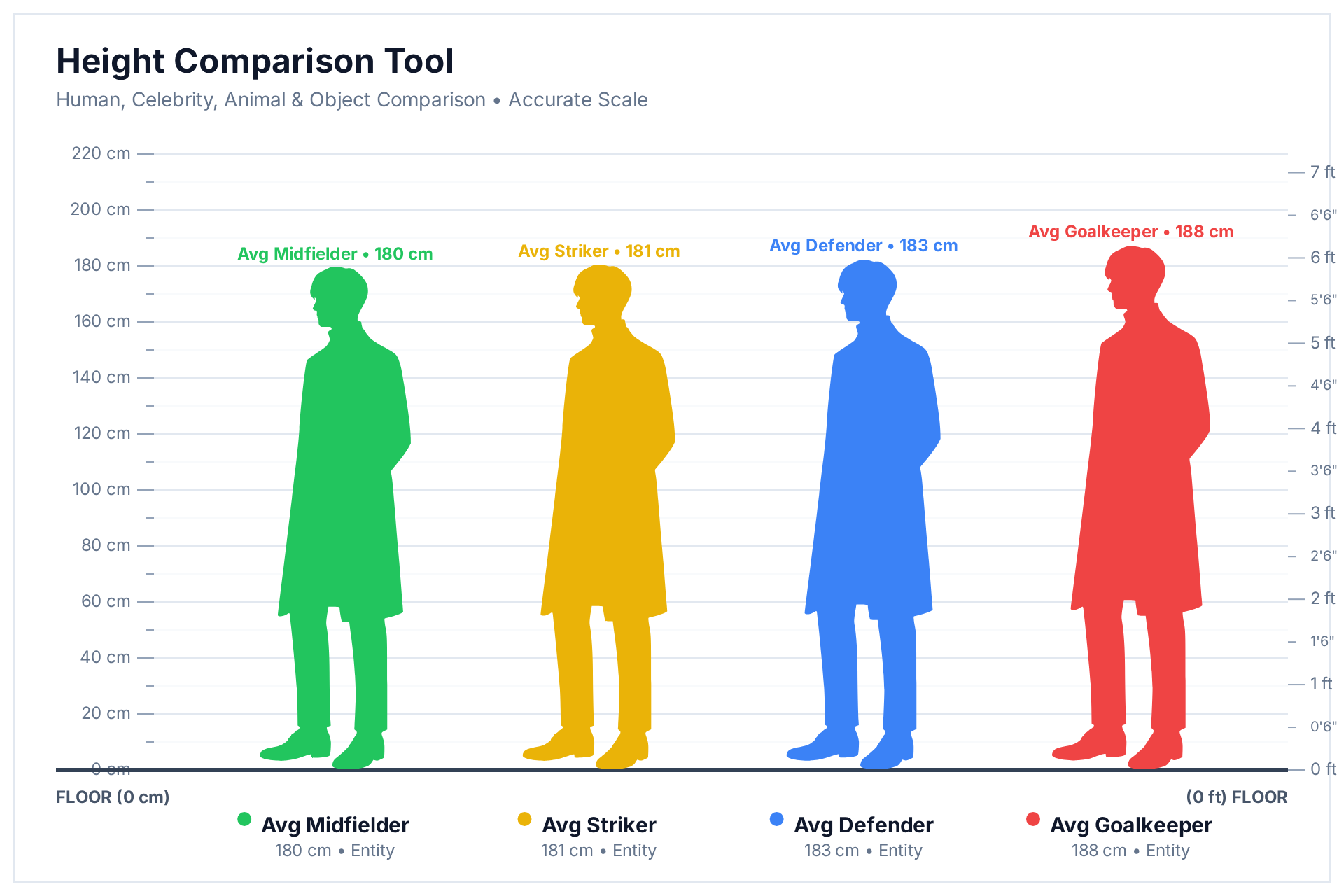
Position averages are derived statistics from tournament and league squads, not official FIFA measurements. Attackers vary most: 175–180 cm in World Cup research, 181 cm in WC 2018 data, 182 cm in a 2026 study, and up to 183 cm for Premier League strikers alone.
Why Height Sorts by Position
Reach, aerial ability and a low centre of gravity — each position buys a different physical advantage.
Goalkeepers are the tallest because their job is literally about covering space: a regulation goal is 7.32 m wide and 2.44 m high, and every extra centimetre of reach and leap shrinks the angles a shooter can exploit. Height also dominates in the six-yard box, where a keeper must rise above a crowd to claim crosses. World Cup research notes the effect plainly: goalkeepers average 189 cm "because they need exceptional reach to block shots" — the largest single-position premium in the sport.
Defenders are next because their core currency is winning the ball in the air. Centre-backs contest headers on goal kicks, clearances and set pieces dozens of times a match, and taller players also make better defensive walls at free kicks. The 2026 IJOK study confirmed the split statistically: goalkeepers and centre-backs differed significantly in height from midfielders and forwards, while full-backs sat closer to the midfield group.
Midfielders and forwards are the shortest groups because their game is played on the ground. Attacking players need "mobility with high acceleration", as the World Cup research puts it — and a lower centre of gravity is a genuine biomechanical edge for dribbling, sharp turns and bursting through gaps. Shorter players change direction faster, stay closer to the ball, and are harder to mark in tight spaces. That is why the two greatest attackers ever, Maradona (165 cm) and Messi (170 cm), were both shorter than the average midfielder.
Researchers describe height selection in football as an "anthropometric arms race": once some teams field tall players for headers and walls, rivals must match them to compete — which is why height premiums persist even in a skill-dominated sport.
The Extremes: 1.54 m to 2.08 m
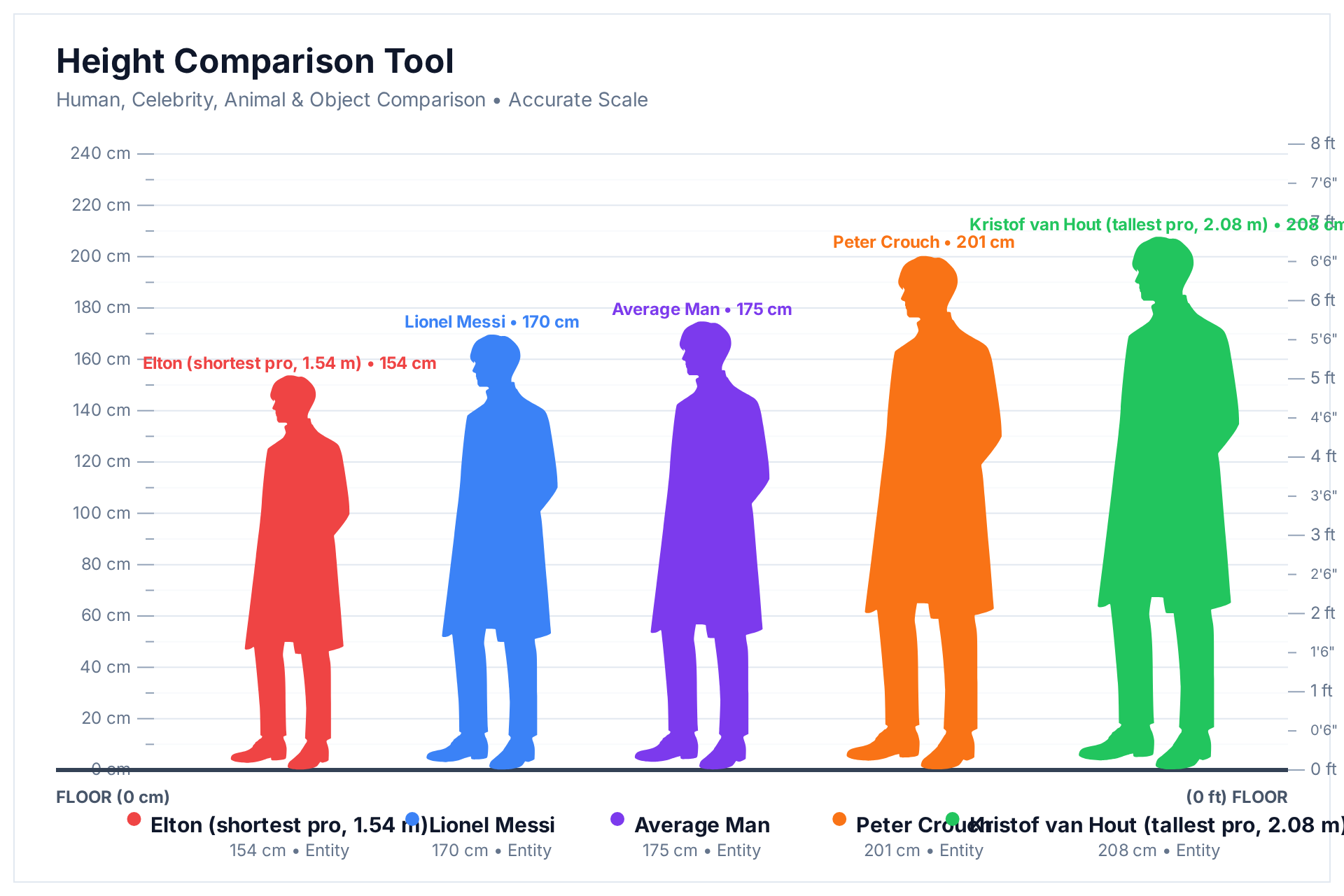
54 cm — nearly two feet — separates the tallest and shortest professionals in history.
At the top stands Kristof van Hout, the 6 ft 10 in (2.08 m) Belgian goalkeeper who played for Standard Liège, Genk and Delhi Dynamos. He is widely documented as the tallest professional footballer in the game's history, a distinction he shares only with Scottish striker Paul Millar, also 2.08 m. Van Hout's frame gave him such reach that he barely needed to jump for corners — though his career also shows that extreme height carries coordination and mobility costs most clubs are wary of.
The other end belongs to Élton José Xavier Gomes, the 5 ft 1 in (1.54 m) Brazilian attacking midfielder nicknamed "Élton Arábia" during his Middle East career. He debuted for Corinthians in 2004, scored on his debut for Steaua București in 2007, and was voted into the fans' team of the decade after a single season in Romania. The record is technically shared: Poland's Marcin Garuch and Qatar's Jafal Rashed Al-Kuwari are also listed at 1.54 m.
Put the two together and the spread is startling: van Hout is 54 cm — 35% — taller than Élton. The average man (175 cm) sits almost exactly halfway between them. Yet both had long professional careers at the position where their body was supposedly wrong: a keeper who could hardly be beaten in the air, and a playmaker nobody could catch.
Famous Players: Where the Stars Sit
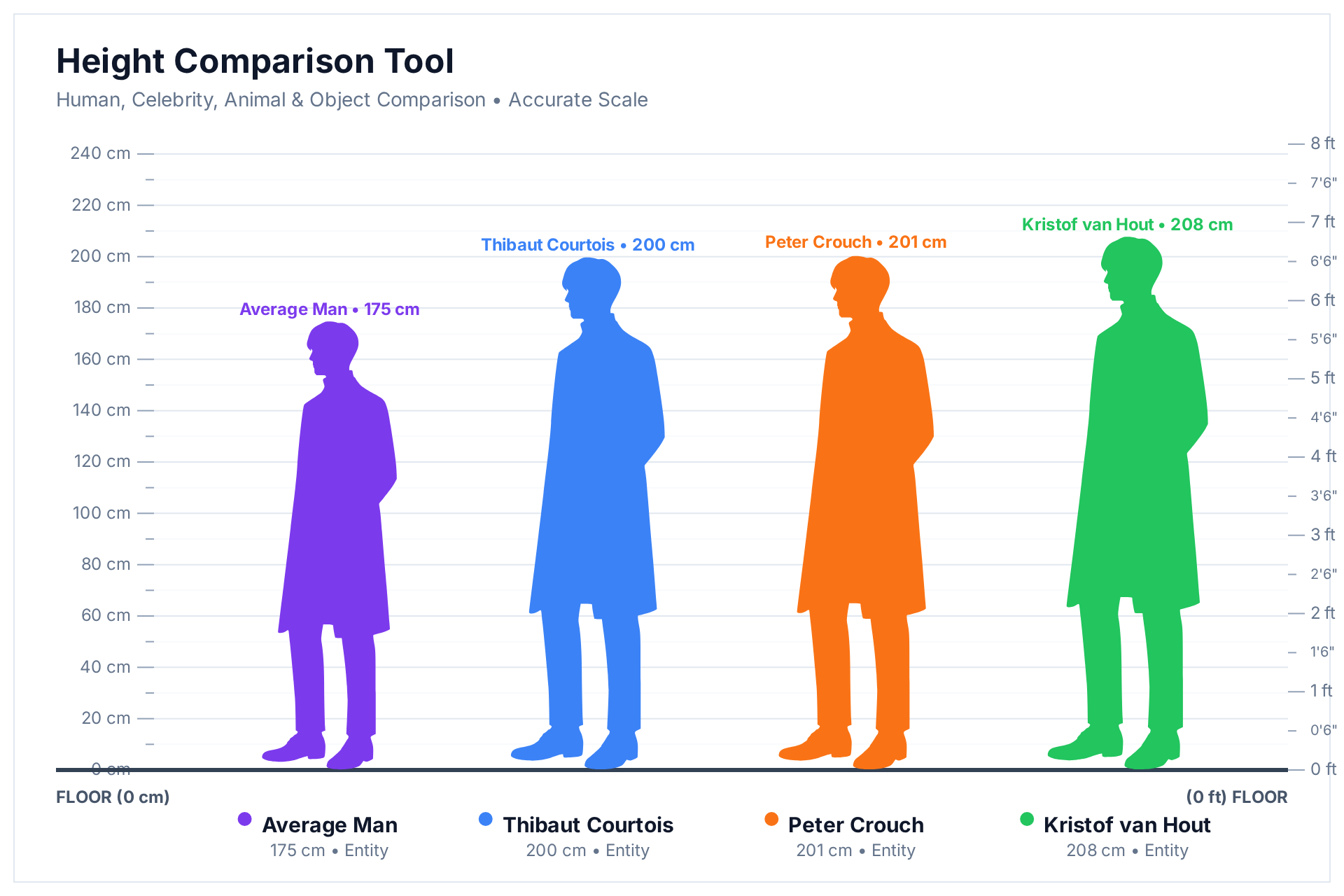
Messi thrived 11 cm below the striker average; Crouch and Courtois towered above it.
Lionel Messi, at 5 ft 7 in (170 cm), is the most decorated proof that height is optional in football. He sits 11 cm below the average striker and a full 5 cm below the average midfielder — yet his low centre of gravity became his signature weapon: defenders could not get a shoulder into him, and he could turn in spaces taller players could not even enter. Diego Maradona was shorter still at 165 cm.
At the opposite extreme of stardom, Peter Crouch (2.01 m, 6 ft 7 in) built a Premier League career on exactly what his height bought: an unmatched aerial threat — 53 headed goals, a league record — while Thibaut Courtois (2.00 m, 6 ft 7 in) used his wingspan to become one of the world's elite goalkeepers, a modern heir to the reach advantage that pushes the goalkeeper average so high.
The giants tier makes the scale visceral: Courtois and Crouch stand a full 25 cm above the average man, and van Hout clears them by another 7 cm. But the career lesson runs the other way: the all-time greats cluster at both ends, and the middle — the 181 cm average — is simply where most careers live.
How Tall Do You Actually Need to Be?
Below about 175 cm you need elite technique; above 190 cm you need to move like a smaller player.
If you are shorter than average, the data is encouraging. The shortest outfield group — midfielders at roughly 178–180 cm — still sits above the general population, but the game's history is full of players who broke the mould: Messi (170 cm), Maradona (165 cm), Élton (154 cm), and Lorenzo Insigne (163 cm), the shortest player at a major European club. What they shared was not height but elite close control, acceleration and game intelligence — the exact traits a low centre of gravity amplifies.
If you are tall, the premium is real but conditional. Goalkeepers and centre-backs convert height directly into saves and clearances, which is why those averages sit at 188 cm and 185 cm respectively. But tall attackers must pair stature with mobility — Crouch's longevity came from touch and timing as much as his head, and the modern game increasingly asks tall forwards to press and run channels like smaller players.
The honest answer from the numbers: around 175–185 cm you fit the game's physical template with the least friction. Outside that band, you need a compensating superpower — and football history suggests that superpower is usually skill, not size. Try it yourself: add your height to the visualiser above and see which position average you land closest to.
Height opens doors by position — 188 cm for keepers, 183 cm for defenders — but the widest door in football history was opened by a 170 cm forward. Skill decides; size only suggests.