The Headline Numbers: ~6 ft 7 in vs ~6 ft 1 in
Six inches — that is the whole story, and it repeats at every position.
Entering the 2024–25 season, the NBA league office roster survey put the average player at 78.54 inches — just under 6 ft 7 in (about 201 cm). Thirty-nine players stood 7 ft or taller and only twelve were 6 ft or shorter, out of roughly 560 rostered players. The figure sits squarely in the 6 ft 6 in to 6 ft 7 in band the league has occupied for four decades.
The WNBA average is most commonly reported at 6 ft 0 in to 6 ft 1 in (183–185 cm), with ESPN putting the league median at 6 ft 1 in for the 2024 season. That leaves a gap of roughly 6 inches between the two leagues — remarkably close to the ~5-inch average height difference between adult men and women in the general US population.
Here is the striking part: the NBA–WNBA gap is not a quirk of basketball — it is biology. Both leagues select for the tallest athletes available, so the same population-level difference that separates men from women shows up between the leagues at nearly identical magnitude.
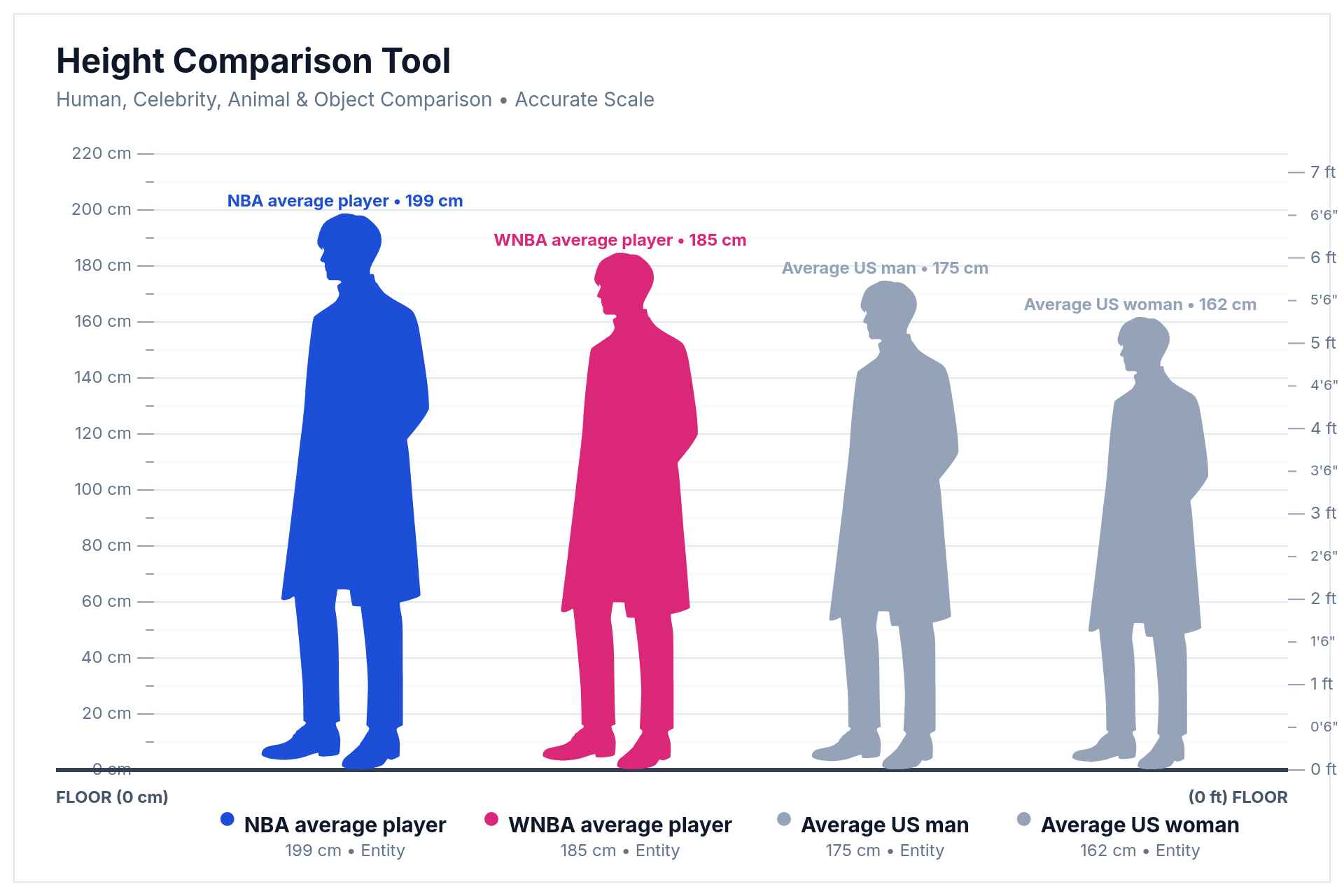
The average WNBA player (6 ft 1 in) would tower over 99% of women — and is taller than the average American man by a clear 4 inches.
NBA Height by Position: From 6 ft 3 in Point Guards to 7 ft Centres
Point guards have never been taller — but the rest of the league is slightly down from the 1980s peak.
Height in the NBA follows a clean ladder by position. Point guards, the traditional floor generals, average between 6 ft 1 in and 6 ft 4 in (185–193 cm) — and a 2024 study found the position at its tallest ever, 6 ft 2.4 in on average. Shooting guards run 6 ft 5 in to 6 ft 7 in, small forwards 6 ft 6 in to 6 ft 9 in, power forwards 6 ft 9 in to 6 ft 11 in, and centres sit at about 6 ft 11 in (211 cm).
There is an interesting wrinkle in the data. Before the 2019–20 season, the NBA required every team to certify exact barefoot heights — no more shoes-on measurements or rounded-up listings. Fifty-seven players were officially re-listed, most of them losing an inch or two overnight. So part of the "players are getting shorter" story is really "the ruler finally got honest."
Even so, the long-term trend is real: the league peaked at 6 ft 7.04 in in 1987, slid to 6 ft 6.33 in in 2021, and has ticked back up to about 6 ft 6.5 in–6 ft 7 in in the last two seasons as a new wave of true seven-footers — led by Victor Wembanyama — entered the league.
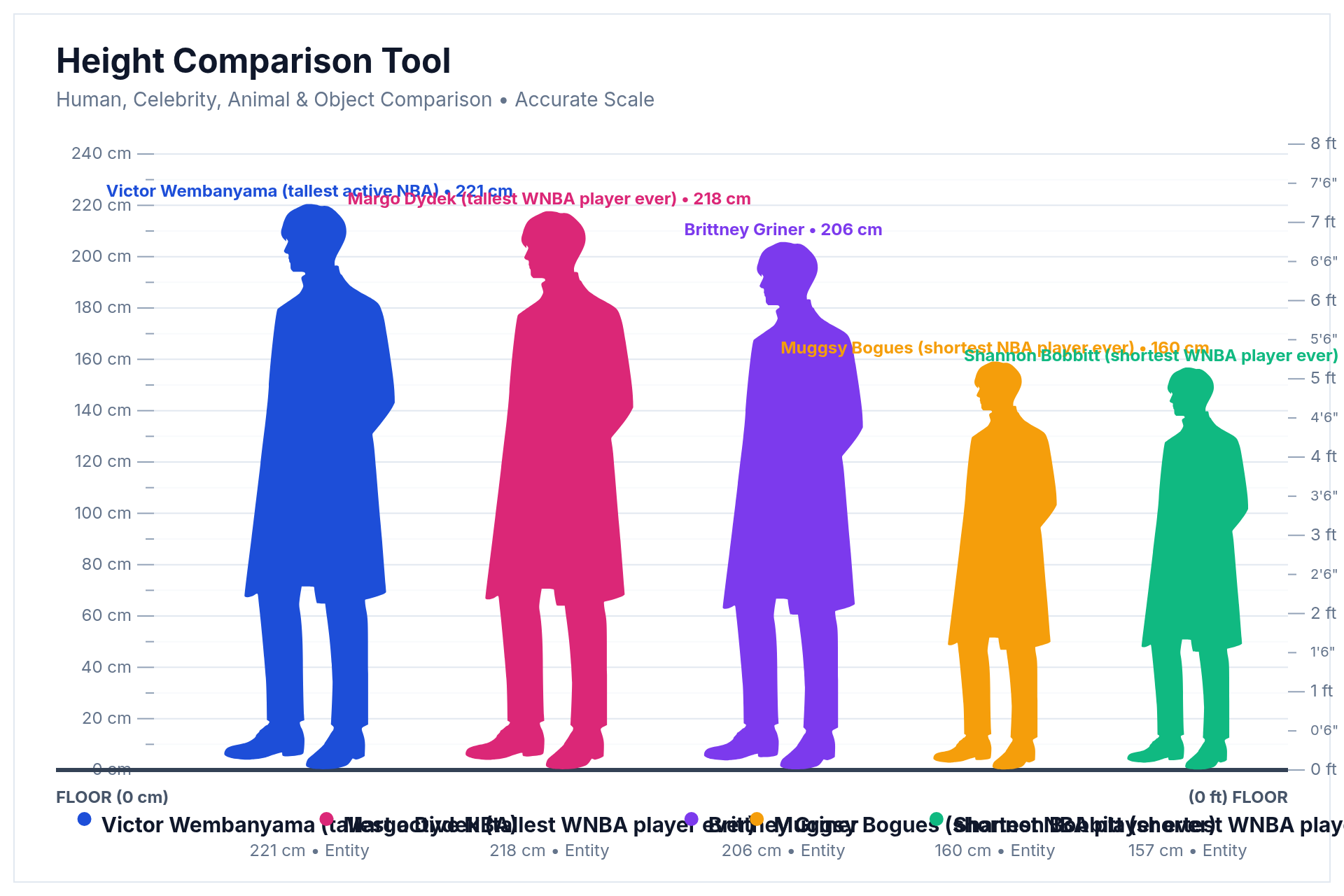
At 7 ft 3 in (221 cm), Victor Wembanyama is the tallest active star in the NBA — and a throwback: the league had been shrinking its centres for years before he arrived.
WNBA Height by Position: Guards at 5 ft 9 in, Centres at 6 ft 4 in
The league has grown half a foot per decade since 1997.
WNBA positions scale down from the centre spot just like the NBA, only shifted roughly six inches lower. Centres average around 6 ft 4 in to 6 ft 5 in (194–196 cm), forwards around 6 ft 2 in (188 cm), and guards around 5 ft 9 in (175 cm). The shortest guards — like 5 ft 7 in Crystal Dangerfield — survive on quickness, but even they would be tall by everyday standards.
The most famous WNBA guard right now, Caitlin Clark, is listed at 6 ft 0 in (183 cm) — a full three inches above the average guard. That edge shows up constantly in her game: she can see and pass over defenders, shoot with a higher release point, and she rebounds (over 5 per game as a rookie) like a much bigger player.
The league itself is growing taller. From an average of 5 ft 11 in in the 1997–2002 era, the WNBA has climbed to roughly 6 ft 1 in today — about 5 inches in three decades, driven by international talent pipelines and better youth development. The 2024 draft class pushed it further: more than a third of first-round picks stood 6 ft 5 in or taller.
The WNBA has added roughly 5 inches to its average player height since the inaugural 1997 season — from 5 ft 11 in to about 6 ft 1 in.
The Extremes: 7 ft 7 in Giants and 5 ft 2 in Guards
Two feet separate the tallest and shortest players in each league.
The NBA ceiling belongs jointly to Manute Bol and Gheorghe Muresan at 7 ft 7 in (231 cm) — among the tallest humans ever recorded. The tallest active NBA player is Victor Wembanyama at about 7 ft 3 in (221 cm), with fellow youngster Zach Edey right beside him. At the other end, 5 ft 3 in (160 cm) Muggsy Bogues played fourteen NBA seasons as a starting point guard, proving the league has room for outliers at both ends.
The WNBA ceiling is Margo Dydek: the Polish centre drafted first overall in 1998 stood 7 ft 2 in (218 cm), won eight straight blocks titles, and remains the only true seven-footer in league history. Today's tallest is Brittney Griner at 6 ft 9 in (206 cm), who made dunking a regular WNBA occurrence. The shortest WNBA players ever — Shannon Bobbitt and Tina Nicholson at 5 ft 2 in (157 cm) — show the same lesson as Bogues: elite skill and quickness can outweigh a two-foot height deficit.
Note how the extremes mirror each other: tallest NBA player (7 ft 7 in) vs tallest WNBA player (7 ft 2 in) — five inches apart; shortest NBA (5 ft 3 in) vs shortest WNBA (5 ft 2 in) — one inch apart. The male–female height difference is visible even at the outer edges of the bell curve.
Why the Gap Exists — and Why It Matters Less Than You Think
Height opens the door; skill keeps you in the room.
The gap is almost entirely explained by the underlying population difference: American men average about 5 ft 9 in, American women about 5 ft 4 in. Both leagues draft from the extreme right tail of their respective distributions — the average NBA player is roughly ten inches taller than the average man, and the average WNBA player nearly nine inches taller than the average woman. Selection pressure is doing the same job in both leagues.
What height buys is real but bounded. Taller players shoot over defenders, grab more rebounds, and block more shots — which is why centres are the tallest players in both leagues. But height is a starting advantage, not a guarantee: the 2024 study showing shrinking centres coincided with the three-point era, where shooting and defensive versatility matter more than an extra inch at the rim.
So the honest comparison is not "NBA taller than WNBA" — it is that both leagues are populated by athletes who would be extraordinary outliers anywhere else. A 6 ft 1 in WNBA guard and a 6 ft 7 in NBA forward are equally remarkable: each stands about as far above their population average as the other.
Relative to their own populations, NBA and WNBA players are equally extreme. The six-inch league gap is the same gap you would find comparing any random group of tall men to any random group of tall women.