The Headline Answer: About 1 in 330 US Men
What the measured data says about one of the most searched heights on the internet.
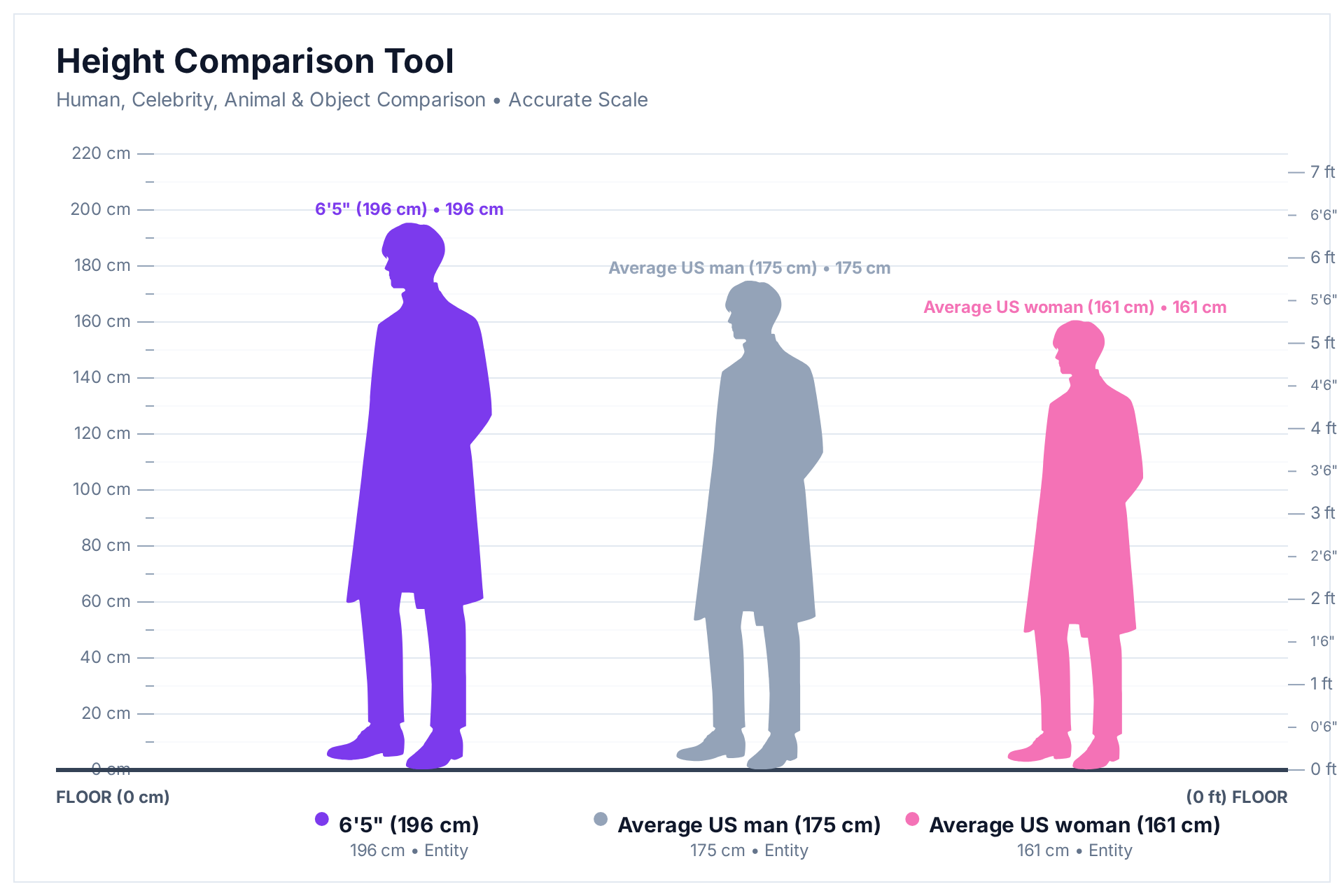
Six feet five inches is 77 inches, and 77 × 2.54 gives 195.58 cm — conventionally rounded to 196 cm. The most authoritative source for American heights is the CDC’s National Health and Nutrition Examination Survey (NHANES), which physically measures a nationally representative sample with a stadiometer instead of asking people how tall they think they are. Its latest anthropometric reference data (August 2021–August 2023) puts the average US adult man at 68.9 inches — 175.3 cm. Against that measured distribution, independent percentile derivations converge on one headline number: 6'5" sits at about the 99.7th percentile.
Translate that into plain odds: 100 minus 99.7 leaves 0.3% of US adult men at or above six-five. That is roughly one man in 330 — picture a full NFL stadium of 60,000 men and only about 180 of them would clear the bar. Apply 0.3% to the roughly 126 million adult men in the United States and you get on the order of 380,000 men nationwide. A large-sounding absolute number, but a thin crowd spread across an entire country: the average American will go weeks or months without passing a genuinely six-five stranger on the street.
One methodological note, because it matters for a number this extreme: 99.7% is a third-party derivation computed from CDC/NHANES measured distributions, not a figure printed verbatim in a CDC press release. Different calculators differ by a point or two depending on which survey wave they use, but every serious derivation lands in the same neighbourhood — the high 99s, the low tenths of a percent. The convergence across independent calculators is the finding, and the 2021–2023 wave is the freshest measured baseline available.
About 0.3% of US adult men are 6'5" or taller (CDC/NHANES-derived). If you remember one number from this article, remember 1 in 330.
The Rarity Ladder: Why Every Inch Past 6'2" Costs You Dearly
The normal distribution does its cruelest work at the far right of the bell curve.
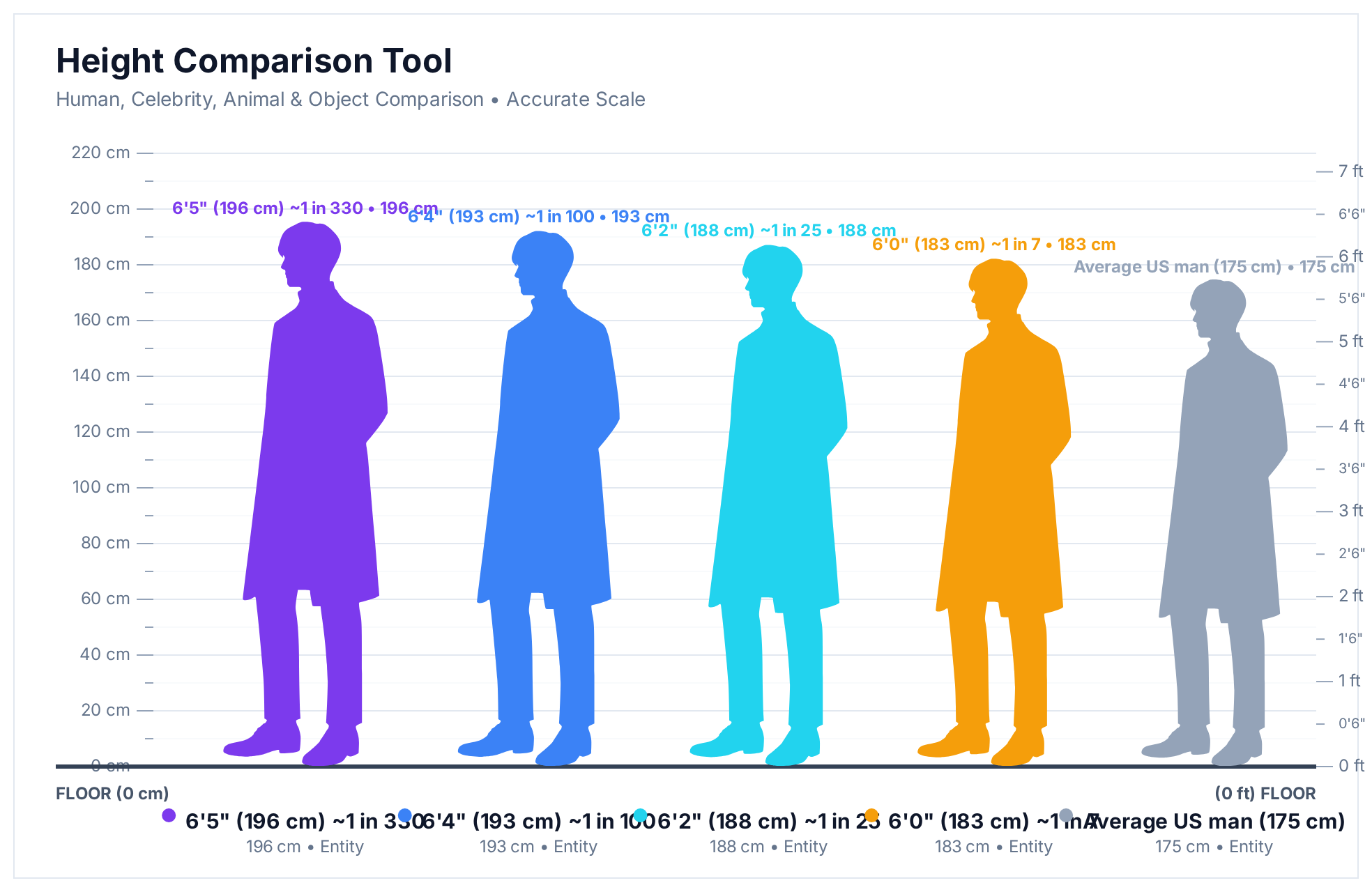
Percentages get abstract fast, so climb the ladder one rung at a time. At 6'0" (183 cm) you sit near the 85th percentile — about 1 in 7, the height this article’s sibling guide found sits just at the edge of “above average enough to notice.” One inch up, 6'1" lands near the 92nd percentile (roughly 1 in 12). At 6'2" (188 cm), about the 96th percentile — 1 in 25. Then the curve falls off a cliff: 6'3" is the 98th percentile (1 in 53), 6'4" the 99th (about 1 in 125), and 6'5" the 99.7th (about 1 in 330).
Do the arithmetic on those rungs and the story writes itself. A six-five man is roughly 48 times rarer than a six-foot man (14.7% versus 0.3%), and about three times rarer than a six-four man (0.8% versus 0.3%). Out on the tail of a bell curve, a single inch more than triples the rarity. This is why the difference between “tall” and “freakishly tall” feels so much bigger than 2.54 cm: each inch past six-two halves — then thirds — whatever pool of men remains.
There is a practical way to feel the ladder instead of reading it. Stand next to a six-foot friend and you will notice the difference but share a crowd comfortably. Stand next to a six-five friend and you are looking at the top of their head from a height difference roughly equal to the width of a hardback book stood upright — except socially, that gap moves you from “one of several tall guys in the office” to “the tall guy in the office.”
For Women — and Around the World
Six-five does not mean the same thing in every population. In some, it barely exists at all.
For women, 6'5" is essentially off the measurable charts. CDC NHANES data puts the average US adult woman at 63.5 inches (161.3 cm) with the 95th percentile at 67.9 inches — and 77 inches sits roughly five standard deviations above that mean. Statistical models put the share of US women at 6'5" or taller well under 0.001%, plausibly on the order of one in millions. That is a model extrapolation at the far tail of the bell curve, not a counted census figure — treat it as “vanishingly rare” rather than a precise headcount — but the qualitative answer is unambiguous: a six-five woman is an extraordinary statistical outlier in any population on Earth.
What about the Netherlands, the country that tops every global height ranking? Dutch men average around 183–184 cm, so 196 cm is only about 1.7 standard deviations above their mean — which still leaves six-five in roughly the top 4–5% of Dutch men, a derived estimate. Even in the land of giants, a six-five man stands out in a crowd; he is merely “very tall” rather than “the tall guy in the room.”
And then there is the other end of the spectrum. In India, where adult men average around 165 cm, a 196 cm man sits more than four standard deviations above the mean — a back-of-the-envelope normal-distribution calculation puts that at roughly one in a hundred thousand, far rarer than in the United States. The same 196 cm of bone and tissue is “top 0.3%” in America, “top few percent” in Amsterdam, and “almost unheard of” in Mumbai. Rarity is always relative to the room you are standing in.
Why 6'5" Feels More Common Than the Maths Says
If only one man in 330 is six-five, why does it feel like you meet one every week?
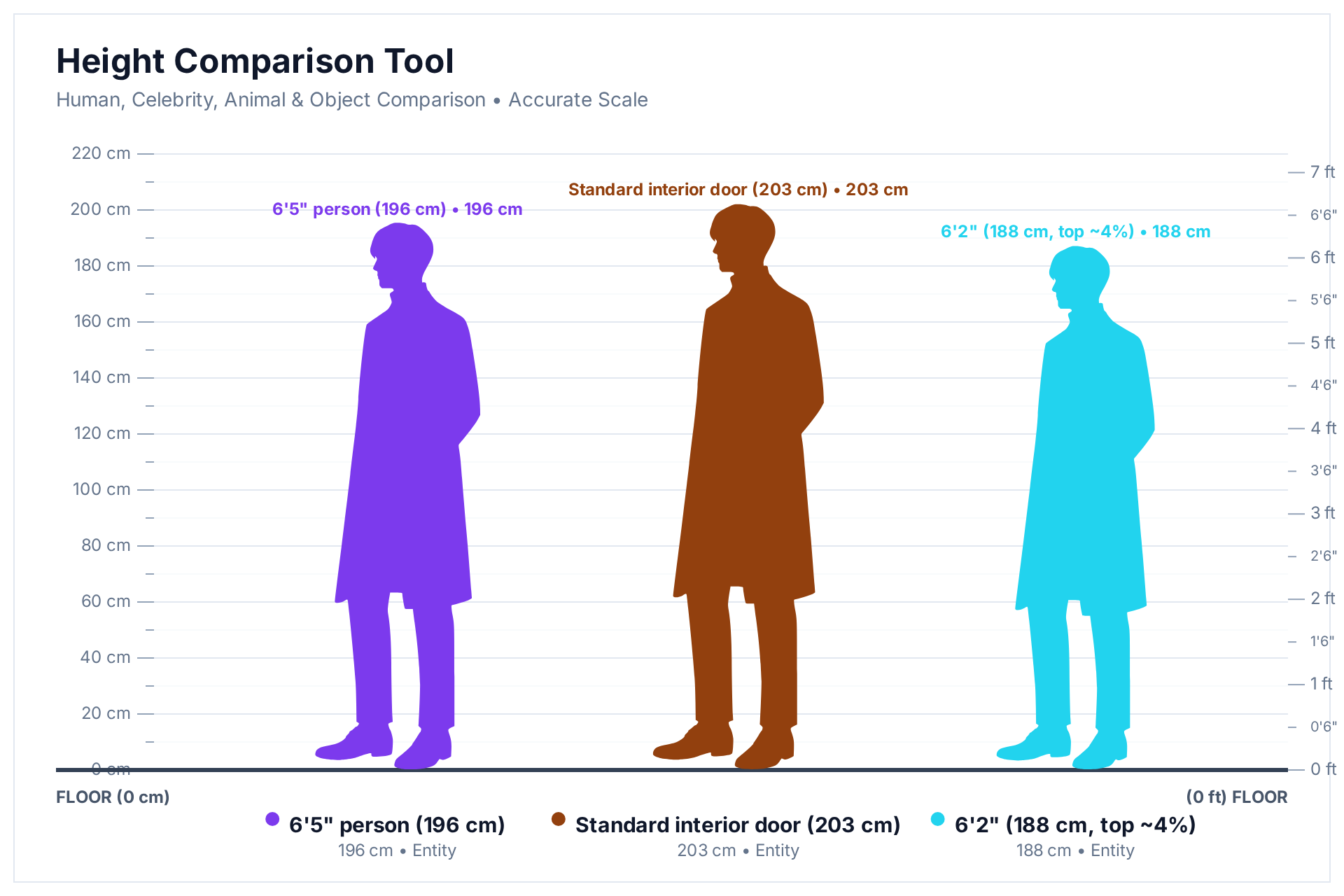
Start with the measuring tape’s oldest enemy: self-reporting. A CDC-published analysis of NHANES 2001–2006 data compared what people claimed against what the stadiometer measured, and found men overstate their height by about 1.22 cm on average — with the exaggeration growing with age. Add shoes (another 2–3 cm), the classic round-up, and the magnetic pull of a round number, and a large share of claimed six-fivers measure 6'4"-and-a-bit barefoot in the morning. A “6'5"” on a dating profile is very often a measured 6'4" — still rare (about 1 in 125), but nearly three times more common than the real thing.
Then there is where your eyes spend their time. Professional athletes are massively overrepresented in media: the average NBA player stands about 6'6" (198 cm), so a six-five man is essentially NBA-sized — just 2 cm under the league average. Television, film, and sports put you in rooms full of statistical outliers, and your brain quietly files those faces under “people.” Add availability bias — you notice the one very tall person in the room the way you notice a red car in traffic — and six-five starts feeling like a height you run into, when mathematically you almost never do.
Finally, there is the social gravity of tallness itself. Tall men are overrepresented in leadership photography, on stages, and in the front rows of wedding photos — height correlates with visibility, not just stature. None of this changes the measured 0.3%. It just means your personal sample of humanity is a badly drawn one, and six-five is the first height where the gap between the sample and the population becomes impossible to ignore.
Claimed heights are usually in shoes, in the evening, rounded up — and men overstate by ~1.2 cm on average. A claimed 6'5" often measures a genuinely-rare-but-thrice-as-common 6'4".
What Life Is Actually Like at 6'5"
The helpful part: doorframes, legroom, and the question you will answer ten thousand times.
The most immediate daily encounter is architecture. The standard US interior door stands 80 inches — 203 cm — tall, which leaves a six-five person just about 7 cm of clearance. No ducking required in most modern homes, but older houses, basement stairwells, attic conversions, and low-hanging signs in car parks become a reflex-check you perform without thinking. Shower heads mounted at the standard height spray the top of your chest. Kitchen counters built for the average cook sit a full 10–15 cm below your comfortable working height, and your lower back will file a complaint.
Transport is the second negotiation. Economy airline seats are designed around the 50th-percentile passenger, so at 196 cm your knees draft a formal protest against the seat in front on any flight longer than an hour — exit rows and bulkheads stop being luxuries and become strategy. Cars are survivable but fiddly: driver’s seats slide back far enough in most saloons, but the rear seat behind you becomes decorative, and low-slung sports cars turn entry and exit into a choreographed manoeuvre. Clothes come from the tall ranges or the tailor; standard large shirts become midriff-baring crop tops, and 34-inch inseams are a starting bid, not a finish line.
And then there is the social tax, paid in small talk. “Do you play basketball?” — asked with total sincerity by strangers, roughly forever, at a height only 2 cm below the average NBA professional. (For the record, the average NBA player is about 6'6" / 198 cm, a figure that has held steady for decades — so yes, you are NBA-sized; no, that does not mean you can dunk.) The honest trade-off of six-five is that the world’s default ergonomics stop fitting you, while the world’s curiosity about you never switches off.
Who’s Actually 6'5"? Verified Faces at the Mark
The most famous six-five man on the planet — and a caution about listed heights.
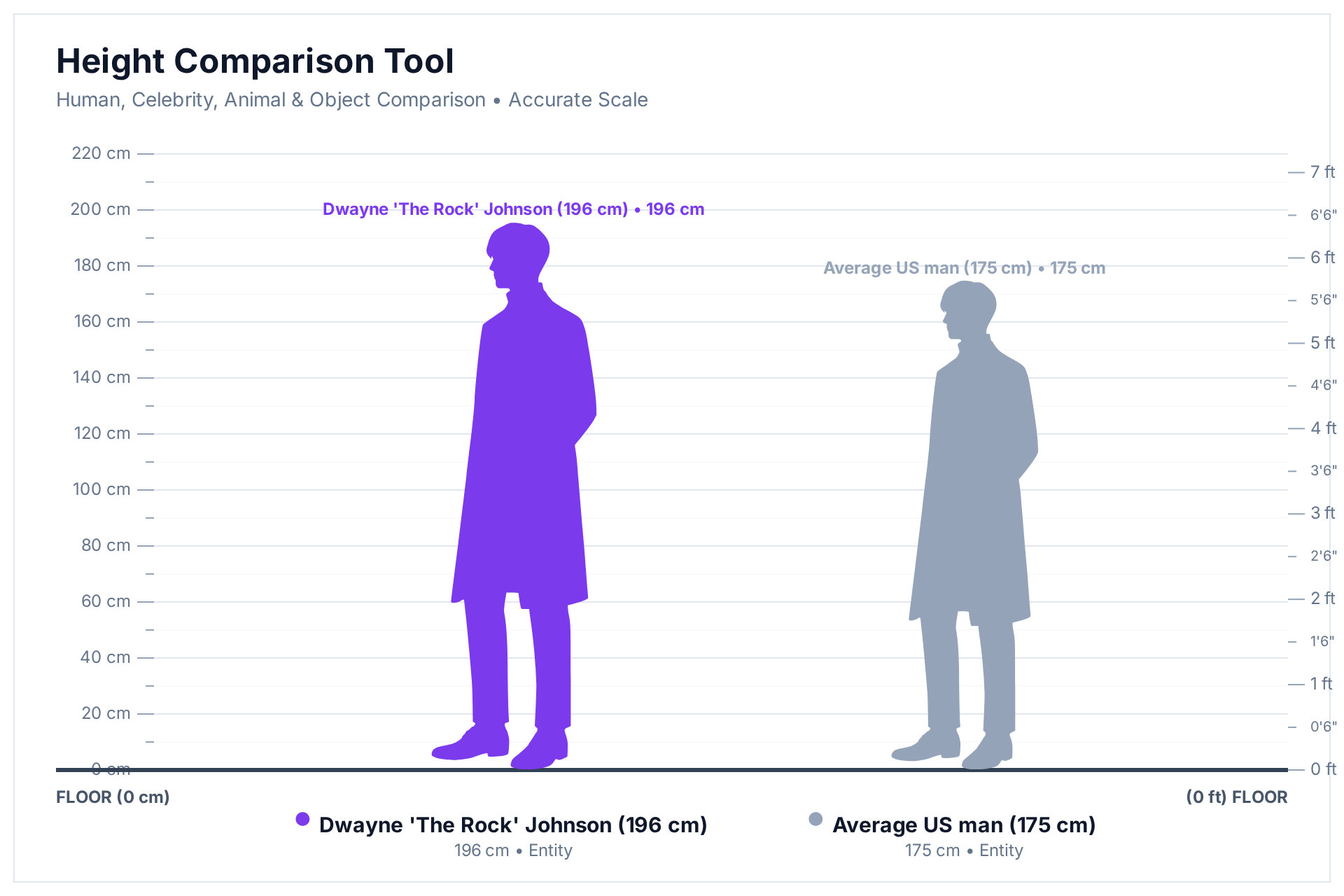
The textbook example is Dwayne “The Rock” Johnson, listed at 6'5" (196 cm) across WWE athlete records and his university football measurements — the same figure verified in HowHeight’s own celebrity dataset. He is the reason so many people can picture six-five instantly: broad-shouldered, filling a doorframe, standing a head above talk-show hosts. When people say “he’s The Rock’s height,” they mean exactly this article’s subject.
One caution before you start collecting names: celebrity heights are the least reliable numbers in the height world. Agents round up, co-stars round each other down, and footwear does quiet heavy lifting on red carpets — the same self-report inflation the CDC measured in ordinary men, amplified by an industry built on image. Treat any listed celebrity height as “listed at” rather than measured, unless it comes from a combine, a draft measurement, or an official record. (Presidential heights, for instance, have been openly disputed for decades.)
That said, six-five is the height where “verified tall” stops being trivia and starts being a job description: heavyweight boxers, NFL tight ends, and power forwards cluster here, because at 196 cm you are big enough for the role without tipping into the coordination costs of seven feet. It is the tallest height that still reads as “very tall person” rather than “statistical marvel” — the last rung before the ladder leaves everyday life behind entirely.