The Headline Numbers: Average Height, Age 13 to 18
A decade of growth compressed into six years — and almost all of it arrives early.
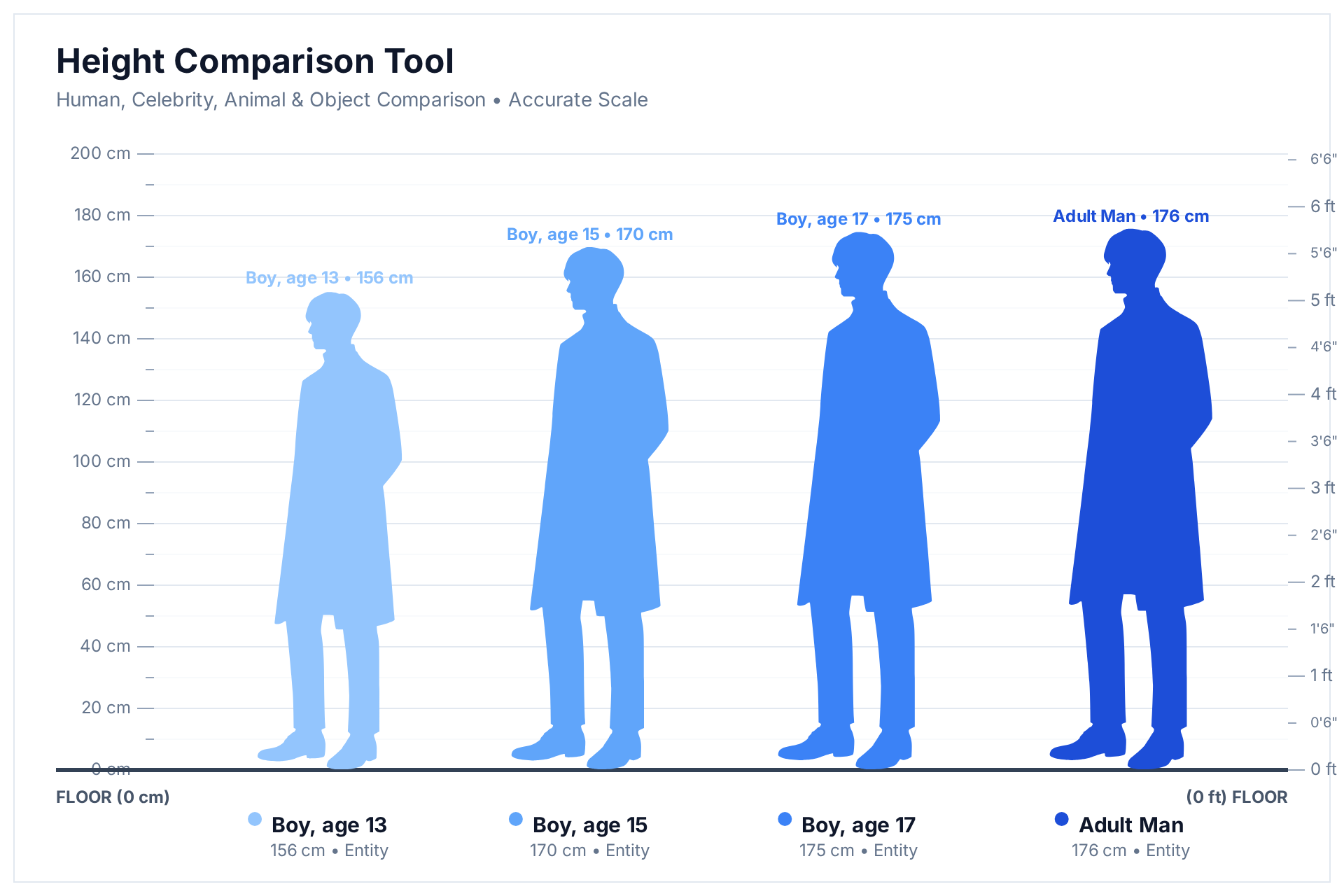
The numbers themselves are refreshingly uncomplicated. According to the CDC growth charts — the percentile tables paediatricians use in the United States — the average (50th-percentile) boy stands 156.2 cm (5’ 1″) at 13, 163.8 cm (5’ 4.5″) at 14, 170.1 cm (5’ 7″) at 15, 173.4 cm (5’ 8″) at 16, 175.2 cm (5’ 9″) at 17 and 176.1 cm (5’ 9.5″) at 18. Put simply, the average boy gains about 20 cm — nearly 8 inches — between his 13th and 18th birthdays, and most of that arrives before he turns 16.
Notice how front-loaded the curve is. Between 13 and 15 the average boy grows roughly 14 cm, at the fastest clip of his entire life. Between 15 and 17 he adds only about 5 cm. Between 17 and 18, barely 1 cm. This is the great illusion of the teenage years: the dramatic growth everyone remembers happens in a short, intense window around 13–15, and the rest is a long, slow glide to the finish line. If you are 15 and feel like growth has stalled, you are probably not imagining it — the fastest part is most likely behind you.
One important caveat before we go further: these are US figures, built from the CDC’s growth-chart reference population. Average teen heights differ around the world — South Asia, for instance, averages noticeably lower — so if you are reading from outside the United States, treat these as a reference curve rather than a personal benchmark. For the global picture, see our guide to average height by country. And when you read the chart below, remember that “average” means exactly half of boys are shorter at each age: being at or below the line is not a verdict on anything.
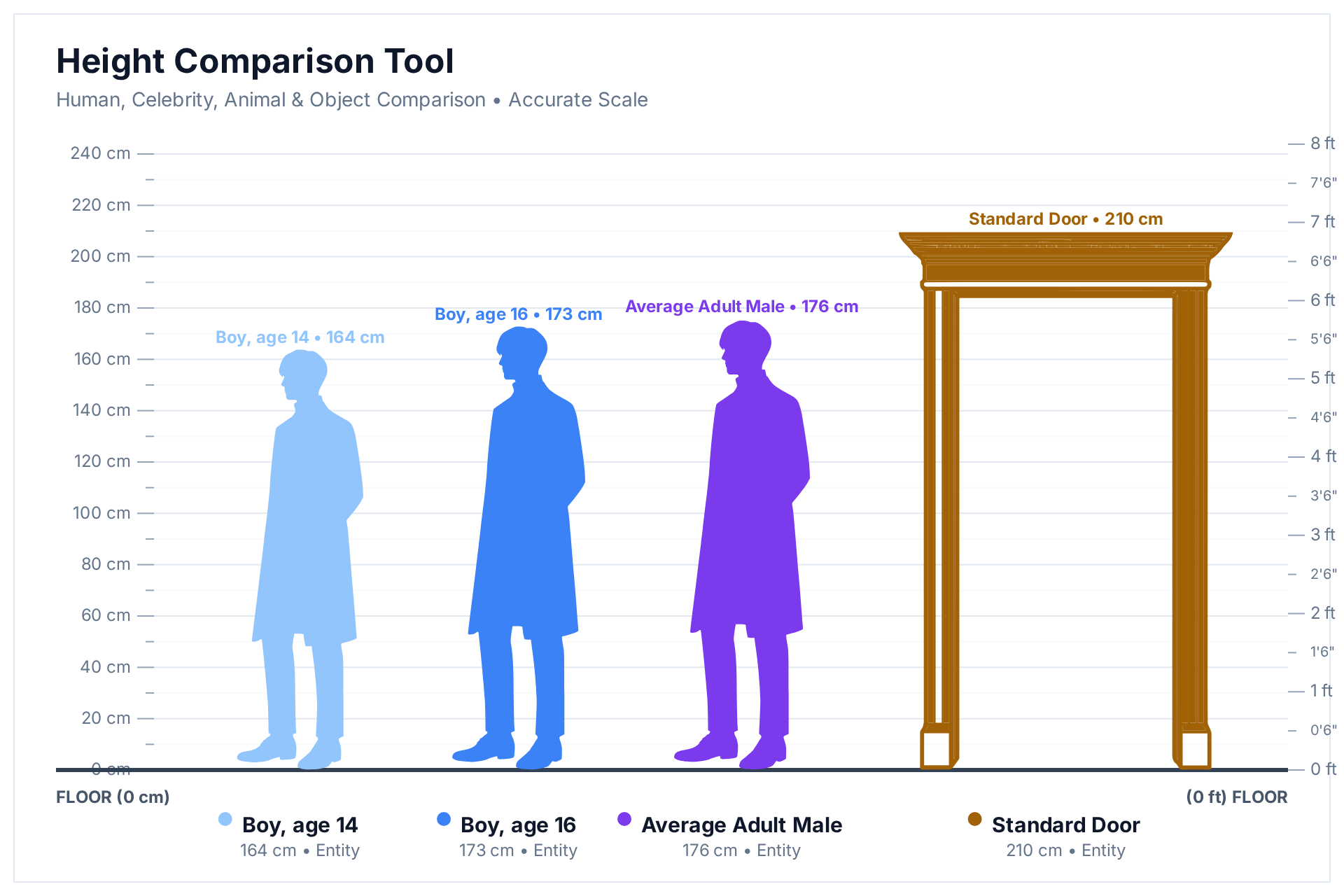
13 → 156.2 cm (5’ 1″) · 14 → 163.8 cm (5’ 4.5″) · 15 → 170.1 cm (5’ 7″) · 16 → 173.4 cm (5’ 8″) · 17 → 175.2 cm (5’ 9″) · 18 → 176.1 cm (5’ 9.5″). CDC 50th-percentile values.
The Growth Spurt: Fastest Around Age 13–14
Peak height velocity is a single, identifiable moment — and boys hit it hard.
Somewhere in the middle of puberty, every boy’s growth rate hits a single fastest point that researchers call peak height velocity, or PHV. In boys it lands around 13.5 years on average — roughly two years later than in girls — and it is intense: boys commonly gain 9 to 12 cm (about 3.5 to 4.7 inches) in the year of peak growth. The typical puberty growth window runs from about 12 to 16, with the biggest changes concentrated at 13 to 15.
Growth does not arrive evenly, either. During peak velocity, the limbs — arms and legs — tend to lengthen first, with the spine and torso catching up later. That is why teenage boys so often look noticeably “leggy” for a stretch, with gangly limbs and a torso that seems a season behind. Shoulder width and muscle mass typically keep building for a year or two after the height spurt itself slows, which is why a boy can look “done growing” in height but keep filling out physically well into his later teens.
Timing, though, is everything, and it varies enormously. Boys whose puberty starts early — before about 10.2 years — tend to grow fast and stop sooner; boys who start late (after about 11.8) grow later but for longer. This is why early developers often tower over their classmates at 13 and then get overtaken at 16: the “late bloomer”, clinically described as constitutional delay of growth and puberty, almost always catches up to his genetic potential in the end. The height of the kid at the front of the class photo at 13 is a very poor predictor of who stands at the back at 18.
Around 13–14, boys often grow fastest when nobody is measuring: new shoes every few months, trousers that are too short within a term, and a standing height that visibly changes between school photos.
What Counts as Normal: The Wide Middle
At 14, the “normal” range is nearly a foot wide — and that is the point.
The most useful column in the table above is not the average but the range. At 14, the 5th–95th percentile band — the heights considered medically normal — stretches from 4’ 11″ to 5’ 10″. Read that again: a perfectly normal 14-year-old can be anywhere from just under five feet to nearly six feet. Two healthy 14-year-old boys standing side by side can differ by almost 30 cm, and neither of them is unusual. At 13 the band is 4’ 8″ to 5’ 7″; by 18 it has narrowed, proportionally, as the late bloomers finish catching up.
This is why a single measurement against the average is nearly useless for teenagers. Paediatricians do not care much whether a 14-year-old is at the 50th or the 25th percentile — they care whether he stays roughly on his own curve over time. A boy who tracks the 20th percentile steadily from 10 to 16 is following a perfectly healthy path; a boy who drops from the 75th to the 25th between annual check-ups is the one who prompts a closer look. The trend is the diagnosis; the number is just a data point.
So when is it worth raising with a doctor? The consistent, low-stress triggers are: falling off your own growth curve, no signs of puberty at all by 14, or growth that seems to have stopped years before your peers’ did. Not “I’m shorter than my best friend.” Friends diverge wildly in timing — that is the normal state of affairs between 12 and 16 — and comparing yourself to the early developer in your class is a guaranteed way to feel abnormal about something completely ordinary.
Track your percentile curve over time, not your height against the average on any single day. A steady curve anywhere inside the 5th–95th band is healthy growth.
When Do Boys Stop Growing?
Most are nearly done by 16–18 — but the finish line has a long tail.
For most boys, meaningful height growth winds down between 16 and 18. The mechanism is unglamorous: the growth plates — thin bands of cartilage near the ends of the long bones where lengthening happens — gradually fuse under the influence of rising sex hormones, locking in final height. This typically completes in Tanner Stage 5, the final stage of puberty. There are telltale signs the end is near: hands and feet are usually the first body parts to stop (a shoe size that has not budged in a year is a classic marker), and facial hair development accelerating toward daily shaving often correlates with the plates closing.
But “most” leaves a long tail. Boys with constitutional delay of growth — the late bloomers — can keep adding height until 19 or 20, and occasionally into the early twenties, because their growth plates stay open longer. Their final heights typically land right on their genetic potential; they just arrive on a delayed schedule. Puberty itself starts anywhere from 9 to 14, so a boy whose spurt starts at 14 finishing his growth at 19 is simply the same process shifted a few years later — not a problem.
The practical upshot: at 16, the average boy is within a few centimetres of his adult height; at 18, he is essentially there. A useful way to think about the whole journey is that a 13-year-old boy has roughly 20 cm of height still to gain — about the length of an adult forearm — and about three-quarters of it will arrive before he turns 16. The years after that are mostly fine-tuning: millimetres, posture, and the muscle mass that makes the final height look the way adults expect it to.
By age 16, most boys have stopped growing in any meaningful sense, though muscle and shoulder width keep developing. If growth has clearly continued past 19–20 for a late bloomer, that is still within the normal range.
Boys vs Girls at the Same Age
At 13, the girls are often taller. It does not stay that way.
One of the great quiet surprises of the teenage height curve is that at 13, girls are on average slightly taller than boys — about 157 cm to the boys’ 156.2 cm. Girls reach their own average adult height of roughly 162 cm by 14 or 15, and they get there earlier: female peak height velocity lands around 11.5 years, roughly two years before the boys’. In a typical Year 8 or Year 9 classroom, the tallest students are disproportionately girls, and that is entirely expected.
The boys then overtake — and it is no contest. Because male peak velocity comes about two years later, grows slightly faster (9–12 cm a year against 7–9 for girls), and benefits from a longer runway before the growth plates fuse at 16–18, the average adult man ends up several inches taller than the average adult woman. The crossover happens around 14 to 15: by 15, the average boy (170.1 cm) is well past the average girl, and the gap only widens from there.
So if you are a 13-year-old boy being teased — or teasing yourself — about the girls towering over you, know that you are standing at the precise moment in human development where that is most normal. The biology has a schedule, and at 13 the boys simply have not had their turn yet. A year or two later, the chart tells a very different story.
Girls average ~157 cm at 13 vs boys’ 156.2 cm; by 15 the average boy is 170.1 cm, already past the average girl’s adult height of ~162 cm.
How to Measure and Track Growth Properly
One careful measurement beats ten casual ones.
Most height anxiety is measurement noise. People are tallest in the morning (up to a centimetre taller than in the evening, thanks to spinal compression through the day), and self-measurements with shoes on, hair included, or a tape held at an angle can easily wander by 2 or 3 cm. Do it properly: barefoot, heels, buttocks, shoulder blades and the back of the head against a wall, looking straight ahead, with a flat object — a book works — lowered onto the crown of the head. Mark, measure the mark, and write it down with the date.
Then stop measuring daily. During puberty, measuring every six months is plenty; between measurements, growth is invisible and watching it will only feed the anxiety. Plot each result on a standard CDC percentile chart — there are free calculators and printables — and watch the curve, not the number. As long as the points stay roughly on the same percentile line, growth is proceeding normally, whatever the absolute figure says.
Finally, the unsexy truth about maximising your height: genetics sets the ceiling, and everything else just helps you reach it. Adequate sleep matters more than most teens expect — the bulk of daily growth hormone is released during deep, slow-wave sleep. So do protein, calcium and vitamin D in the diet, regular exercise, and avoiding the things that can genuinely stunt growth, like smoking or chronic undernutrition. No stretch, supplement or “height exercise” programme can add centimetres the growth plates will not give — but a well-slept, well-fed teenager will reach every centimetre his genes allow.
Book a check-up if growth has fallen off its curve, puberty shows no signs by 14, or you are worried for any other reason. A bone-age X-ray can estimate remaining growth potential in minutes — forums cannot.