The Full Crew, Ranked: From Jinbe (301 cm) to Chopper (90 cm)
211 cm separate the tallest and shortest Straw Hats — more than the height of an average man.
Ranked by their current, post-timeskip canon heights, the Straw Hat crew runs: Jinbe (301 cm), Brook (277 cm), Franky (240 cm), Nico Robin (188 cm), Roronoa Zoro (181 cm), Sanji (180 cm), Usopp (176 cm), Monkey D. Luffy (174 cm), Nami (170 cm) and Tony Tony Chopper (90 cm). The gap between the extremes — 211 cm — is itself taller than most humans who have ever lived.
The crew falls naturally into three tiers. At the top, three genuine giants all stand above 240 cm: a whale-shark fish-man, a living skeleton and a self-rebuilt cyborg. In the middle, the five human core fighters plus Robin cluster in a very ordinary 170–188 cm band — heights you would pass on any street without a second glance. And alone at the bottom, at exactly 90 cm, sits the crew’s doctor.
These are not fan estimates. Every figure comes from Eiichiro Oda himself: the heights were first published in the manga’s SBS reader-question corners (Volumes 10, 37 and 69) and then re-confirmed in the Vivre Card databooks, most recently the 2024 Egghead set. When this article says Luffy is 174 cm, that is the number Oda’s own databook prints.
The Monster Trio: Luffy, Zoro and Sanji vs the Average Man
The three strongest fighters are all within a few centimetres of average human height.
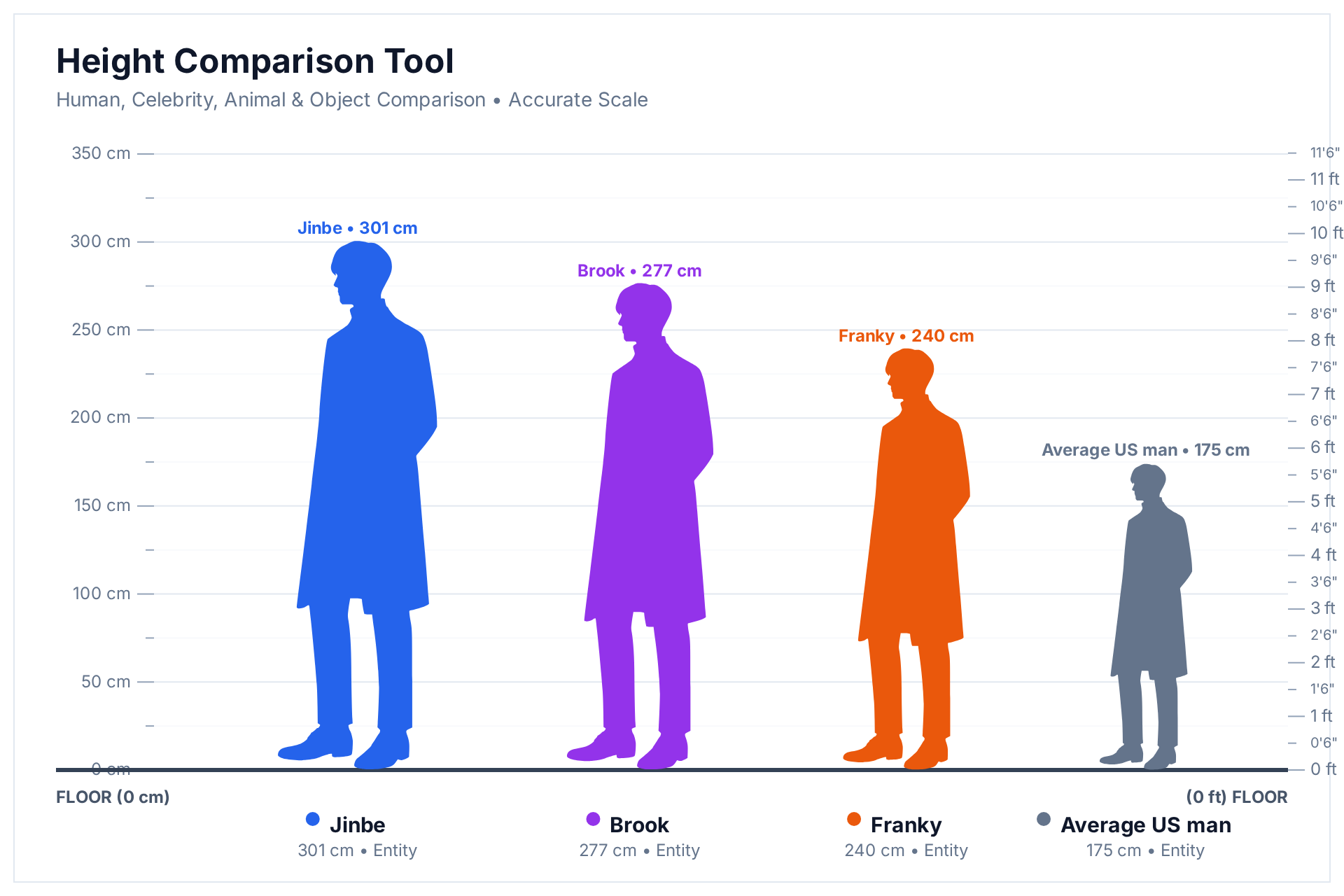
The crew’s famous Monster Trio — Luffy, Zoro and Sanji — are the fighters the story leans on when everything is on the line. Their heights, though, are almost aggressively normal: Zoro at 181 cm (5 ft 11 in), Sanji at 180 cm (5 ft 11 in) and Luffy at 174 cm (5 ft 8.5 in). The average US man stands 175 cm, which means the trio’s captain is a centimetre shorter than average, and his two wings sit just above it.
Settle one of the fandom’s longest-running debates while you are here: Zoro is taller than Sanji — by exactly one centimetre. It is the kind of margin that vanishes in boots, posture and art style, which is why the argument has survived for years, but the databooks are unambiguous: 181 vs 180.
There is a storytelling reason the trio are human-scaled. Oda keeps his protagonists at relatable heights so that the true monsters of the New World — Kaido, Big Mom, the Admirals’ towering frames — feel enormous by contrast. Luffy does not need to be tall to dominate a panel; his presence is drawn from posture, grin and Haki, not centimetres. Against his home-country average (Japanese men average about 172 cm), Luffy reads as solidly average — the everyman at the centre of an increasingly inhuman world.
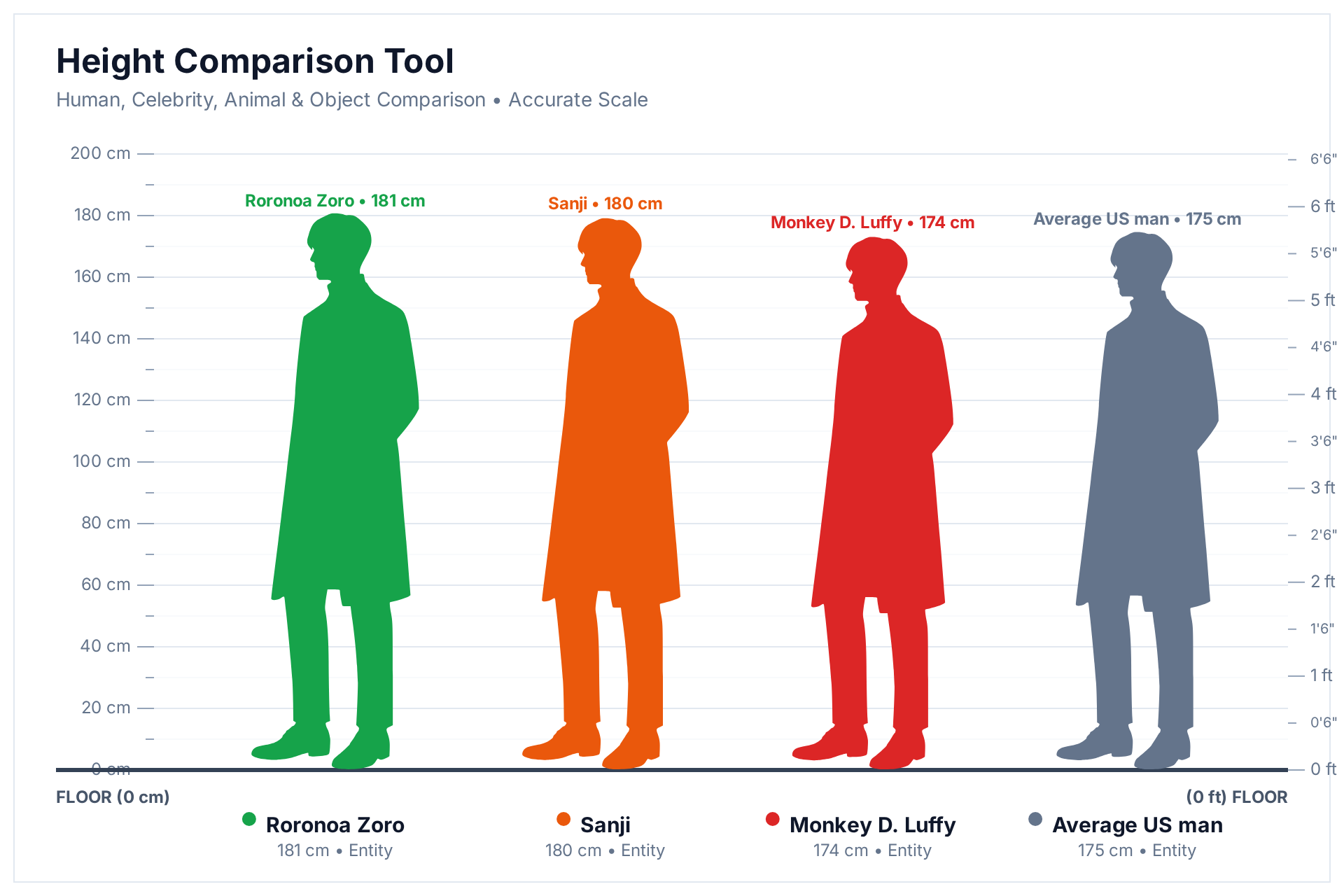
Zoro: 181 cm. Sanji: 180 cm. One centimetre — the databooks have spoken, and the debate can finally rest.
Chopper: 90 cm of Doctor, Reindeer and Comedy
The crew’s doctor is the size of a toddler — and has never grown a centimetre.
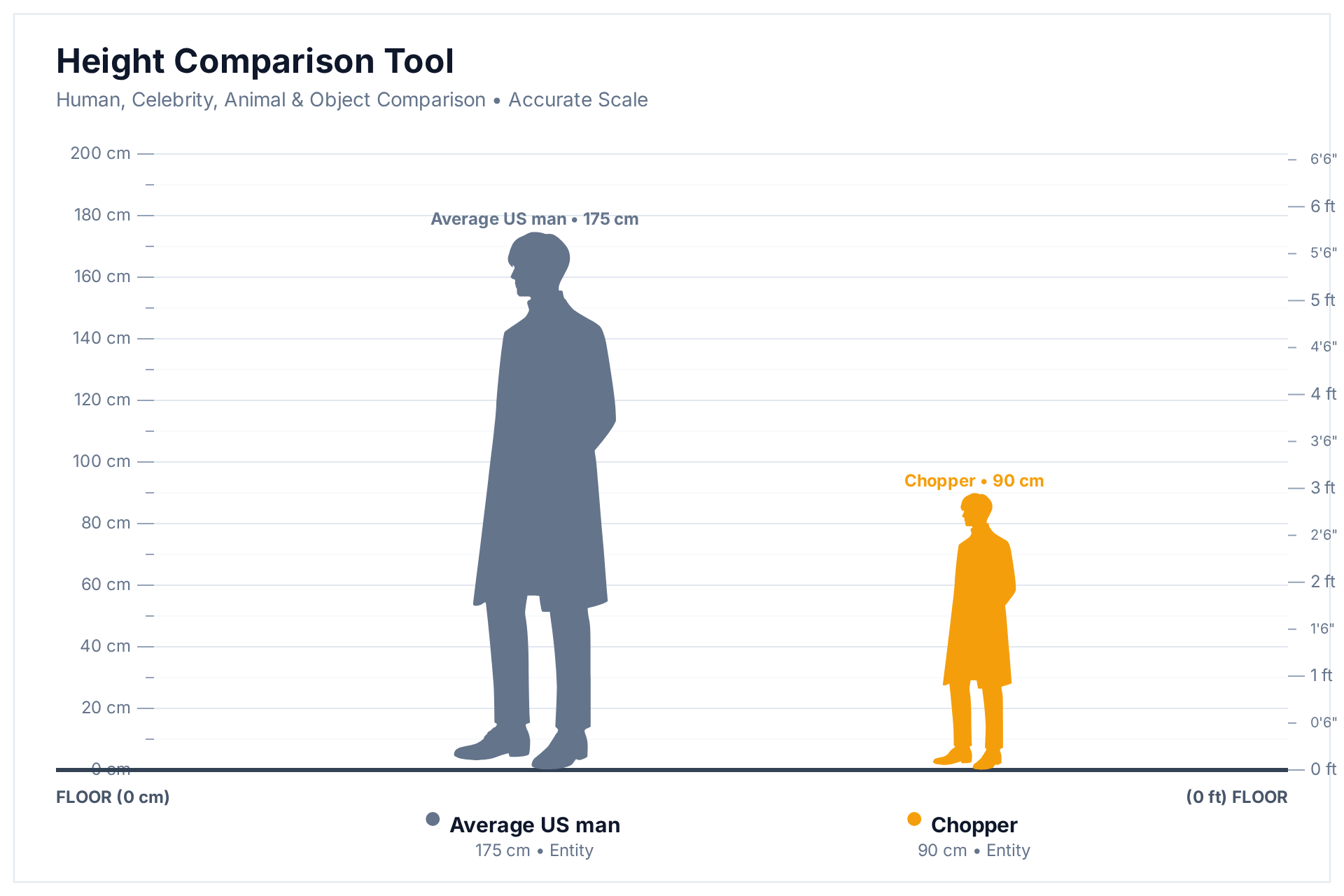
Tony Tony Chopper’s official height is 90 cm (2 ft 11 in), and it is the same figure in both the pre-timeskip and post-timeskip databooks. For reference, that is roughly the height of an average two-year-old child. He is the only Straw Hat whose listed height did not move at all across the two-year separation.
The comedy of the crew’s group shots lives in this number. Put the 301 cm Jinbe and the 90 cm Chopper in the same frame and you get a 211 cm joke that never gets old — Oda stages it deliberately, with Chopper frequently perched on shoulders, heads and railings just to stay in the panel. Against an average US man (175 cm), Chopper barely reaches mid-thigh.
One caveat for anyone measuring screenshots: 90 cm is Chopper’s default Brain Point form — the small reindeer-human hybrid the databooks use as his official height. His Rumble Ball transformations (Jumping Point, Guard Point, Horn Point, Monster Point) change his apparent size dramatically, so a Monster Point screenshot will not match the databook. The 90 cm figure is the canonical baseline, not a frame-by-frame measurement.
The Giants: Jinbe, Brook and Franky
Three crew members stand above 240 cm — each for a completely different reason.
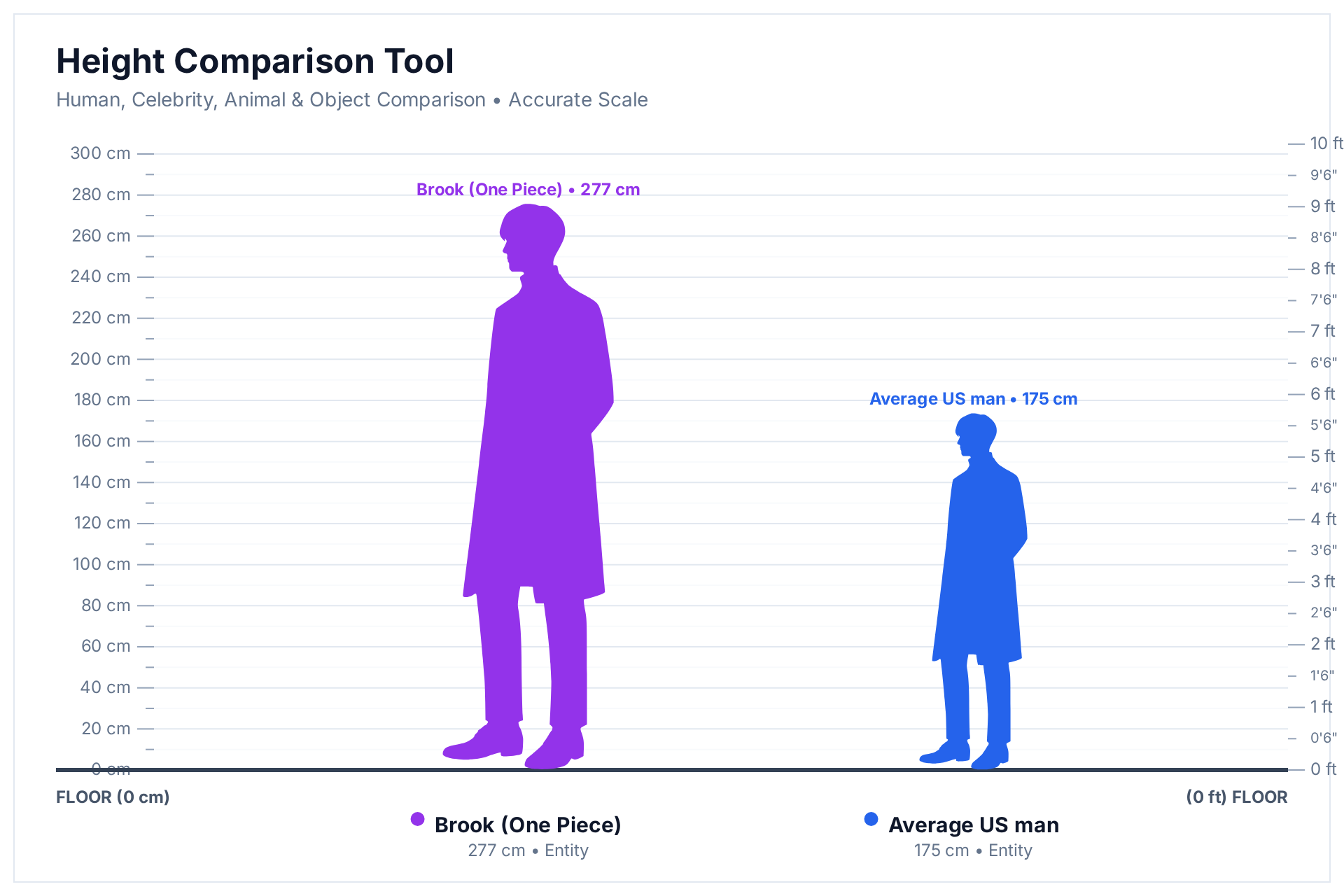
Jinbe, at 301 cm (9 ft 10 in), is the tallest Straw Hat by a wide margin — 24 cm clear of Brook. As a whale-shark fish-man he was always going to be enormous; his is a single published figure, since he formally joined the crew after the timeskip and has no pre-timeskip databook entry. To put 301 cm in perspective: it is taller than Robert Wadlow, the tallest person in recorded history at 272 cm. Jinbe exceeds the outer limit of documented human height by nearly 30 cm.
Brook’s 277 cm (9 ft 1 in) comes with the best footnote in the databooks: he grew from 266 cm to 277 cm across the timeskip — an 11 cm growth spurt — despite being a skeleton. This is genuine canon, printed in the Vivre Cards, and Oda has never offered an explanation. The fandom has collectively decided the explanation is that Brook is Brook, and honestly that is enough.
Franky’s growth is the only one with an in-story engineering report. He went from 225 cm to 240 cm — a 15 cm jump, the largest on the crew — because he spent the timeskip rebuilding himself, upgrading from the BF-36 body to the BF-37. It was not a growth spurt; it was a renovation. That also makes Franky the only Straw Hat whose height is, in principle, adjustable.
Jinbe at 301 cm stands nearly 30 cm above Robert Wadlow (272 cm), the tallest person in recorded history. Brook at 277 cm clears him too.
Who Grew During the Timeskip?
Seven Straw Hats came back taller; three came back exactly the same.
The two-year separation at Sabaody was a growth spurt for most of the crew. Franky added 15 cm (by rebuilding himself), Brook added 11 cm (by being Brook), Zoro and Sanji each added 3 cm (178 → 181 and 177 → 180), Luffy and Usopp each added 2 cm (172 → 174 and 174 → 176), and Nami added 1 cm (169 → 170). Chopper, Robin and Jinbe did not move at all.
The natural growth makes sense: most of the crew were teenagers when they were scattered by Bartholomew Kuma, and two years of late-adolescent development accounts neatly for the 1–3 cm gains. The outliers needed in-story mechanisms — Franky’s self-modification and Brook’s unexplained skeleton physics — which is exactly what Oda gave them.
Here is the practical warning, because this is where the internet goes wrong more than anywhere else in One Piece data: a huge number of third-party databases silently list pre-timeskip figures as current. If a site tells you Luffy is 172 cm or Zoro is 178 cm, you are looking at the old numbers — the current canon is 174 and 181. Whenever you see a Straw Hat height quoted, check whether the source distinguishes pre- and post-timeskip. If it does not, treat the figure with suspicion.
Luffy at 172 cm or Zoro at 178 cm means the source is showing pre-timeskip figures. Current canon: Luffy 174 cm, Zoro 181 cm, Sanji 180 cm.
The Straw Hats vs Real Humans: Where Would You Stand?
Five of the ten would be unremarkable in a crowd; five would stop traffic.
Line the human-scale Straw Hats up against real-world averages and the picture is surprisingly mundane. Nami (170 cm), Luffy (174 cm), Usopp (176 cm), Sanji (180 cm) and Zoro (181 cm) sit within a few centimetres of the average US man (175 cm) and the average Dutch man (183 cm, the tallest national average on earth). Against the Japanese male average (172 cm — Luffy’s home-country baseline), every one of them reads as average or slightly tall.
Robin is the exception that proves the rule. At 188 cm (6 ft 2 in), she stands a full 25 cm above the average US woman (163 cm) — a height that would turn heads anywhere on the planet. She is also, quietly, the fourth-tallest Straw Hat overall, which surprises readers who picture her as merely elegant rather than statuesque.
And then there are the three who break the scale entirely. Brook at 277 cm would tower 94 cm — more than three feet — over the average Dutch man. Franky at 240 cm and Jinbe at 301 cm simply have no real-world analogue; there is no crowd on earth where they would not be the tallest person in it by an absurd margin. That contrast — five ordinary humans, one statuesque archaeologist, one toddler-sized doctor and three giants — is the whole visual joke of the Thousand Sunny’s crew photo, and the numbers finally let you measure it.