The Headline Number: 6 ft 2 in of Mean Muscle
Every NFL player is, on average, five inches taller than the average American man.
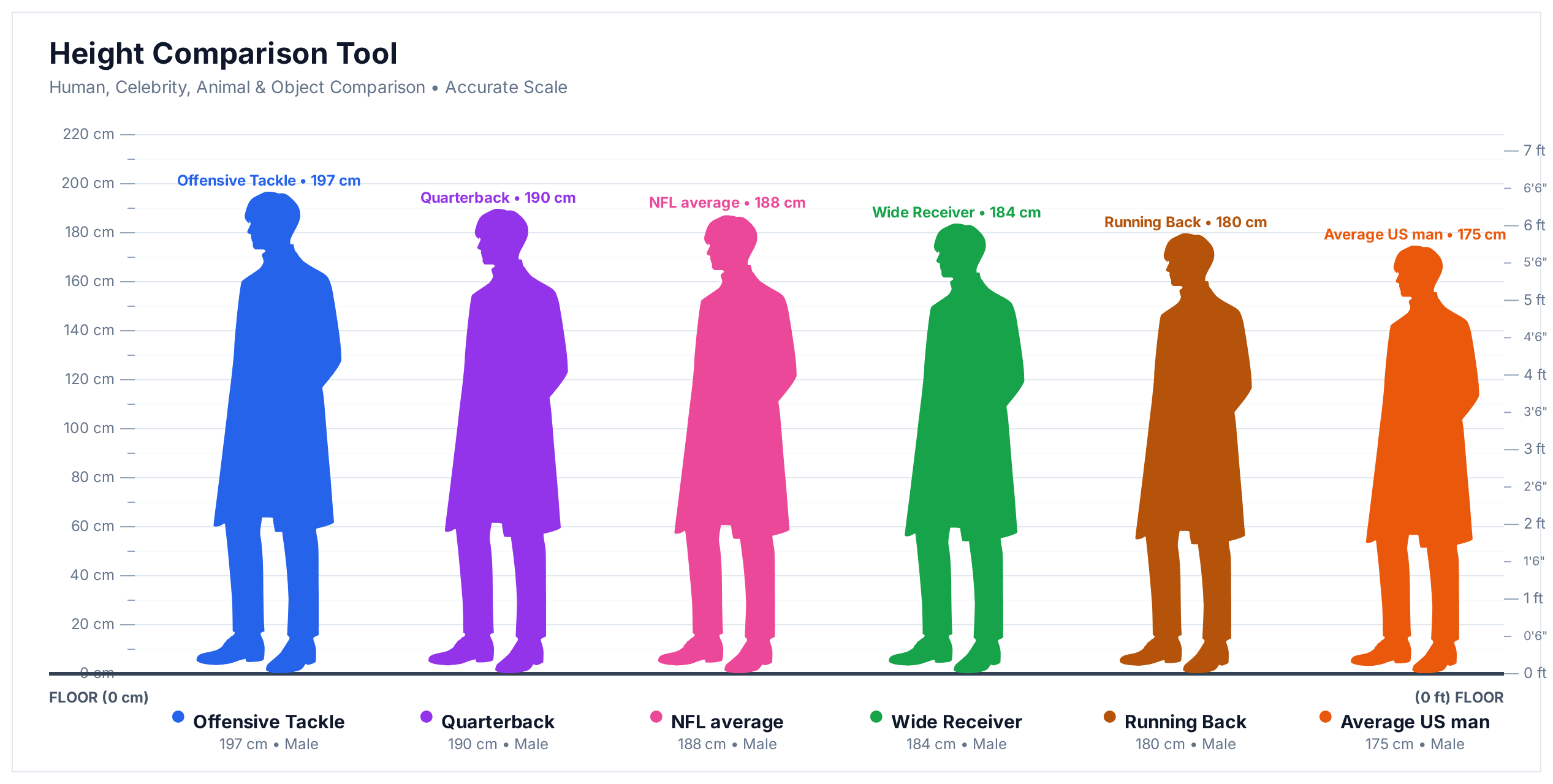
Across the full league, the average NFL player measures about 74.2 inches — 6 ft 2¼ in, or roughly 188 cm. An independent sampling study of league rosters landed in almost exactly the same place at 74.14 inches. Against the average American man of about 5 ft 9 in (175.3 cm per the CDC’s NHANES survey), the typical footballer stands a full five inches taller.
But that single number hides a 7-inch spread between positions, and that spread is where the interesting story lives. Football is the rare sport where the roster reads like a bell curve of human anatomy: the men protecting the quarterback are giants, the men catching the ball are lean mid-sized athletes, and the men running with the ball are the shortest of all — yet somehow also some of the most destructive.
The chart below lines up the position averages from a 2023 roster study against the average American man. It is worth pausing on the left and right edges: the average offensive tackle towers more than eight inches over the average man on the street, while the average running back barely clears him at all.
Why the Trenches Are So Tall: Offensive Tackles at 6 ft 6 in
At offensive tackle, height is literally arm’s length — it keeps the quarterback alive.
Offensive tackles average about 6 ft 5¾ in (197 cm), making them the tallest group on the field, and it is no accident. A tackle’s job is to keep 280-pound edge rushers away from the quarterback, and reach is everything: longer arms mean the rusher is engaged earlier and the pocket stays clean. Every extra inch of height is extra inches of wingspan.
That is why the position’s height records are absurd. The tallest players in NFL history are overwhelmingly tackles: Dan Skipper at 6 ft 10 in, Caleb Jones at 6 ft 9 in, and a long list of 6 ft 8 in bookends such as Orlando Brown Jr., Jordan Mailata, Kolton Miller and Trent Brown. Tight ends come second at 6 ft 4½ in (194 cm) for a related reason — they need to box out defenders and catch balls thrown over linebackers.
Defensive ends sit at nearly the same height as tight ends (about 6 ft 4¼ in) because they are the mirror image: length lets them bat down passes at the line and wrap up ball carriers. Notice how the whole trenches cluster — tackles, ends, guards, centres, defensive tackles — packs into a narrow band between 6 ft 3 in and 6 ft 6 in. Once you are fighting hand-to-hand in a phone booth, size is destiny.
The Skill Positions: Why Running Backs Are the Shortest at 5 ft 11 in
Short is not small — the average back is under six feet and over 210 pounds.
Running backs average just 5 ft 10¾ in (about 180 cm), the lowest of any position group. This is not a flaw; it is physics. A lower centre of gravity makes a back harder to tackle cleanly, quicker through gaps, and better at absorbing contact. Barry Sanders (5 ft 8 in), Emmitt Smith (5 ft 9 in) and modern stars like Christian McCaffrey (5 ft 11 in) all sit at or below the position average — and at around 210–220 pounds, they are among the densest athletes in the sport.
Cornerbacks and safeties, at almost exactly 6 ft even (183 cm), are built for the opposite problem: they have to mirror wide receivers — who average 6 ft 0½ in (184 cm) — in open space. That matchup is why the receiver and defensive-back numbers track each other so closely: defences draft height to cancel height.
And then there are the specialists. Kickers and punters sit near the bottom of the table (around 6 ft 0 in), because the job is leg mechanics, not contact. But as the next section shows, the active league’s shortest player hides in exactly that group.
Quarterbacks: The 6 ft 2½ in Average — and the Exceptions That Break It
Scouts prototype the position at 6 ft 3 in to 6 ft 5 in, but the league’s best includes 5 ft 10 in outliers.
The average NFL quarterback measures about 6 ft 2½ in (190 cm). That average is pulled upward by the prototype: big, durable passers who can see over 6 ft 6 in linemen from the pocket. The tallest starting quarterbacks, Justin Herbert and Trevor Lawrence, both stand 6 ft 6 in, with Josh Allen and Daniel Jones close behind at 6 ft 5 in.
But the position’s most interesting data points are at the bottom. Bryce Young and Kyler Murray, at 5 ft 10 in, are the shortest starting quarterbacks in today’s league — and both were taken first overall in their drafts. History backs the outlier case too: Drew Brees (6 ft 0 in) won a Super Bowl, and the shortest quarterback ever, Pard Pearce at 5 ft 5 in, played six NFL seasons and a championship team back in the 1920s.
So is quarterback height overrated? Scouts still treat 6 ft 3 in as the sweet spot — tall enough to see the field, athletic enough to escape it. But the modern league’s shorter stars prove that processing speed and accuracy can compensate for three missing inches.
The Extremes: A 7-Footer, a 6 ft 10 in Field-Goal Blocker, and a 5 ft 1 in Record That Stands
No one in NFL history has matched Richard Sligh’s seven feet — or Jack Shapiro’s five.
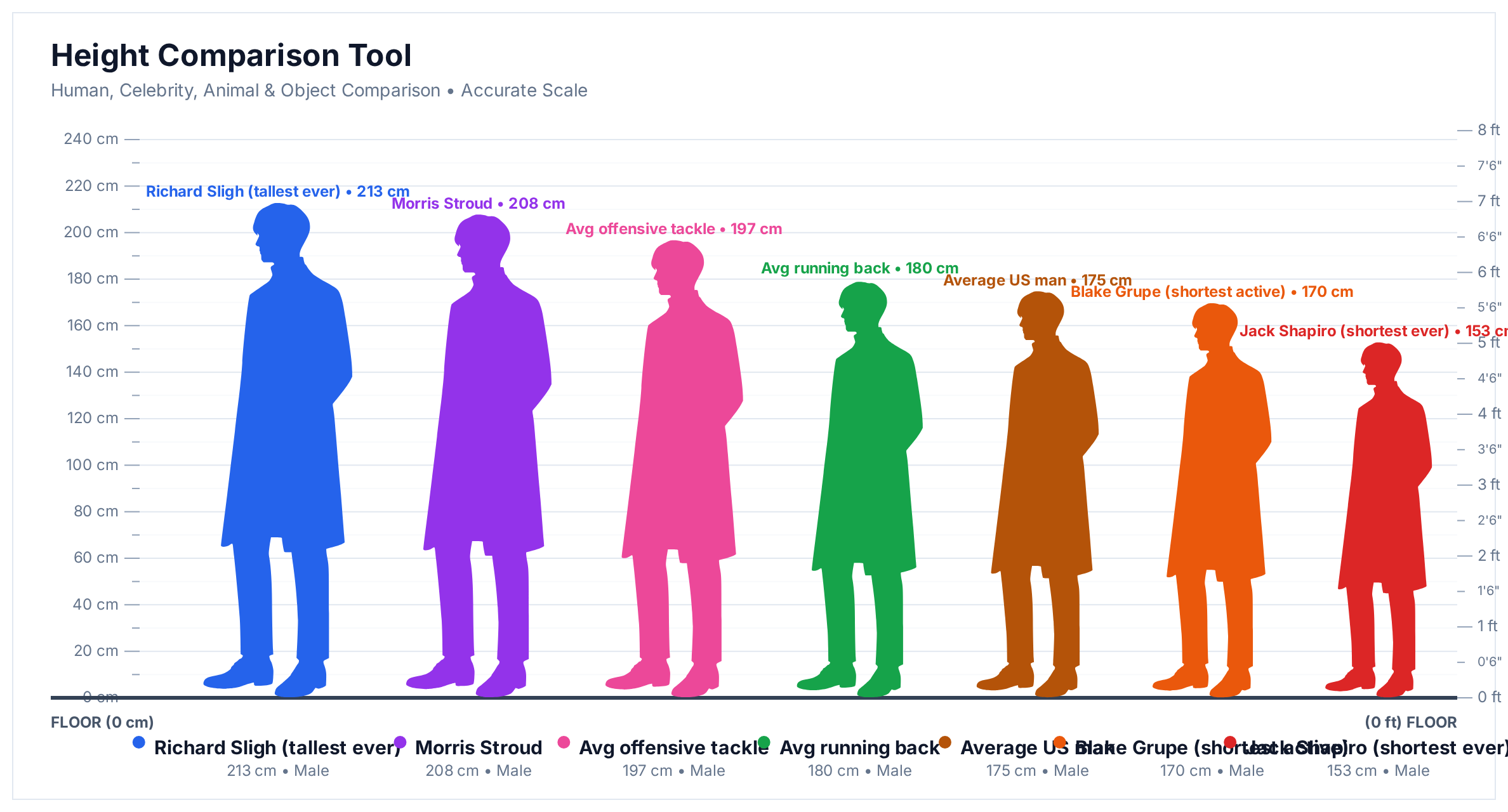
The tallest player in NFL history is Richard Sligh, a 7-foot (213 cm) defensive tackle who played eight games for the Oakland Raiders in 1967 and even appeared in Super Bowl II. Nearly sixty years later, nobody has matched him; he remains the league’s only seven-footer.
Just below him sit two 6 ft 10 in (208 cm) men: Morris Stroud, a Kansas City Chiefs tight end of the early 1970s, and Dan Skipper, a modern Lions offensive tackle. Stroud is famous for more than height — he used to line up under the goalposts to swat away opponents’ field-goal attempts, which forced the NFL to ban the practice. It is still called the “Stroud Rule”.
At the other end, the shortest player in NFL history is Jack Shapiro, who stood about 5 ft 1 in (Guinness measured him at 5 ft ½ in) and played one game for the 1929 Staten Island Stapletons. The shortest active player is Saints kicker Blake Grupe at 5 ft 7 in — a full 29 inches shorter than Sligh. The chart below puts the record-holders, the position extremes, and the average man side by side, and the scale is honestly hard to believe.