US Presidents by Height: The Complete Ranking
Forty-five presidents, a 30 cm spread, and one man towering over them all.
Abraham Lincoln, at 6 ft 4 in (193 cm), is the undisputed tallest president in American history — a title he shares with no one. At the other end stands James Madison at just 5 ft 4 in (163 cm), the shortest president ever, a full foot (30 cm) shorter than Lincoln. Between those two bookends the remaining 43 presidents fill in almost every half-inch mark, with the average president standing about 5 ft 11 in (180 cm).
The ranking above orders all 45 presidencies (Grover Cleveland’s two non-consecutive terms count once) from tallest to shortest, using the best-documented figures compiled by Wikipedia’s presidential-heights researchers and cross-checked against the POTUS.com presidential facts project. Where sources record a half inch, it is shown; most modern presidents’ heights come from official records and medical examinations, while the 18th- and 19th-century figures rely on military records, tailor’s notes and contemporary accounts.
A few things stand out immediately. First, presidents are a tall group: only James Madison (5 ft 4 in) and Benjamin Harrison (5 ft 6 in) are reckoned to have been below average height — a claim popularised by Nancy Etcoff’s 1999 book Survival of the Prettiest. Second, the list skews tall at the top but clusters hard around six feet: seven presidents measure exactly 6 ft 0 in, and another four come in at 5 ft 11½ in. Third, every president since 2000 has been at least six feet tall, continuing a trend that has made modern presidents taller than their 19th-century predecessors.
Tallest: Lincoln at 193 cm. Shortest: Madison at 163 cm. Average: ~180 cm. Gap between extremes: 30 cm — the length of a school ruler.
The Tallest Presidents: Lincoln’s League
Five presidents stand clear of the field — and the top two are a full head above the shortest.
Lincoln’s 6 ft 4 in (193 cm) put him at roughly the 99th percentile of men in his era, and he would still tower today. His height was part of his political theatre: in the famous Lincoln–Douglas debates of 1858, the lanky 193 cm Lincoln stood beside Stephen A. Douglas — who measured just 5 ft 4 in (163 cm), exactly Madison’s height — and the 30 cm contrast was impossible to miss. Lincoln’s long limbs, stovepipe hat and gaunt frame made him one of the most instantly recognisable figures of the 19th century.
Second on the list is Lyndon B. Johnson at 6 ft 3½ in (192 cm), just half an inch shy of Lincoln. LBJ’s size was legendary in Washington — he weaponised it with “the Johnson treatment,” leaning over senators, gripping their lapels and talking them into votes at a distance of inches. Third is Donald Trump, listed at 6 ft 3 in (191 cm) by the White House physician, though the figure is disputed: older documents record 6 ft 2 in (188 cm) and some estimates go as low as 5 ft 11 in (180 cm).
Fourth place is shared by two men 190 years apart: Thomas Jefferson (6 ft 2½ in / 189 cm) and Bill Clinton (the same 6 ft 2½ in / 189 cm). Jefferson was notably tall for the 18th century, when the average American man stood several inches shorter than today, and contemporaries frequently commented on his commanding frame. Just behind them, a trio of 6 ft 2 in (188 cm) presidents — Chester A. Arthur, Franklin D. Roosevelt and George H. W. Bush — rounds out the tallest ten.
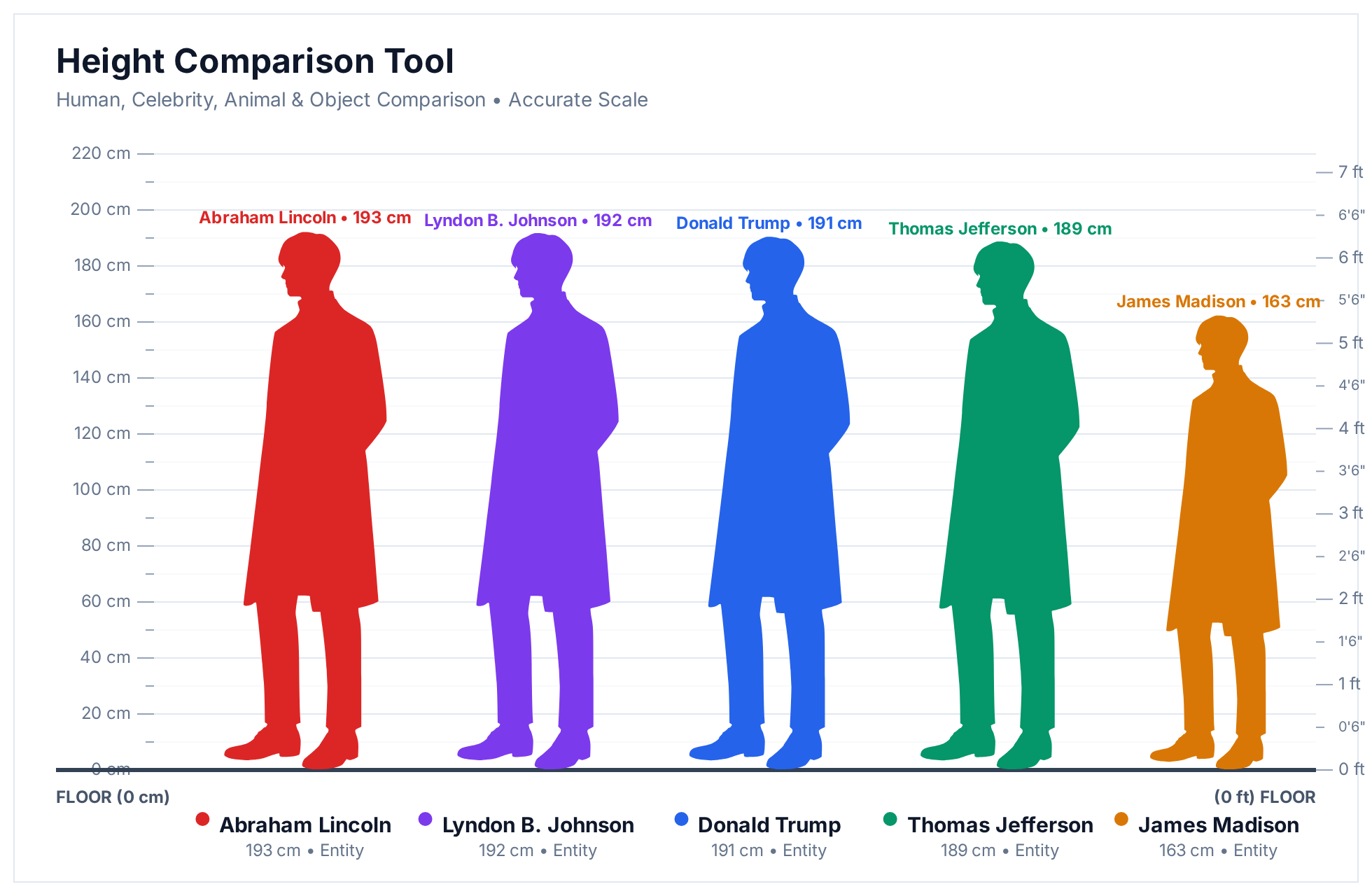
Lincoln (193 cm) and LBJ (192 cm) are the only presidents to clear 6 ft 3 in. Trump’s listed 191 cm is a disputed third.
The Shortest Presidents: Small Stature, Large Legacies
The bottom of the ranking is crowded with giants of American history.
James Madison’s 5 ft 4 in (163 cm) made him the smallest president — and one of the smallest heads of state in modern history. Yet Madison’s physical stature bore no relation to his political one: as the principal author of the Constitution and the Bill of Rights, and the fourth president, he shaped the republic more profoundly than most of his taller successors. His tiny frame became a running joke in his own time; he reportedly had to stuff his boots to keep them from sliding off.
Next up are Martin Van Buren and Benjamin Harrison, both 5 ft 6 in (168 cm). Harrison was nicknamed “Little Ben” for the obvious reason, and his smallness was contrasted cruelly with his grandfather William Henry Harrison (5 ft 8 in / 173 cm) — though the grandfather died a month into his term, so the height difference outlasted the presidency. Van Buren, the eighth president, was the first born as a US citizen rather than a British subject, and his 168 cm frame made him noticeably shorter than nearly every contemporary statesman.
Then come John Adams and William McKinley at 5 ft 7 in (170 cm). Adams, like his son John Quincy Adams (5 ft 7½ in / 171 cm), was stocky and broad rather than tall — Abigail Adams described him as compactly built. McKinley, the last president to have served in the Civil War, won two elections despite standing a full four inches (10 cm) shorter than his opponent William Jennings Bryan (5 ft 11 in / 180 cm), an early and emphatic refutation of the “taller candidate always wins” idea.
Madison (163 cm) wrote the Constitution; Adams (170 cm) was a founding father. Four of the five shortest presidents are rated among the most consequential.
Does Height Win Elections? The Taller-Candidate Pattern
Folk wisdom says the taller candidate always wins — the record says otherwise.
One of the most repeated claims in American politics is that the taller of the two major candidates always wins the presidency. It sounds plausible: voters associate height with leadership, and for long stretches — most of the 20th century — the taller candidate did keep winning. Studies have found a genuine height advantage in popular-vote share, and the pattern held for decades at a time, which is why the myth feels true.
But a careful 2013 study cited by the presidential-heights research concluded something more subtle: taller candidates were significantly more likely to win the popular vote, yet not significantly more likely to win actual elections — the taller candidate’s win rate in the Electoral College did not beat chance. And the exceptions are glaring. Joe Biden (6 ft 0 in / 183 cm) beat Donald Trump (listed 6 ft 3 in / 191 cm) in 2020. George W. Bush (5 ft 11½ in / 182 cm) beat the 6 ft 4 in (193 cm) John Kerry in 2004 and the 6 ft 1 in (185 cm) Al Gore in 2000. Jimmy Carter (5 ft 9½ in / 177 cm) beat the 6 ft 0 in Gerald Ford in 1976, and Richard Nixon (5 ft 11½ in) beat the 6 ft 1 in George McGovern in 1972.
Go further back and the exceptions multiply: William McKinley (5 ft 7 in / 170 cm) beat the taller William Jennings Bryan twice, in 1896 and 1900; Rutherford B. Hayes (5 ft 8½ in / 174 cm) beat the 5 ft 10 in Samuel Tilden in 1876; and James Garfield (6 ft 0 in / 183 cm) beat the 6 ft 1½ in Winfield Hancock in 1880. The biggest height mismatch in electoral history came in 1860: Lincoln’s 193 cm against Stephen A. Douglas’s 163 cm — a 30 cm gulf that the shorter man nearly closed in the debates.
The honest summary is that height is a mild tailwind, not a rule. Since 1900 the taller candidate has won most elections, but the shorter candidate has won often enough — 2020, 2004, 2000, 1976, 1972 — that no one should bet the election on a tape measure. Charisma, timing and the economy matter far more than centimetres.
Taller candidates win the popular vote more often than chance — but they do not win elections more often than chance. Votes, not inches, decide.
Presidents vs Ordinary People: Leaders Run Tall
The average president is 5 cm taller than the average American man today — and the gap used to be wider.
Put the average president — about 5 ft 11 in (180 cm) — next to the average American man today (roughly 5 ft 9 in / 175 cm) and the presidency’s height bias is visible: the officeholder stands about 5 cm (2 in) above the national male average. Even Madison, the shortest president at 163 cm, would not have looked absurdly short beside the average man of his own era, when nutrition and disease kept average heights lower than today.
The visual below makes the range concrete. Lincoln’s 193 cm towers over Madison’s 163 cm, with the average president (180 cm) and average US man (175 cm) slotted between them. Notice how the two averages sit close together in the middle — the story of presidential height is really the story of the extremes, not the middle.
There is also a long-run trend worth noting: presidents have grown taller over time, tracking — and slightly outpacing — the general population. The 18th-century presidents were striking figures partly because height itself was rarer; George Washington at 6 ft 1½ in (187 cm) and Jefferson at 189 cm would have stood out in any crowd of their contemporaries. Every president elected in this century has stood at least 6 ft 0 in, suggesting the height premium in American politics, whatever its cause, has not faded.
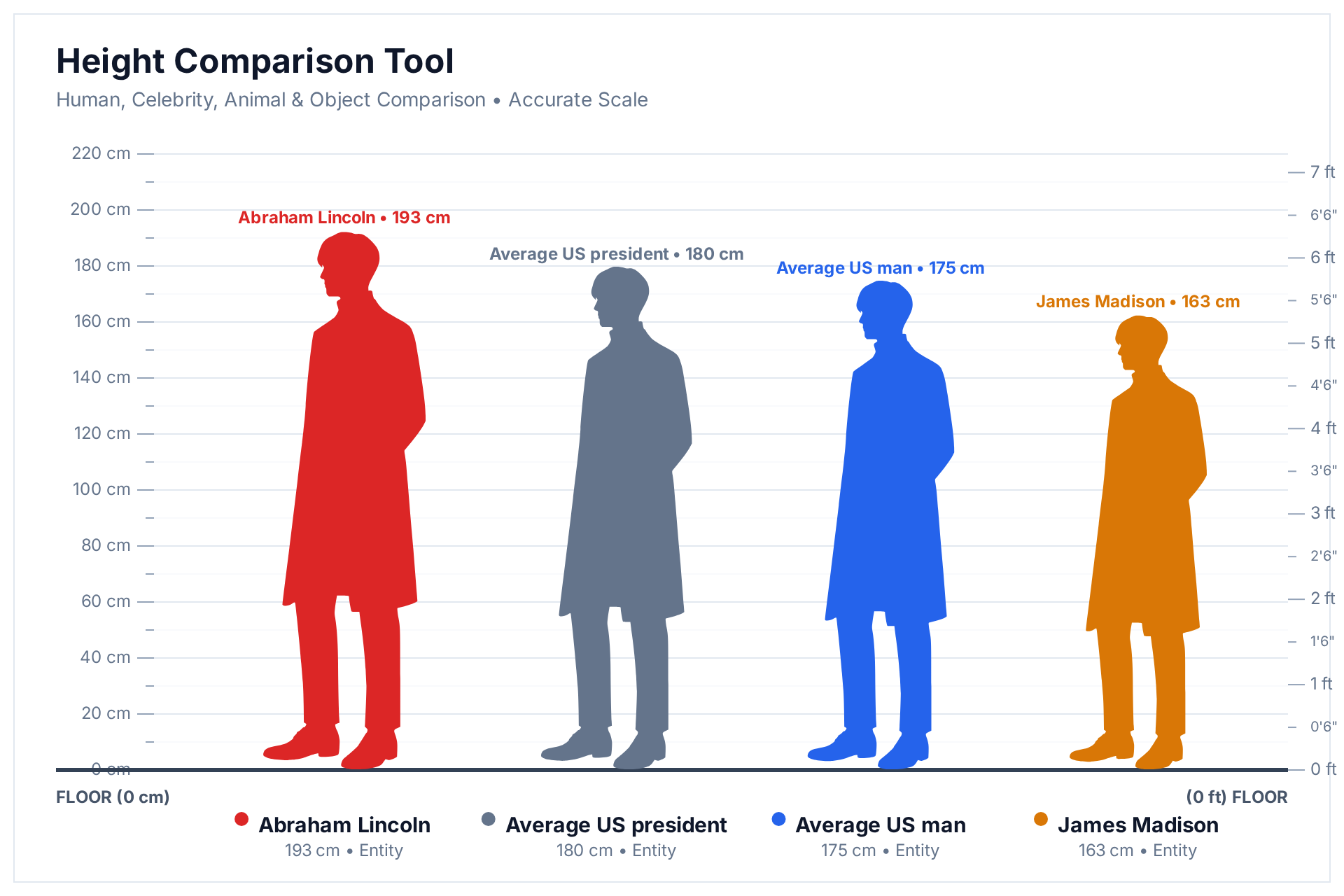
Average president: 180 cm. Average US man: ~175 cm. Only two presidents in history fall below average height.
White House Height Records
The oddities and outliers the ranking reveals.
William Howard Taft, at 5 ft 11½ in (182 cm), was an inch below the presidential average — but he holds the weight record: between 335 and 350 pounds at his heaviest, the most of any president. Taft’s bulk famously required a specially built 7-foot-long bathtub in the White House. Height and presence are different things, and Taft had presence in spades.
The biggest electoral height mismatch came in 1860, when Lincoln (193 cm) faced Stephen A. Douglas (163 cm) — the same height as Madison, the shortest president. The most lopsided modern matchup was 2024: Trump (listed 191 cm) against Kamala Harris (reported 5 ft 4½ in / 164 cm), a 10½-inch (27 cm) gap. And the tallest losing candidate on record? John Kerry at 6 ft 4 in (193 cm) — exactly Lincoln’s height — lost to the 5 ft 11½ in Bush in 2004, proving that even Lincoln’s inches don’t guarantee the presidency.
Finally, spare a thought for the founders of the ranking’s lower reaches. John Adams (170 cm) and his son John Quincy Adams (171 cm) are the only father-and-son pair in the bottom ten; George H. W. Bush (188 cm) and George W. Bush (182 cm) are the only father-and-son pair in the top half. Height, it seems, is no more heritable in politics than popularity.
John Kerry (193 cm) — as tall as Lincoln — is the tallest major-party candidate to lose a presidential election.