The Top 20 Tallest Nations: Europe Owns the Leaderboard
Nineteen of the twenty tallest countries are European — and the margins at the top are razor thin.
The Netherlands sits at the top of every serious national height ranking: Dutch men average 183.8 cm (6 ft ½ in) and Dutch women 170.4 cm (5 ft 7 in). But look at how crowded the summit is — Montenegro at 183.3 cm, Estonia at 182.8 cm, Bosnia and Herzegovina at 182.5 cm and Iceland at 182.1 cm are all within a single inch of each other. The difference between 2nd place and 5th is about half a centimetre per rank, which means the ordering shuffles between studies depending on the survey year and method.
These figures come from the NCD Risk Factor Collaboration’s pooled analysis of more than 2,180 population studies covering 65 million people, published in The Lancet — the largest height dataset ever assembled. It measured 19-year-olds in 2019, so it captures each generation at the age growth has effectively stopped. The overall picture is unambiguous: all ten of the tallest countries for both sexes are in Europe, and the tallest teenagers live in north-western and central Europe.
Context helps the numbers land. The average US man peaked at 177.5 cm back in 1996 and the country now sits 37th for men — America once had the third-tallest men on Earth. At the other extreme, the shortest men in the world live in Timor-Leste at 160.1 cm, and the shortest women in Guatemala at 150.9 cm. The gap between the tallest and shortest national averages is 23.7 cm for men — roughly the length of an adult’s forearm.
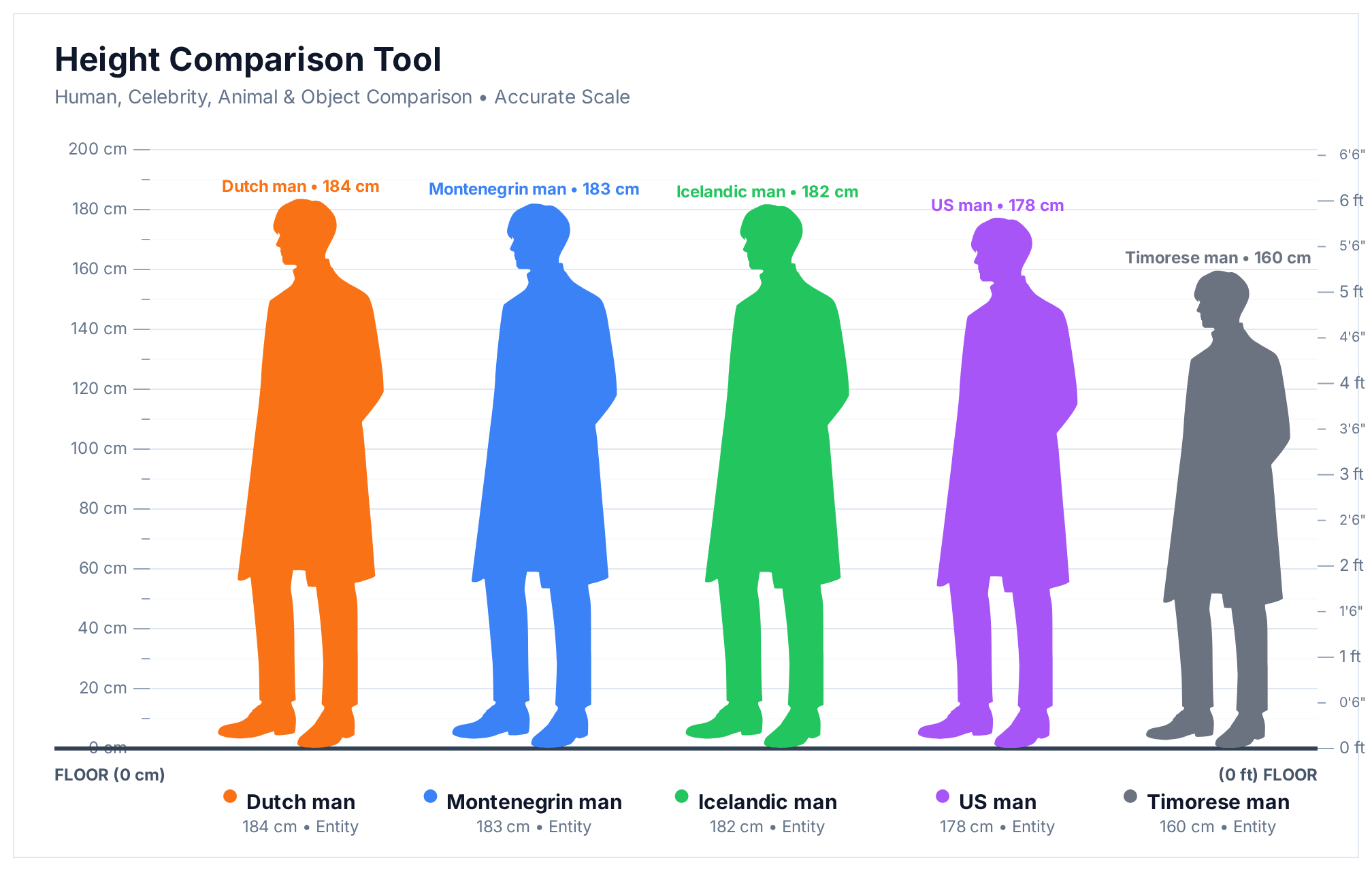
The tallest national average (Dutch men, 183.8 cm) and the shortest (Timorese men, 160.1 cm) differ by 23.7 cm — nearly 15% of the shorter average.
The Dutch Miracle: From Europe’s Shortest to the World’s Tallest
In 1850 the average Dutch man was about 165 cm — among Europe’s shortest. Today he is the world’s tallest.
The Netherlands is the most instructive height story on Earth because it proves national averages are not destiny. Around the mid-19th century, young Dutch men averaged about 165 cm (5 ft 5 in) — shorter than the English, the Germans and the French of the era, and 5 to 8 cm shorter than Americans. Over roughly 150 years they gained close to 20 cm, the largest recorded national height gain on record, transforming one of Europe’s shortest populations into its tallest.
What explains the growth is not genes. A 2023 simulation study estimated that natural selection contributed less than half a centimetre to the historical increase — genetics works on evolutionary timescales, not 150-year ones. The drivers were almost entirely environmental: better nutrition (notably a dairy-rich diet heavy in calcium and protein), cleaner water, fewer childhood infections, better healthcare, and rising prosperity. Lead researcher Majid Ezzati of Imperial College London puts it plainly: about a third of the global variation is genetic, but genes don’t change that fast, so changes over time are largely environmental.
The Dutch are not even unique in the pattern — South Korean women shot up more than 20 cm in a century and Iranian men added 16.5 cm, the fastest gains ever recorded. But the Dutch case is the cleanest demonstration that the height ceiling is set by conditions, not DNA. When successive generations of children eat well, stay healthy and grow up without the stunting effects of disease and malnutrition, the whole population rises — by twenty centimetres.
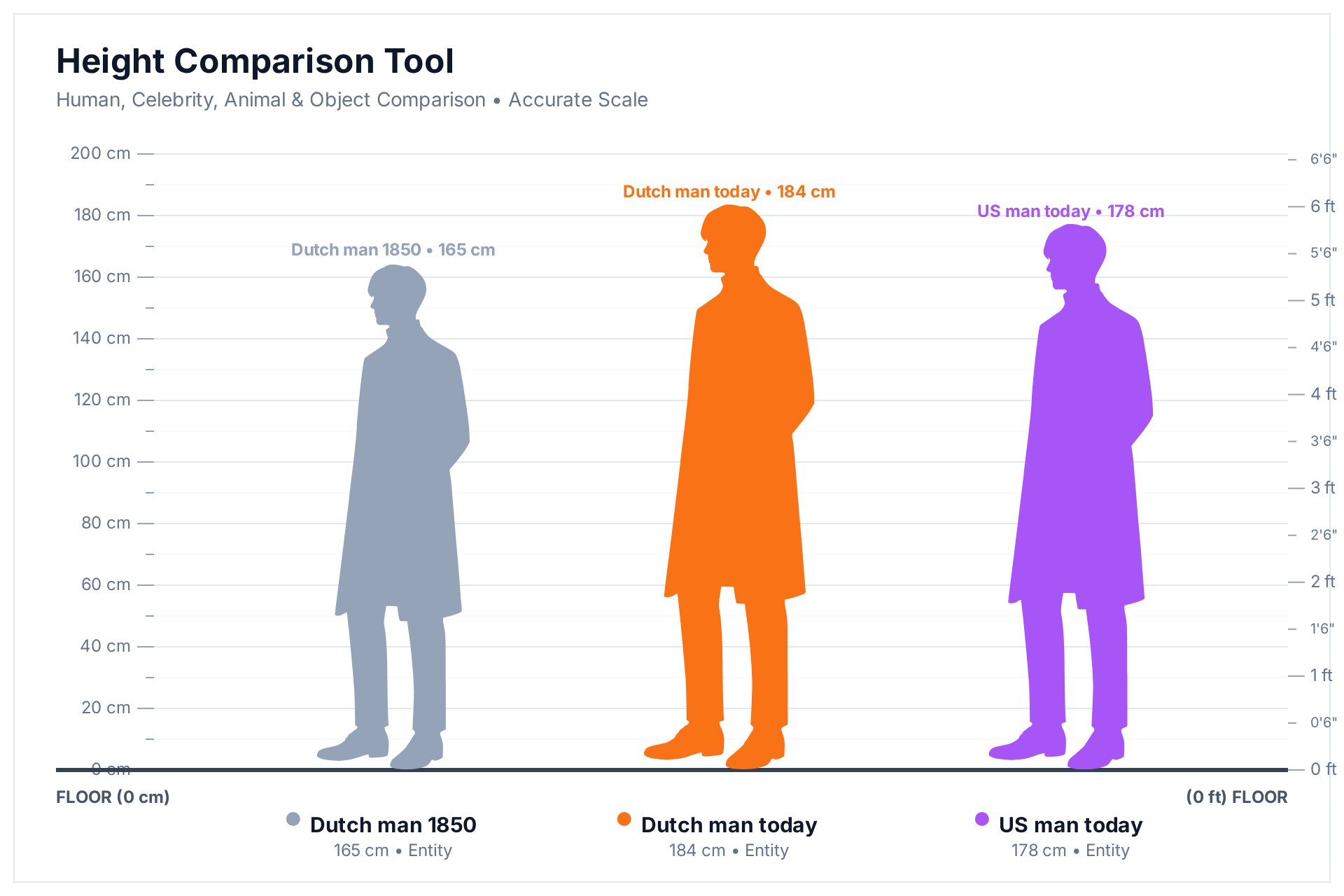
Dutch men gained ~20 cm in 150 years; natural selection explains less than 0.5 cm of it. Height follows living standards.
The Dinaric Twist: A Mountain Region Taller Than Any Country
The single tallest population on Earth is not a nation at all — it is the Dinaric Alps.
Here is the twist that national rankings hide: measured at the regional level, men of the Dinaric Alps average 184.6 cm — taller than the Dutch national average. This rugged stretch of the western Balkans, spanning parts of Bosnia and Herzegovina, Croatia and Montenegro, is home to the world’s densest concentration of very tall people. Bosnia and Herzegovina ranks 4th among nations at 182.5 cm, but within the Dinaric core the figures run higher: Dalmatia (183.7 cm) and Herzegovina (183.4 cm) both exceed their national averages.
Researchers have seriously argued that young men in this region may already be taller than the Dutch. The headline Dutch figure of 183.8 cm comes from 21-year-olds; Dutch 18-year-olds measured in the same period averaged only 182.4 cm — and the Montenegrin and Dinaric surveys were done on younger cohorts. As the authors of a 2022 Biology paper on Balkan anthropometrics put it, it is possible that young Montenegrin men are actually taller than Dutch men. National averages smooth out extraordinary regions.
The Dinaric case also sharpens the nature-vs-nurture question. These populations were famously short in the 19th century — poorer and worse-fed than their Dutch contemporaries — yet reached world-leading heights on improving diets and healthcare in the 20th century. Genetics may set a higher ceiling here than almost anywhere, but it took a century of better living standards to reveal it.
Dinaric Alps men average 184.6 cm — 0.8 cm taller than the Dutch national average. Countries are big statistical averages; regions tell the sharper story.
The American Fall: From 3rd Tallest to 37th
US men gained only 6 cm in a century while the Dutch gained 20 — and American height has stalled entirely.
A century ago the United States had the third-tallest men and fourth-tallest women in the world. Today it ranks 37th for men and 42nd for women. Over the same century that Dutch men gained roughly 20 cm, American men gained about 6 cm — and even that modest growth stopped decades ago. US men’s average height peaked at around 177.5 cm in 1996 and has barely moved since; women’s peaked at about 164 cm in 1988.
The researchers didn’t investigate the causes directly, but economists who study height have offered plausible explanations: patchier healthcare access than other wealthy nations, higher rates of teenage pregnancy (linked to underweight and preterm babies), and rising childhood obesity, which triggers earlier puberty and earlier growth stoppage. Whatever the mix, the result is striking: a wealthy country that started the 20th century 5 to 8 cm ahead of the Netherlands now trails it by more than 6 cm.
The wider pattern makes the point harder to miss. Heights are still rising fast in countries catching up — South Korean women and Iranian men set the century’s records — but growth has slowed or stopped across most of Western Europe and North America, suggesting many wealthy populations have hit their genetic ceiling. The height race is now being run by the countries whose childhood conditions improved most recently.
In 1914 Americans towered over the Dutch by 5–8 cm. Today the Dutch tower over Americans by 6 cm.
The Mystery Twist: The Dutch Are Getting Shorter
Statistics Netherlands found Dutch 19-year-olds are now shorter than the 1980 generation — by a full centimetre.
The story gets stranger. After a century of relentless growth, the Dutch run has quietly reversed: men born in 1980 averaged 183.9 cm at age 19, but men born in 2001 averaged 182.9 cm — a full centimetre shorter in one generation. Dutch women slipped even further, from 170.7 cm for the 1980 cohort to 169.3 cm for the 2001 cohort, a drop of 1.4 cm. The figures come from roughly 719,000 heights collected through national health surveys by Statistics Netherlands.
Nobody is certain why. Theories include changing immigration patterns (the statistics track people born and raised in the Netherlands, but the genetic and dietary mix of the population has shifted), declining milk consumption among young people, rising childhood obesity, and changing lifestyles. The decline also punctures the simple story that heights only ever rise: once a population hits its ceiling, it can drift back down.
It is worth keeping perspective, though. A one-centimetre dip leaves the Dutch firmly on top of every ranking, and the broader lesson of the data is unchanged — national height is a thermometer for how well a country feeds, heals and raises its children. East Timor’s 160.1 cm and Guatemala’s 150.9 cm for women are not genetic verdicts; they are measurements of childhood conditions, exactly as the Netherlands’ 165 cm was in 1850.
How to Read National Height Numbers Honestly
Why different rankings disagree — and which differences actually matter.
You will find slightly different figures depending on the source, and that is normal. Some datasets use self-reported heights, which run about a centimetre high because people round up; the best studies physically measure participants. Ages differ too: the NCD-RisC studies measure 18- or 19-year-olds, while national surveys often average across all adults, who skew shorter because older generations grew up in worse conditions. And survey years matter — the Dutch 183.8 cm figure comes from a different cohort than the 182.5 cm the 2016 eLife study reported for 19-year-olds.
So treat small differences as noise and large ones as signal. Whether Montenegro is 182.9 or 183.3 cm across studies is noise; whether the Dutch are 20 cm taller than in 1850 is signal. Rankings below the top ten shuffle freely between surveys, but the broad pattern never changes: Northern Europe on top, the Anglophone world in the middle, South and Southeast Asia at the bottom.
One final honesty note: these are population averages, and averages are not people. Even in the Netherlands — the tallest nation on Earth — plenty of men are 170 cm and plenty of women are 160 cm; the standard deviation in adult height is roughly 7 cm, so only about 68% of Dutch men fall between 177 and 191 cm. National averages describe a population’s conditions. Your height was written by your own family, your own diet and your own childhood.