The Growth-Plate Rule: The One Fact That Decides Everything
Your long bones grow from cartilage discs at their ends. When those discs fuse, growth stops — permanently.
Every honest answer to "how do I increase my height?" starts in the same place: your growth plates. A growth plate — the epiphyseal plate — is a disc of soft cartilage near each end of a long bone, like the thigh bone or shin bone. The cells in that disc multiply and are slowly replaced by bone, and that steady replacement is what makes the bone longer. It is the only mechanism by which a human being gets taller. There is no other one, and there is no way around it once it stops.
The plates close near the end of puberty, and the timing follows how far through puberty you are more closely than it follows your birthday. For girls, most plates fuse between roughly 14 and 16, usually within one to two years after the first menstrual period; KidsHealth puts the typical range at 13–15. For boys, most close between roughly 16 and 18, with KidsHealth giving 15–17. MRI studies put it in the same territory: nine in ten girls are closed by 15–18 and nine in ten boys by 17–20, with every girl closed by 19 and every boy by 21. The main driver of closure is estrogen — which girls make in larger amounts, and which boys convert from testosterone — so girls close about two years earlier than boys on average.
Once a plate has fused, that bone cannot grow any longer. The cartilage is replaced by a solid line of bone, and no amount of stretching, hanging, swimming, supplement-taking or wishful thinking reopens it. This is why the article is organised the way it is: everything that genuinely adds bone length only works while the plates are open, and everything an adult can do is either recovering height they already have, adding apparent height, or surgery. If you are a teenager wondering whether you still have growing left to do, the only reliable answer is a bone-age X-ray of the hand and wrist — a doctor can read it in minutes, and it is the only way to know for sure whether your plates are open.
Plates open: sleep, nutrition and medical care can help you reach your full genetic height. Plates closed: no exercise, stretch, supplement or food adds a centimetre of bone. Everything after that is posture, footwear, clothing — or surgery.
While You Are Still Growing: Reaching Your Genetic Potential
About 80% of height variation is inherited. The other 20% is where your choices live — and it is about not losing height, not gaining extra.
Genetics explains roughly 80% of the variation in height between people, according to twin and family studies. That sounds like a verdict, but it is better read as a range: your genes set a target, and the remaining 20% — nutrition, sleep and health during your growing years — decides whether you actually reach it. Nothing in this section pushes you past your genetic potential. It protects it.
Sleep is the first of the three. Growth hormone is released in pulses during deep sleep, which is why teenagers are advised to get 8–10 hours a night — not because an extra hour of sleep adds a centimetre directly, but because chronic short sleep can hold growth back. The same logic applies to nutrition: protein, calcium, vitamin D, zinc and iron are all needed for normal bone growth, and deficiencies in any of them can stunt it. A child who is malnourished grows more slowly; a child who is already well fed does not grow taller by eating more of anything. Milk does not make you taller unless you were deficient in what milk provides. The supplement industry sells the opposite story, but the evidence is clear: extra nutrients beyond requirement do not add height.
The third factor is the one people most often miss: treating medical conditions. Thyroid problems, coeliac disease, chronic illness and genuine growth-hormone deficiency can all slow growth, and all of them are treatable — but only if someone notices. A child who is much shorter than their parents, or whose growth has slowed sharply, should see a doctor. Growth hormone treatment exists, but it is prescription-only for specific diagnosed conditions, not a height booster for healthy short children. And no sport lengthens bones: tall basketball players are selected for height, not made taller by playing basketball, and the same applies to swimming, volleyball and every other sport that gets credited with it.
Good sleep, good food and good health do not make you taller than your genes intended. They stop you ending up shorter than your genes intended. That is a real and valuable gain — it is just not the gain the supplement adverts promise.
What Does Not Work: Stretching, Hanging, Sports and Supplements
The most-searched methods are the least effective. Here is what the evidence actually says about each one.
Stretching and hanging are the most popular answers to this question on the internet, and the least supported. The claim is usually that hanging from a bar or doing a daily stretching routine decompresses the spine and permanently lengthens it. The first half is true and the second half is not. Spinal traction does add a few millimetres: one study found 25 minutes of lumbar traction raised stature by about 9 mm, against about 3 mm from simply lying down — and the gain faded within about an hour as the discs recompressed. No study shows a daily stretching program producing a lasting height gain. Yoga and Pilates improve flexibility and posture, which can make you stand at your full height, but they do not lengthen bones. The discs between your vertebrae compress through the day and rehydrate overnight, which is why you are about 2 cm taller in the morning than in the evening — and why any "gain" from hanging is gone by lunchtime.
The sports claim fails the same way. Basketball and swimming are constantly credited with making teenagers taller, but the arrow points the other way: tall children are picked for basketball teams and tall teenagers are drawn to swimming, because height helps in both sports. There is no evidence that playing either sport lengthens bones, and no mechanism by which it could — the growth plates respond to hormones and nutrition, not to jumping or arm strokes. The same applies to the inversion tables and "grow taller" devices sold online: they stretch the spine temporarily, exactly like hanging, and the millimetres they add are gone within the hour.
"Grow taller" supplements are the most expensive version of the same non-result. They are typically calcium, amino acids and herbs, sold with before-and-after photographs and no clinical evidence. In well-nourished people there is no evidence they increase height at all — and once the growth plates are fused, there is no mechanism by which they could. The honest competitors in this space say so plainly: after the plates fuse, no exercise, stretch, supplement or device will make you taller. The dishonest ones — the old-style pages claiming swimming, hanging and inversion can "permanently lengthen the spine" and add 1–2 inches in adulthood — are selling the exact misinformation this article exists to correct.
Ask two questions: does it claim to lengthen bone after the plates have fused, and does it have a study behind it? If the answer to the first is yes and the second is no, it is not a method — it is a sales pitch.
What Adults Can Still Change: Posture, the Morning Effect, and Apparent Height
No new bone — but 1–2 cm of recovered height, 2 cm of morning height, and a few centimetres of footwear are real.
If your plates are closed, the largest honest gain available to you is posture — and it is a recovery, not a growth. Most adults do not stand at their full height: a forward head, rounded shoulders and a tilted pelvis can easily cost 1–2 cm, and some sources put the total recoverable height at up to 1–3 cm once pelvic and head position are corrected. Standing tall — ears over shoulders, shoulders over hips, chin level — restores the height you already have. The chart below shows what that looks like: the same person at 175 cm standing tall and at 173 cm slouched. The 2 cm difference is small on the chart, which is the point — it is real, it is free, and it is the whole of what posture can do. Strengthening the core and back muscles helps you hold it, and it is the one "height exercise" with genuine evidence behind it, because it changes how you stand, not how long your bones are.
The second adult effect is the morning one. You are about 2 cm taller in the morning than in the evening, because the discs in your spine compress under gravity through the day and rehydrate while you sleep lying down. Adults lose about 19 mm from morning to evening on average. That is why you should always measure yourself in the morning, standing barefoot against a wall, with a flat object on top of your head and your heels, buttocks and shoulders touching the wall — and why a height measured at 8 pm will reliably read lower than the same person measured at 8 am. Neither number is wrong; they are the same person at two points in the disc cycle.
Then there is apparent height — the part that needs no disclaimer because it makes no biological claim. Shoe lifts and insoles add 2–5 cm invisibly, and they are the only instant adult gain that actually exists. Beyond that, the honest tricks are visual: monochrome outfits and vertical lines make the eye read you as taller, a leaner physique looks taller at the same height, and well-fitted clothes beat baggy ones. None of this changes your body. All of it changes how tall you look, which — for most of the situations where people care about height — is the thing they actually wanted.
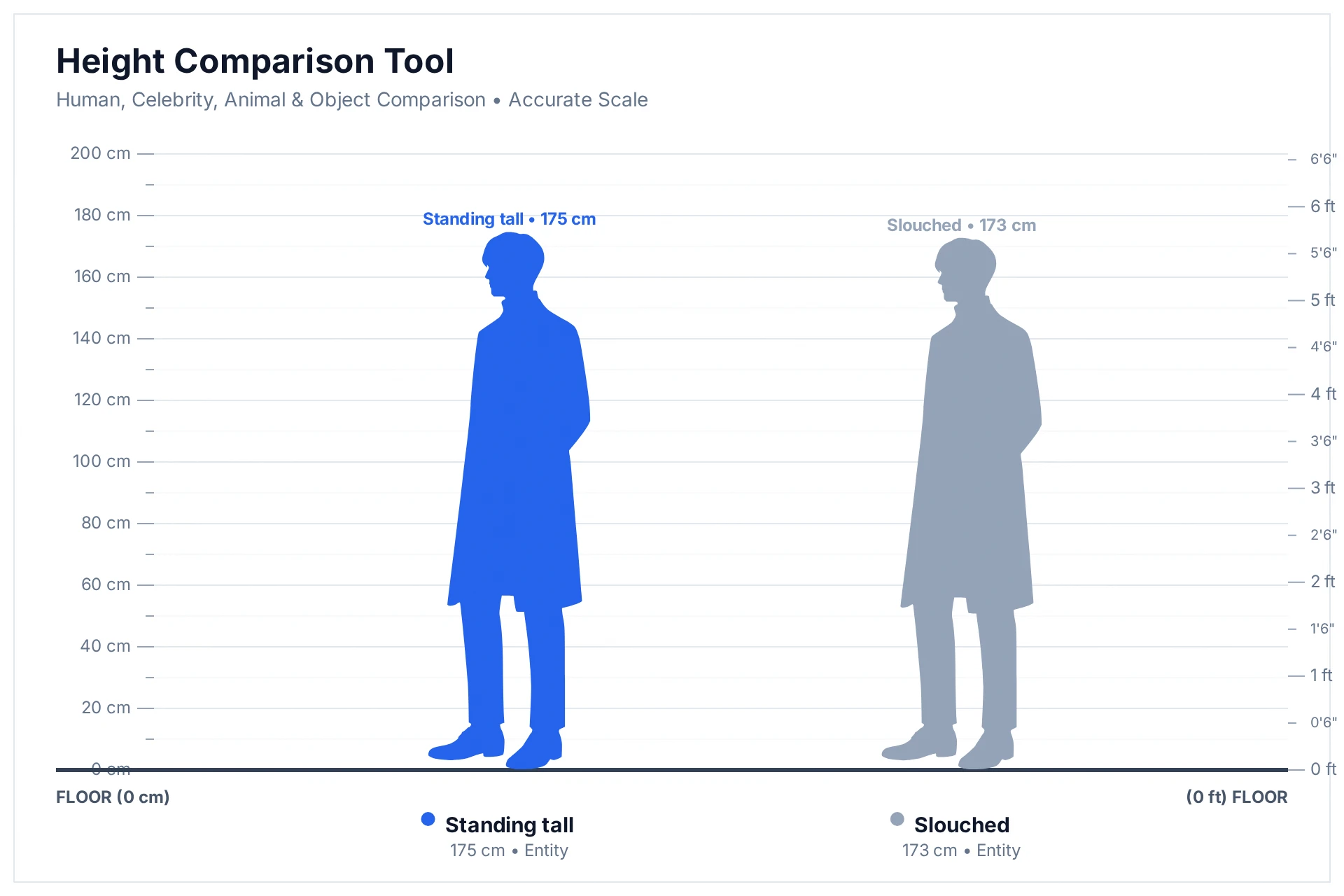
Always measure barefoot, in the morning, against a wall. You are about 2 cm taller at 8 am than at 8 pm — so an evening measurement will always flatter the tape the wrong way.
The Surgery Option: Limb Lengthening Is Real — and It Is Major Surgery
The only adult method that adds real bone length. Typical gain about 8 cm. Typical cost about $125,000. Timeline about six months.
There is exactly one method that adds real bone length after the growth plates have closed: limb-lengthening, or stature-lengthening, surgery. A surgeon cuts the femur (thigh bone) or tibia (shin bone), inserts an internal magnetic rod, and extends the gap by about 1 mm a day while new bone forms in it. The Hospital for Special Surgery — the leading US centre for the procedure — says the most common gain from femur lengthening is 3 inches, about 8 cm, because that is how long the implanted rods extend. Repeating the procedure in the tibia can add another 2–3 inches, for a total of about 5–6 inches. A 2020 study of 795 patients found a mean gain of 6.7 cm per segment. The chart below shows what the typical 8 cm gain looks like on an average man: 175 cm before, 183 cm after.
The price matches the seriousness. HSS lists stature surgery at $125,000 for the femurs and $135,000 for the tibias, covering the surgery, hospital stay, implants, anaesthesia and follow-up visits until lengthening is complete. Across US centres the range is roughly $70,000–$150,000 per bone segment, with combined femur-and-tibia treatment reaching $173,000–$175,000 at some clinics; prices abroad are lower, but the procedure is the same. Insurance does not cover cosmetic height gain, so for purely cosmetic cases the bill is entirely out of pocket — and rod removal, about a year later, is a further cost on top.
The timeline and the risks are the part the adverts leave out. Lengthening at 1 mm a day means roughly two to three months of daily extension for a typical femur gain, then months of consolidation while the new bone hardens — about six months in total for 3 inches, with the rods removed at around twelve months. During that time you are on crutches, in daily physiotherapy, and largely unable to work normally. The risks are real: joint stiffness, infection, non-union (the new bone failing to harden), and nerve injury in about 9% of limbs in published cohorts. That is not a scare figure — it is the published rate, and it is why no responsible surgeon describes this as a shortcut. It is the only real adult option, and it is major orthopaedic surgery with a year of your life attached.
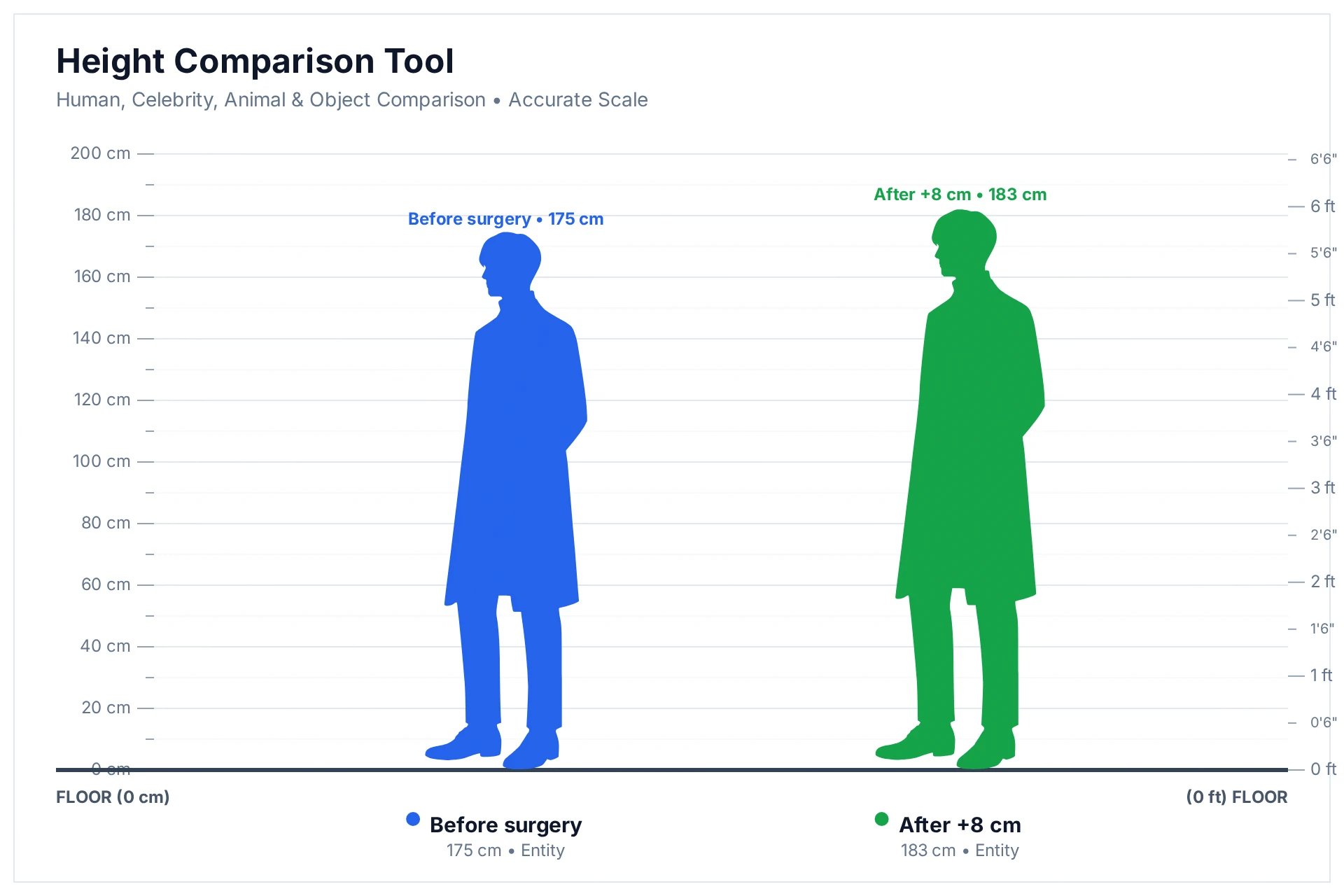
About 8 cm of real bone, about $125,000, about six months of recovery, and a roughly 9% nerve-injury rate per limb. If any of those four numbers surprises you, the procedure is not what the adverts suggested.
How Tall You Actually Are: Measure Properly, Then Judge Against the Average
Before chasing extra centimetres, get an honest baseline — most people are taller than they think, and the average is lower than the internet suggests.
A surprising amount of height anxiety is a measurement problem. Shoes add 2–3 cm, a slouch costs 1–2 cm, and an evening measurement reads about 2 cm lower than a morning one — so the same person can plausibly measure anywhere across a 5–7 cm range in a single day depending on how they do it. The honest method is the one in this site's measuring guide: barefoot, in the morning, back against a wall, heels, buttocks and shoulders touching it, a flat object resting on the crown of your head, and the mark read at eye level. Do it three mornings in a row and take the middle value. That is your height.
Then put it in context, because the context is kinder than the internet. The average US man, measured by the CDC's National Health and Nutrition Examination Survey, is about 5 feet 9 inches — roughly 175 cm. The average US woman is about 5 feet 4 inches — roughly 162 cm. The global averages are lower still: about 171 cm for men and 159 cm for women. The chart below draws the two US averages to scale, and the 13 cm gap between them is the normal, unremarkable difference between the sexes — the same gap this site's tall-woman/short-man article explores from the other side. If you are a 175 cm man, you are the average. If you are a 178 cm woman, you are taller than about 97% of women. Most people who search "how to increase height" are not short; they are average, measuring themselves in the evening, in shoes, against a feed full of 6-footers.
And height keeps changing after you stop growing — slowly, in the other direction. In a long-running study of 2,084 adults, height loss started at around 30; by 70, men had lost about 3 cm and women about 5 cm, and by 80 the losses were about 5 cm and 8 cm. The cause is the spine: discs thin, vertebrae compress, and posture deteriorates with age. Nutrition and exercise in adulthood do not add height, but they protect the height you have, by maintaining bone density and the muscle that holds you upright. The honest version of "how to increase height" for an adult is therefore a different question: how do I keep the height I have? Stand tall, stay strong, measure in the morning — and if your plates are still open, sleep, eat and see a doctor.
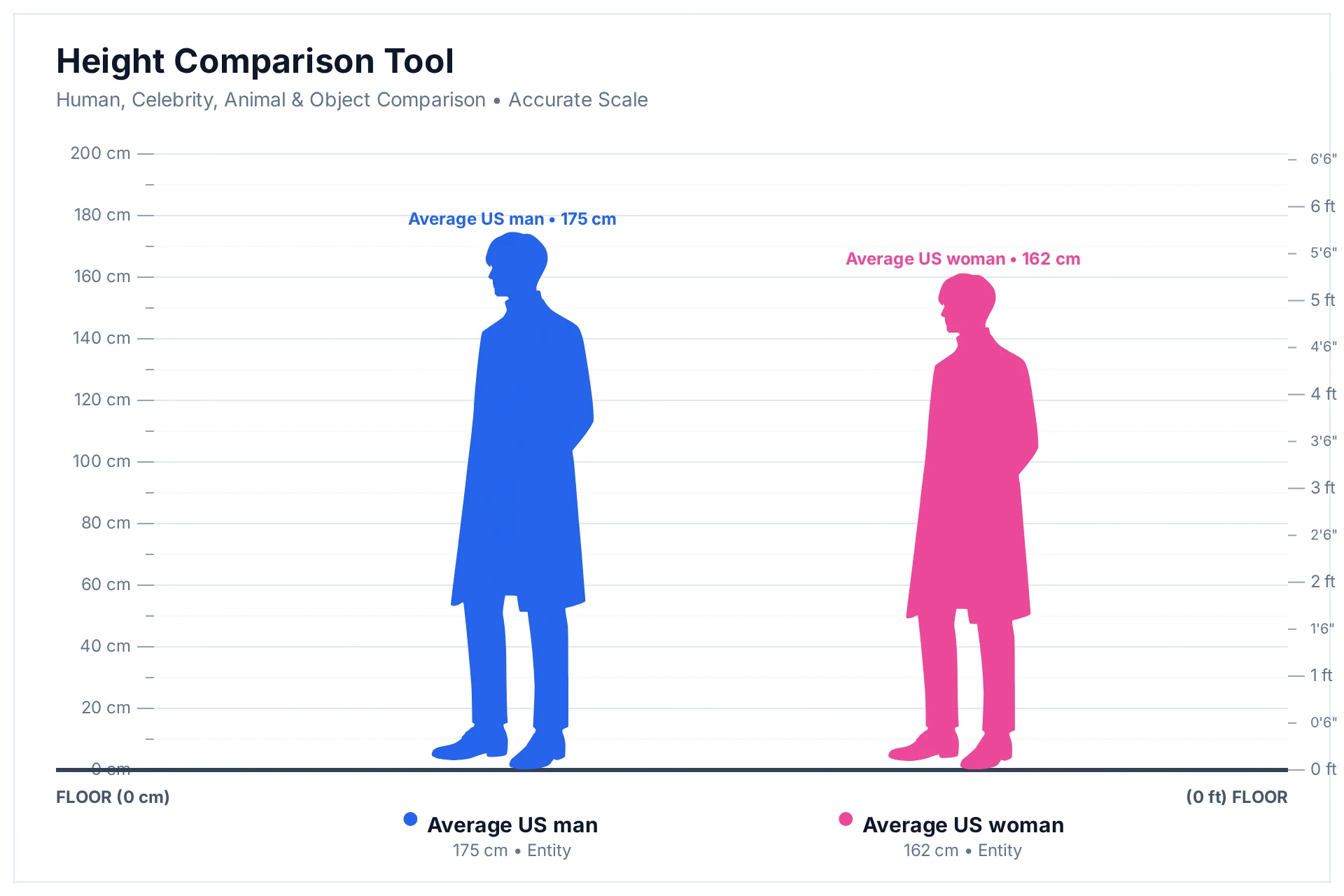
This article is general information, not medical advice. A child who is much shorter than their parents, or a teenager worried about growth, should see a doctor — a bone-age X-ray is the only way to know whether the growth plates are still open.