The 2026 Grid, Shortest to Tallest: 1.67 m to 1.88 m
Twenty-one centimetres — about eight inches — separates the shortest and tallest drivers on the current grid.
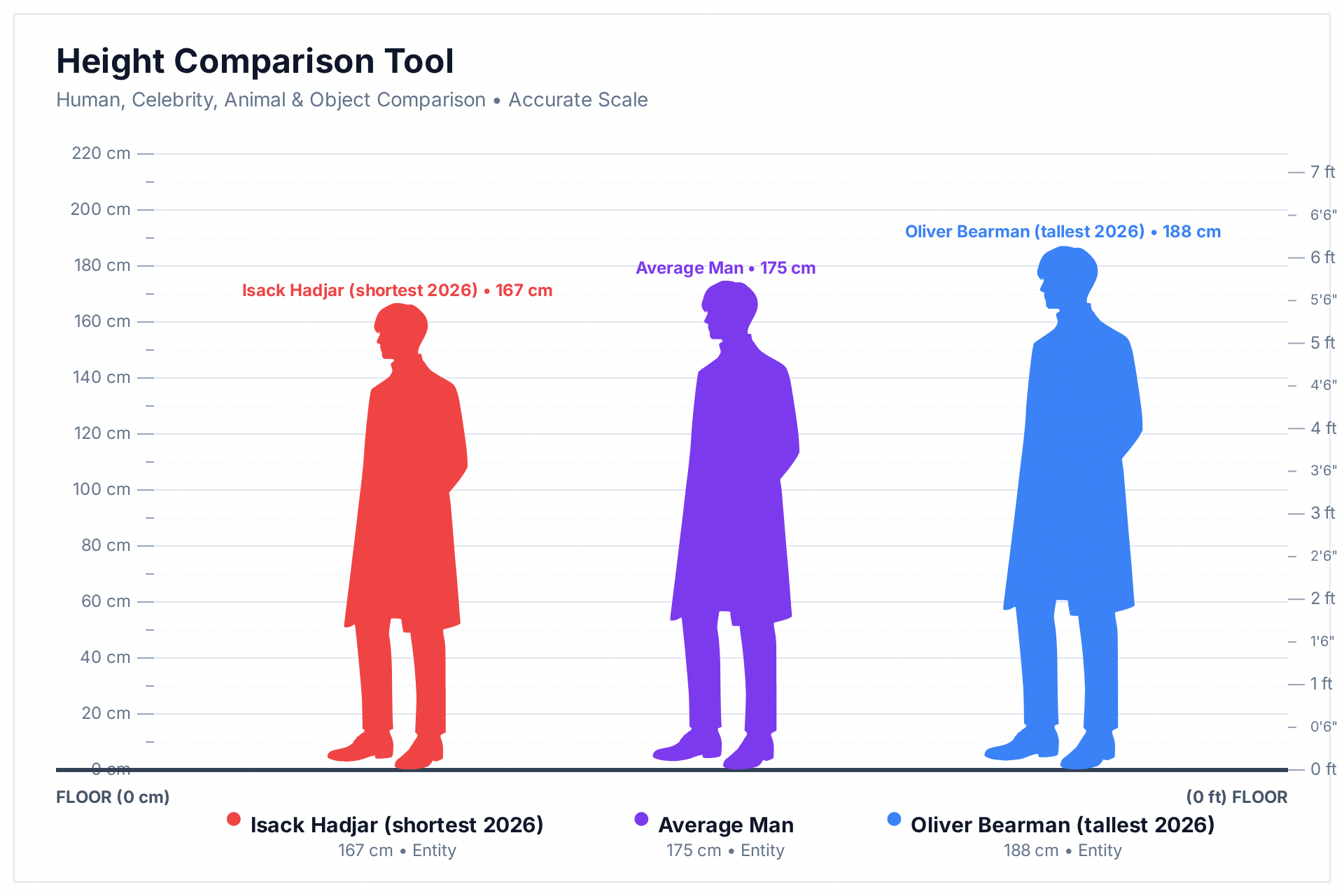
The 2026 Formula 1 grid spans 21 cm from boot to helmet: Isack Hadjar at 1.67 m (5'6") up to Oliver Bearman at 1.88 m (6'2"). Across the 22-driver grid, the average sits at about 1.78 m (5'10") — a touch above the average adult man (175 cm), but far shorter than the giants of basketball or American football.
The shape of the grid is new this year. Yuki Tsunoda — at 1.59 m (5'3") the shortest driver of the modern era — moved into a Red Bull reserve role for 2026, handing the "shortest on the grid" title to Hadjar. At the top end, Bearman's 1.88 m (per his own official site) makes him 2 cm taller than the previous standard-bearers, Alex Albon and Esteban Ocon, both 1.86 m (6'1") — Ocon being Bearman's Haas teammate, which makes Haas the tallest driver pairing in the sport.
The full table below lists all 22 drivers in height order. One figure needs an asterisk: Lando Norris is listed at 1.77 m by PlanetF1 but 1.70 m by Autosport and RacingNews365, so the table shows the higher figure with the dispute flagged. Bearman, too, appeared at 1.84 m on some early lists before the 1.88 m figure from his own site became the 2026-season consensus. Reported driver heights disagree more than you'd expect — this article shows the consensus and flags the disputes rather than picking numbers silently.
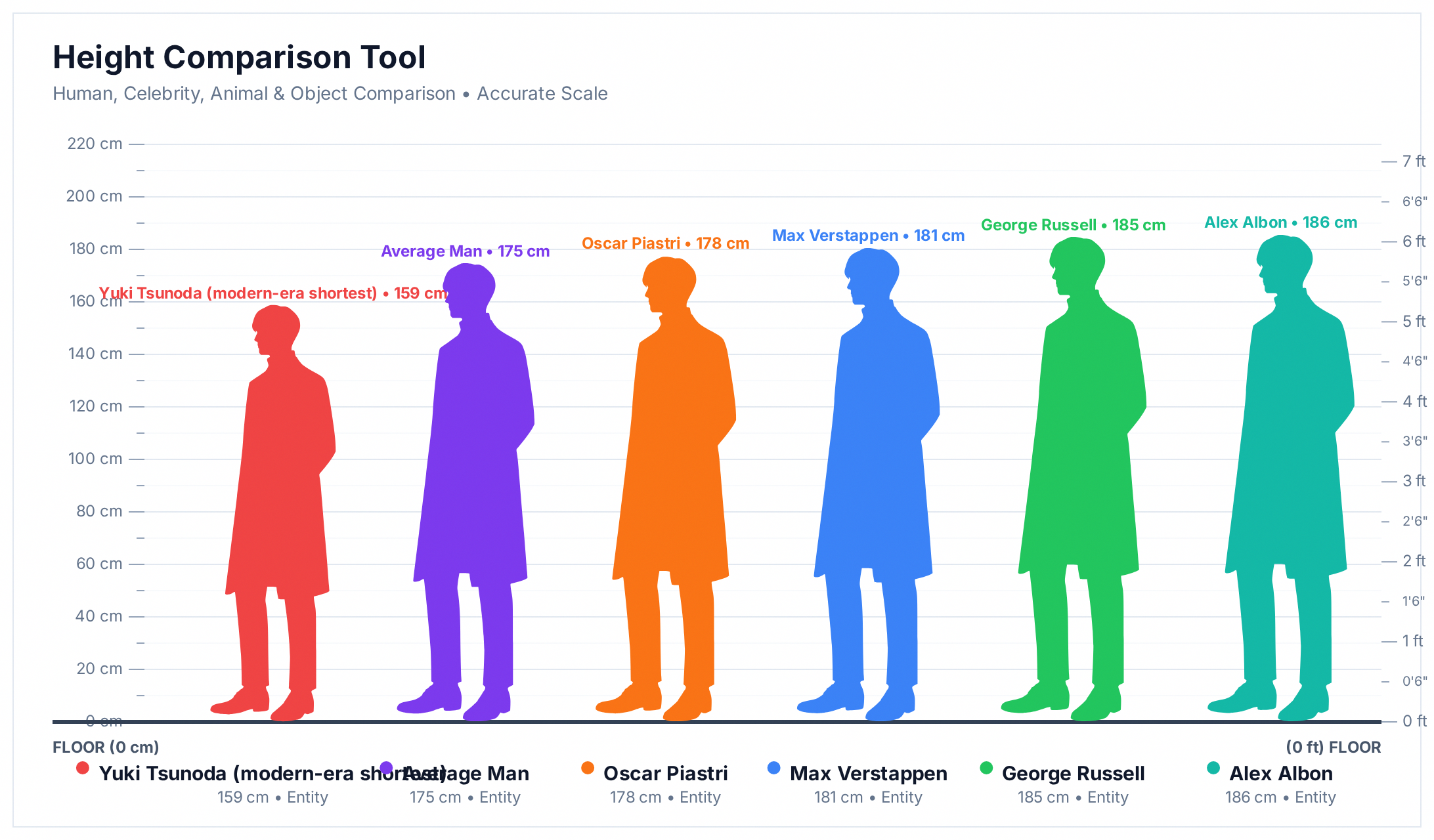
Averaging the 22 published 2026 grid figures gives ~1.78 m (5'10"). Sources vary slightly (1.74–1.78 m) depending on which disputed figures they use for Norris and Bearman, but the picture is consistent: the typical F1 driver is just above the average man.
Why F1 Drivers Are Shorter Than You'd Expect
An 82 kg minimum weight rule and a carbon-fibre bathtub: the physics that keeps the grid compact.
The average F1 driver (1.78 m) is about 20 cm shorter than the average NBA player and sits well below the typical NFL lineman. That is not coincidence — it is physics plus regulation. Since 2019, the FIA has enforced a minimum combined weight for driver plus helmet, suit and boots: 80 kg originally, raised to 82 kg for 2025. Any driver under the limit gets ballast bolted low in the cockpit, which erases what used to be a genuine performance advantage for lighter (usually shorter) drivers — and protects driver welfare by stopping teams from demanding unhealthy target weights.
Before that rule, shorter meant faster: every kilogram saved above the minimum was pure performance, and teams were known to push drivers toward punishing weight targets. The 82 kg rule was introduced specifically to end that arms race. Even with it in place, though, taller drivers still pay a packaging tax: they sit higher, disrupting airflow over the car, and they leave engineers less freedom about where to place ballast — and ballast placement is a genuine handling tool, shifting weight low and where the car needs it.
How tightly the field is weight-equalised was demonstrated at the 2024 Belgian Grand Prix, when George Russell's Mercedes weighed in at 796.5 kg after fuel was drained — 1.5 kg under the 798 kg minimum. His victory was disqualified and the win handed to teammate Lewis Hamilton. When a Grand Prix is lost over the weight of a small bag of sugar, you can see why teams measure their drivers to the centimetre.
The FIA sets no minimum or maximum height for drivers. The only requirement is that the cockpit volume must safely accommodate the driver — the constraints are engineering (seat fit, pedal reach, airflow), not regulatory. Shorter drivers like Tsunoda use extra seat padding and custom pedal cases; taller drivers need bespoke seat fittings.
The New Extremes: Hadjar vs Bearman
A 21 cm gulf between Red Bull's shortest driver and Haas's tallest — the widest spread in recent memory.
Isack Hadjar, at 1.67 m (5'6"), is the shortest full-time driver on the 2026 grid — and he races for Red Bull, the team whose cockpit fitting is famously exacting. He missed three rounds mid-season with a wrist injury (Liam Lawson stood in), but returned at Baku and finished on the podium. The 21 cm gap between him and Bearman is the largest spread between grid extremes in recent seasons.
Bearman at 1.88 m (6'2") is a genuine outlier: no driver this tall has raced full-time in the modern era, and he sits just 6 cm short of the all-time record set half a century ago. Alongside Ocon (1.86 m), Haas fields a combined 3.74 m of driver — the tallest pairing on the grid, and a packaging headache their engineers reportedly plan bespoke seat fittings around.
The Tsunoda story is not quite over, either. While he is nominally a Red Bull reserve in 2026, he returned to a race seat for three rounds (the Netherlands, Italy and Spain) when Hadjar was injured — even scoring a point at Monza. His 1.59 m (5'3") remains the modern-era benchmark at the short end, and his cockpit is famously customised: extra foam padding to raise his seating position and a purpose-built pedal case so he can reach the pedals.
All-Time Records: 1.57 m to 1.94 m
Thirty-seven centimetres separate the tallest and shortest drivers in F1 history — and nobody in fifty years has stretched either record.
The tallest driver ever to race in Formula 1 is widely reported as Hans-Joachim Stuck, at 6'4" (1.94 m), who contested 74 Grands Prix between 1974 and 1979 for March, Brabham, Shadow and ATS. The ground-effect era pushed cockpits forward and left him sitting bolt upright in cars designed to be as small as possible — he never properly fit any of them, yet still scored a podium at the 1977 United States Grand Prix before finding greater success in sports cars.
The tallest of the modern era (2000s onward) was the late Justin Wilson at 1.93 m (6'4"). His height was a genuine career obstacle: Minardi wanted him for two races in 2002 and could not get his legs into the car, so Anthony Davidson took the seat instead. Minardi had to redesign its 2003 challenger — dropping the seat floor and moving the pedals forward — to build the car around him.
The shortest ever is Andrea Montermini at 1.57 m (about 5'1"), who raced 29 Grands Prix from 1994 to 1996 with Simtek, Pacific and Forti. Small stature was never his problem — funding was. The 37 cm gap between Montermini and Stuck is nearly a quarter of Montermini's entire height, and the records at both ends have stood untouched for decades.
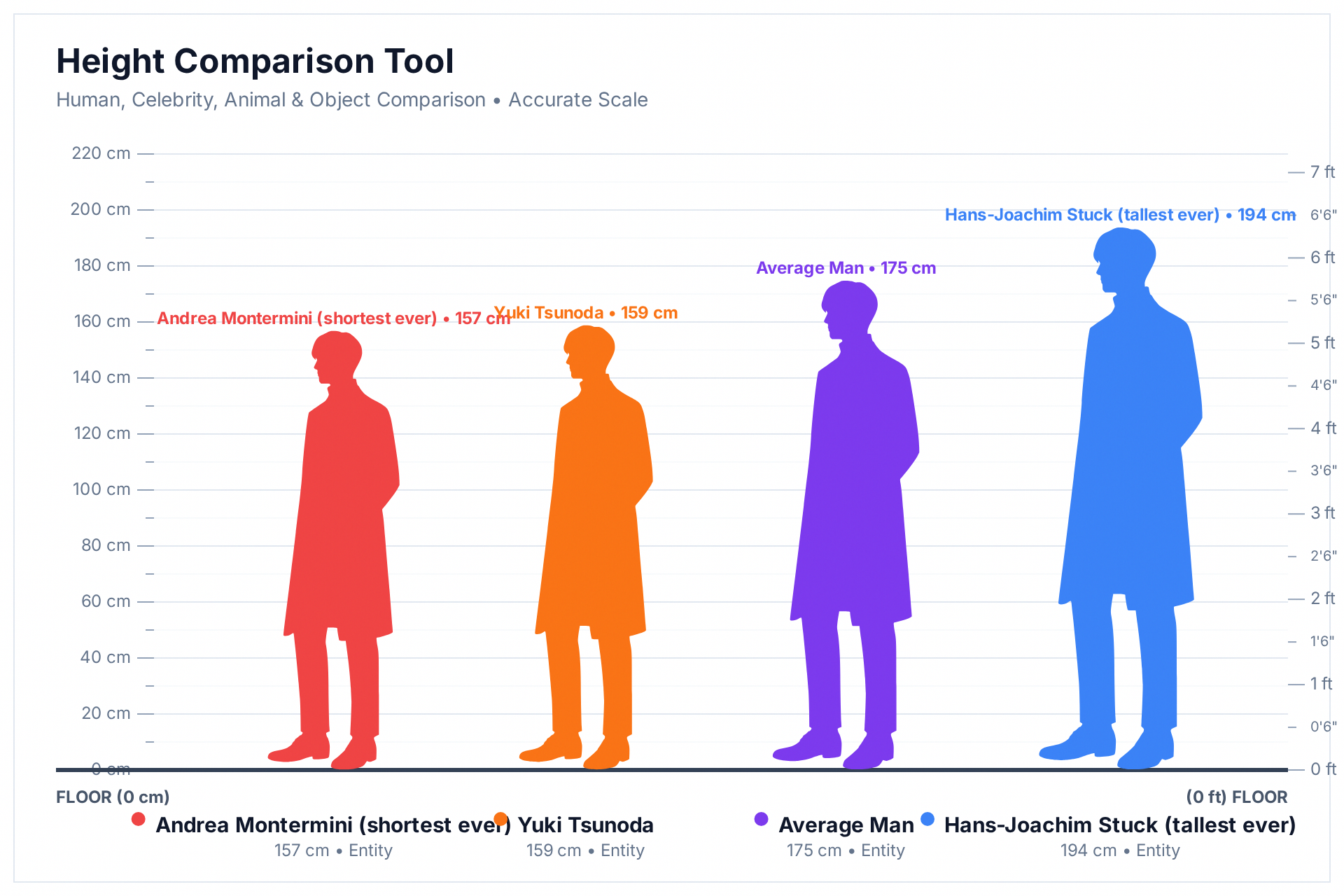
Pre-2000 driver heights are widely reported rather than officially measured — RacingNews365 flags its own caveat on early records. The modern figures (Bearman, Hadjar, Tsunoda) come from team- or driver-published data and are far more consistent across sources.
How Do You Measure Up?
Most readers are taller than half the F1 grid — add your height and see.
The visualiser at the top of this article is preloaded with the 2026 grid's key markers — Bearman, Russell, Verstappen, Piastri, the average man, Hadjar, Tsunoda — plus the all-time record holders Stuck and Montermini. Add your own height and see exactly where you would sit on an F1 grid. At 175 cm, the average man already outranks Hadjar, Alonso and Antonelli; at 180 cm you would tower over a third of the field.
Two honest caveats before you do. First, reported heights disagree more than you'd expect: Norris is 1.70 m or 1.77 m depending on the source, and Bearman appeared at 1.84 m before his own site's 1.88 m figure gained traction. We have shown the 2026-season consensus and flagged the disputes rather than choosing silently. Second, driver weights are closely guarded team secrets — but with the 82 kg cockpit minimum, everyone on the grid is effectively equalised anyway.
For more numbers, the sports section has the full set: average NFL player height by position, WNBA vs NBA height comparison, and average soccer player height by position — plus the extremes of the men's game, from 1.54 m Élton to 2.08 m Kristof van Hout.
F1 rewards compactness, not tallness: the 2026 grid averages 1.78 m, the shortest full-timer is 1.67 m, and the tallest driver in half a century is 1.88 m. In a sport decided by milligrams, the cockpit — not the podium — sets the ideal height.