The Headline Numbers: Average Height, Age 13 to 18
Girls do their growing early — the average 14-year-old is nearly done.
The numbers themselves are refreshingly uncomplicated. According to the CDC growth charts — the percentile tables paediatricians use in the United States — the average (50th-percentile) girl stands 157.0 cm (5’ 2″) at 13, 160.5 cm (5’ 3″) at 14, 162.0 cm (5’ 4″) at 15, 162.5 cm at 16, and about 163.0 cm (5’ 4″) at 17 and 18. Between her 13th and 18th birthdays, the average girl gains roughly 6 cm — about two and a half inches. That is it. Compare the mirror-image boy figures: the average boy gains about 20 cm over the same stretch, most of it arriving after 13.
The year-over-year column in the table above tells the whole story. Between 13 and 14 the average girl adds 3.5 cm — the last real year of noticeable growth. Between 14 and 15, only 1.5 cm. After that, the curve is essentially flat: half a centimetre a year, then nothing. This is the great inversion of the teenage years: boys do their dramatic growing during the teens, while girls do theirs before the teens even begin. If you are 14 and feel like your growth has stopped, you are almost certainly not imagining it — the fastest part is years behind you.
Newer measured data tells the same story. The CDC’s National Health and Nutrition Examination Survey, measured by trained examiners in 2021–2023, found average heights of 61.6 in (156.5 cm) for the 12–13 band, 62.8 in (159.5 cm) for 14–15, and 63.6 in (161.5 cm) for both 16–17 and 18–19 — the flat plateau after 15 shows up whether you read the chart medians or the freshest measured means. One caveat, as ever: these are US figures. Average teen heights differ around the world, so if you are reading from outside the United States, treat this as a reference curve rather than a personal benchmark — see our guide to average height by country for the global picture.
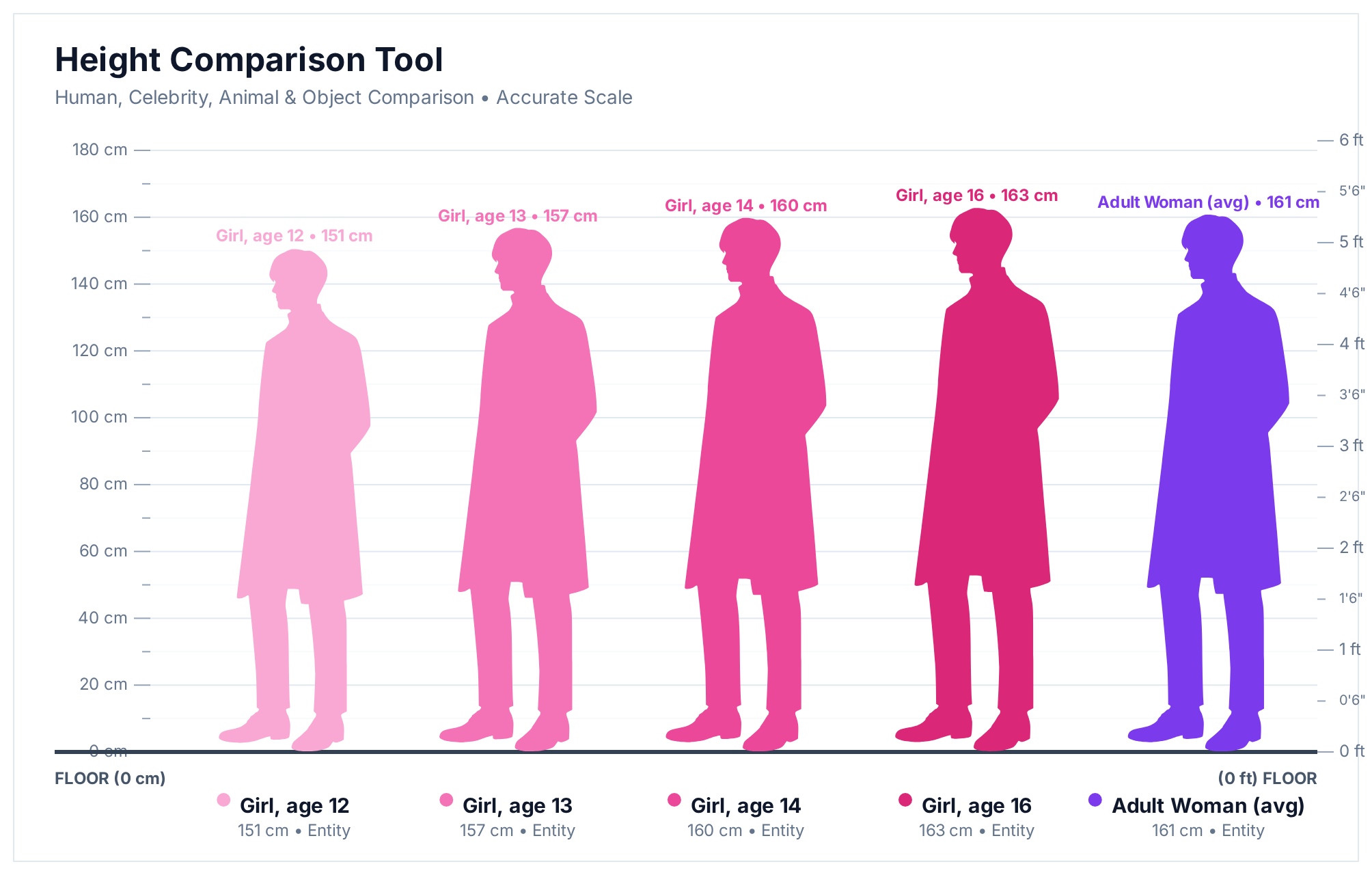
13 → 157.0 cm (5’ 2″) · 14 → 160.5 cm (5’ 3″) · 15 → 162.0 cm (5’ 4″) · 16 → 162.5 cm · 17–18 → 163.0 cm (5’ 4″). CDC 50th-percentile values.
The Growth Spurt: Peaking Around Age 11–12
The fastest year of a girl’s life happens before she turns 12 — and most of it is done by 13.
Every child’s growth rate hits a single fastest point that researchers call peak height velocity, or PHV. In girls it lands around 11.8 years on average — roughly two years earlier than in boys — and the window of rapid growth is roughly ages 10 to 13. The peak itself is less intense than in boys but it is still dramatic: girls typically gain around 7 to 9 cm in their fastest year, which is why ages 10 to 12 are the years of the constantly-outgrown shoes and the school photos where the heights seem to reshuffle every term.
Growth does not arrive evenly, either. As in boys, the limbs — arms and legs — tend to lengthen first, with the spine and torso catching up later, which is why preteen girls so often look noticeably “leggy” for a stretch. Hips and shoulder development follow the height spurt, not lead it. And there is one milestone that often gets misread: menarche does not end growth, it just slows it. Research published in Pediatric Research finds girls typically gain a further 2.5 to 5 cm (roughly 1 to 3 inches) after their first period, and clinical sources describe the same range — the fastest growth is behind them, but the plates are not yet closed.
Timing, as always, varies enormously. Girls who start puberty early — before about age 8 — tend to grow fast and stop sooner; girls who start late grow later but for longer. This is why early developers often tower over their classmates at 11 and then get overtaken by the late bloomers in their mid-teens. In a typical Year 7 or Year 8 classroom, the tallest students are disproportionately girls, and that is exactly what the biology predicts: at 12, girls average about 151 cm while boys are still waiting for their spurt to begin.
The average girl gains a further 2.5–5 cm (1–3 inches) after her first period. If the fastest growth seemed to happen before puberty’s visible milestones, that is normal — peak velocity at ~11.8 usually arrives first.
What Counts as Normal: The Wide Middle
At 13, the “normal” band is more than half a foot wide — and that is the point.
The most useful numbers in this guide are not the averages but the percentile bands. At 13, the 10th percentile sits at about 4’ 11″ (150 cm) and the 90th percentile at about 5’ 5¾″ (167 cm) — a band more than 17 cm wide in which every girl is growing perfectly normally. A 13-year-old at 5’ 0″ lands around the 25th percentile: clearly below the average, completely ordinary. Read that slowly if you need to: a healthy 13-year-old can be anywhere from just under five feet to nearly five foot six, and the difference is timing and genetics, not health.
One piece of search-result debris to avoid: you will find pages claiming the CDC says the average 13-year-old girl is 4’ 11″. That is wrong. Four-eleven is the 10th percentile — well below average — not the 50th. The confusion likely comes from mixing up the CDC and WHO references (the WHO median for 13 is about 155.4 cm versus the CDC’s 157 cm) or from sloppy reading of the percentile tables. Wherever you read growth numbers, check whether they say 50th percentile: if they do not, the number is not an average.
This is why a single measurement against the average is nearly useless for teenagers. Paediatricians do not care much whether a 13-year-old is at the 50th or the 25th percentile — they care whether she stays roughly on her own curve over time. A girl who tracks the 20th percentile steadily from 9 to 15 is following a perfectly healthy path; a girl who drops from the 75th to the 25th between annual check-ups is the one who prompts a closer look. The trend is the diagnosis; the number is just a data point.
Track your percentile curve over time, not your height against the average on any single day. A steady curve anywhere inside the 5th–95th band is healthy growth — and 4’ 11″ is the 10th percentile, not the average.
When Do Girls Stop Growing?
Most reach final adult height at 14–15 — a full two years before the boys.
For most girls, meaningful height growth ends at 14 or 15. The mechanism is the same as in boys, just on an earlier schedule: the growth plates — thin bands of cartilage near the ends of the long bones where lengthening happens — gradually fuse under the influence of rising sex hormones, locking in final height. This typically completes around 14 to 16, and the chart data backs it up: girls aged 14 to 19 add only about half an inch in total after 14. By 15, the average girl is within a centimetre or two of where she will stay.
There are telltale signs the end is near, and they mirror the boys’ list on an earlier clock. Hands and feet are usually the first body parts to stop — a shoe size that has not budged in a year is a classic marker of the plates closing. Periods becoming regular, and the 1-to-3 inches of growth in the year or two after menarche, usually bracket the final stretch. Healthline’s clinical summary puts most girls at adult height around 15 or 16, and paediatric sources converge on the same window: the meaningful growth is done by about 15.
As with boys, “most” leaves a tail. Late bloomers — girls whose puberty arrives at the late end of the normal range — can keep adding small amounts into their late teens, and their final heights typically land right on their genetic potential on a delayed schedule. The practical upshot: at 14 the average girl has about 2 to 3 cm of height still to gain; at 16 she is essentially there. Anything a 16-year-old measures is, for all practical purposes, her adult height.
Most girls reach final adult height between 14 and 15, with growth plates fusing around 14–16. Girls 14–19 add only ~0.5 in (1.3 cm) more after 14 — a 14-year-old’s height is nearly her adult height.
Girls vs Boys at the Same Age
At 12–13, the girls are taller. By 15, the boys have blown past — and it never flips back.
One of the great quiet surprises of the teenage height curve is that at 13, girls are on average slightly taller than boys — about 157 cm to the boys’ 156.2 cm. The explanation is pure scheduling: female peak height velocity lands around 11.8 years, roughly two years before the boys’, so in early Year 9 the girls have already spurted and the boys have not yet started. In a typical classroom at that age, the tallest students are disproportionately girls, and it is entirely expected.
The crossover comes fast, around 14 to 15. By 14 the average boy (163.8 cm) is past the average girl (160.5 cm); by 15 he is at 170.1 cm against her 162.0 cm; by 18 he is 176.1 cm against her ~163 cm — a gap of roughly 13 cm, about five inches. Because male peak velocity comes about two years later and benefits from a longer runway before the growth plates fuse at 16–18, the average adult man ends up several inches taller than the average adult woman. That two-year lag is, in essence, most of the adult height gap.
The adult endpoints confirm it. Measured CDC data for adults aged 20 and over (NHANES 2021–2023) gives the average woman 63.5 in (161.3 cm) and the average man 68.9 in (175 cm). Notice where the teenage curves land: the average 16-year-old girl (162.5 cm) is already a shade taller than the average adult woman, while the average 16-year-old boy (173.4 cm) still has a couple of centimetres to find. Girls finish first; boys finish taller. For the full boys’ curve, see our companion guide to average height of a teenage boy by age.
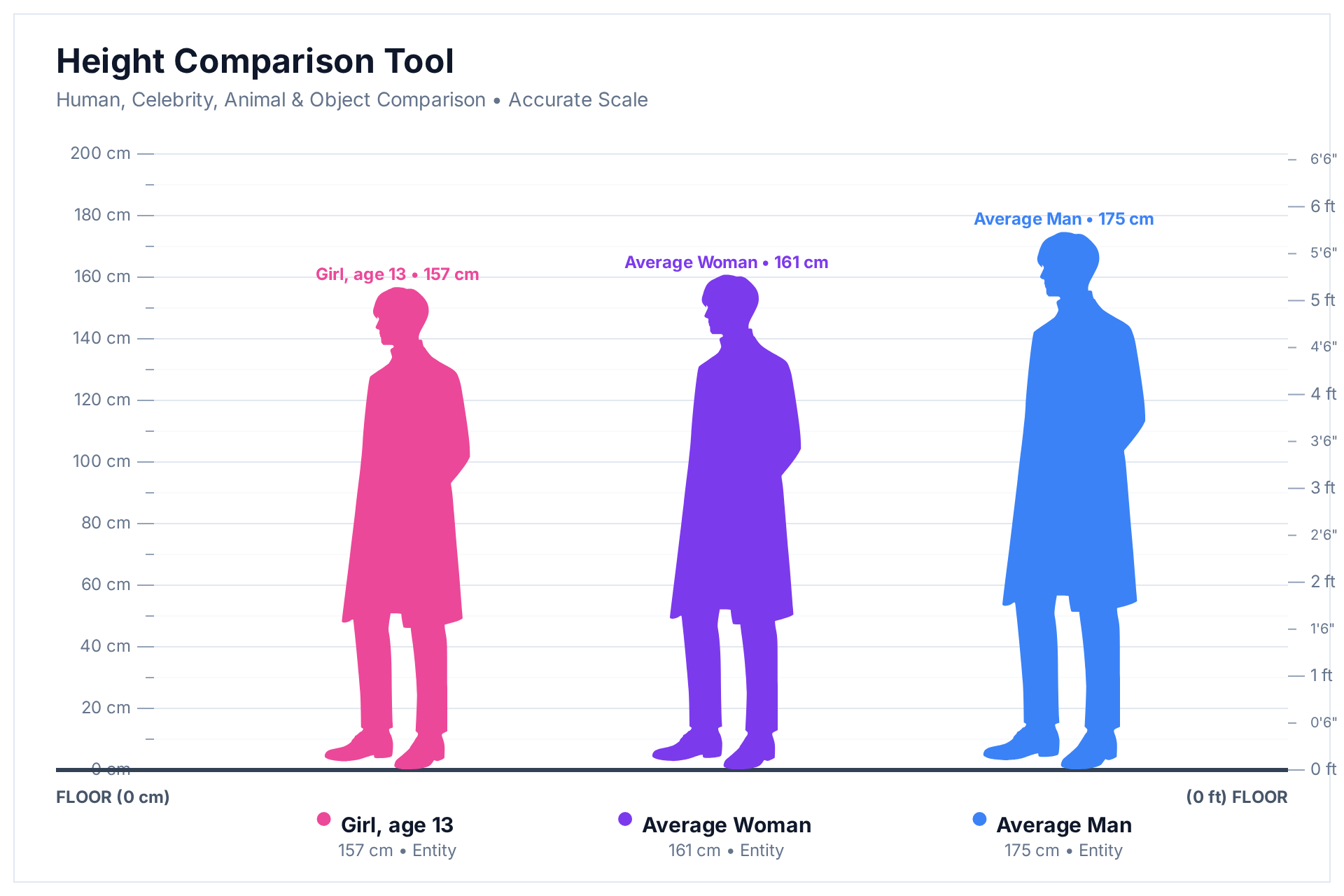
Girls average ~157 cm at 13 vs boys’ 156.2 cm; by 15 the average boy is 170.1 cm — past the average girl’s adult height of ~162 cm — and the gap only widens.
How to Measure and Track Growth Properly
One careful measurement beats ten casual ones.
Most height anxiety is measurement noise. People are tallest in the morning (up to a centimetre taller than in the evening, thanks to spinal compression through the day), and self-measurements with shoes on, hair included, or a tape held at an angle can easily wander by 2 or 3 cm — enough to swallow a whole year of a girl’s teenage growth. Do it properly: barefoot, heels, buttocks, shoulder blades and the back of the head against a wall, looking straight ahead, with a flat object — a book works — lowered onto the crown of the head. Mark, measure the mark, and write it down with the date. (Our full walkthrough of measuring your height accurately at home covers the technique step by step.)
Then stop measuring daily. During the teens, measuring every six months is plenty; between measurements, the changes are invisible and watching them will only feed the anxiety. Plot each result on a standard CDC percentile chart — there are free calculators and printables — and watch the curve, not the number. As long as the points stay roughly on the same percentile line, growth is proceeding normally, whatever the absolute figure says. Crossing two or more major percentile bands up or down between check-ups is the pattern paediatricians actually watch for.
Finally, the unsexy truth about maximising height: genetics sets the ceiling, and everything else just helps you reach it. Adequate sleep matters more than most teens expect — the bulk of daily growth hormone is released during deep, slow-wave sleep. So do protein, calcium and vitamin D in the diet, regular exercise, and avoiding the things that can genuinely stunt growth, like smoking or chronic undernutrition. No stretch, supplement or “height exercise” programme can add centimetres the growth plates will not give — but a well-slept, well-fed teenager will reach every centimetre her genes allow.
Book a check-up if growth has fallen off its curve, puberty shows no signs at all by 13, or you are worried for any other reason. A bone-age X-ray can estimate remaining growth potential in minutes — forums cannot.