The Short Answer: 5’7″ and Up Is Tall for a Woman
Nine in ten adult women in the US are shorter than 5’7″ — that is what “tall” means in practice.
If you want one number, here it is: in the United States, a woman is generally considered tall from 5’7″ (170 cm) upward. The reasoning is statistical, not aesthetic. The average US woman aged 20 and over stands 63.5 inches (161.3 cm) — a measured figure from the CDC’s National Health and Nutrition Examination Survey, taken by trained examiners with shoes off, so it is about as solid as height data gets. At 5’7″ you stand roughly 8.5 cm above that average, which places you at about the 90th percentile. Nine in ten adult women are shorter than you. That is, for all practical purposes, tall.
The zone just below it — 5’5″ to 5’6″ — is where opinions split. At 5’5″ (~70th percentile) you are clearly above average but nobody would call you tall; at 5’6″ (~84th percentile) you are noticeably above average and people may start describing you that way, especially if you are taller than most women in your family or social circle. Think of 5’6″ as “tall-ish” and 5’7″ as where the consensus answer begins.
One more thing worth internalising early: “tall” is a relative word, not a medical diagnosis. There is no clinical height at which a doctor declares a woman “tall” the way there is no line where someone becomes officially “short”. Percentiles are the honest way to answer the question because they describe where you actually stand — literally — relative to other people. The chart below renders the key benchmarks to scale so you can see what the numbers mean in space, not just on paper.
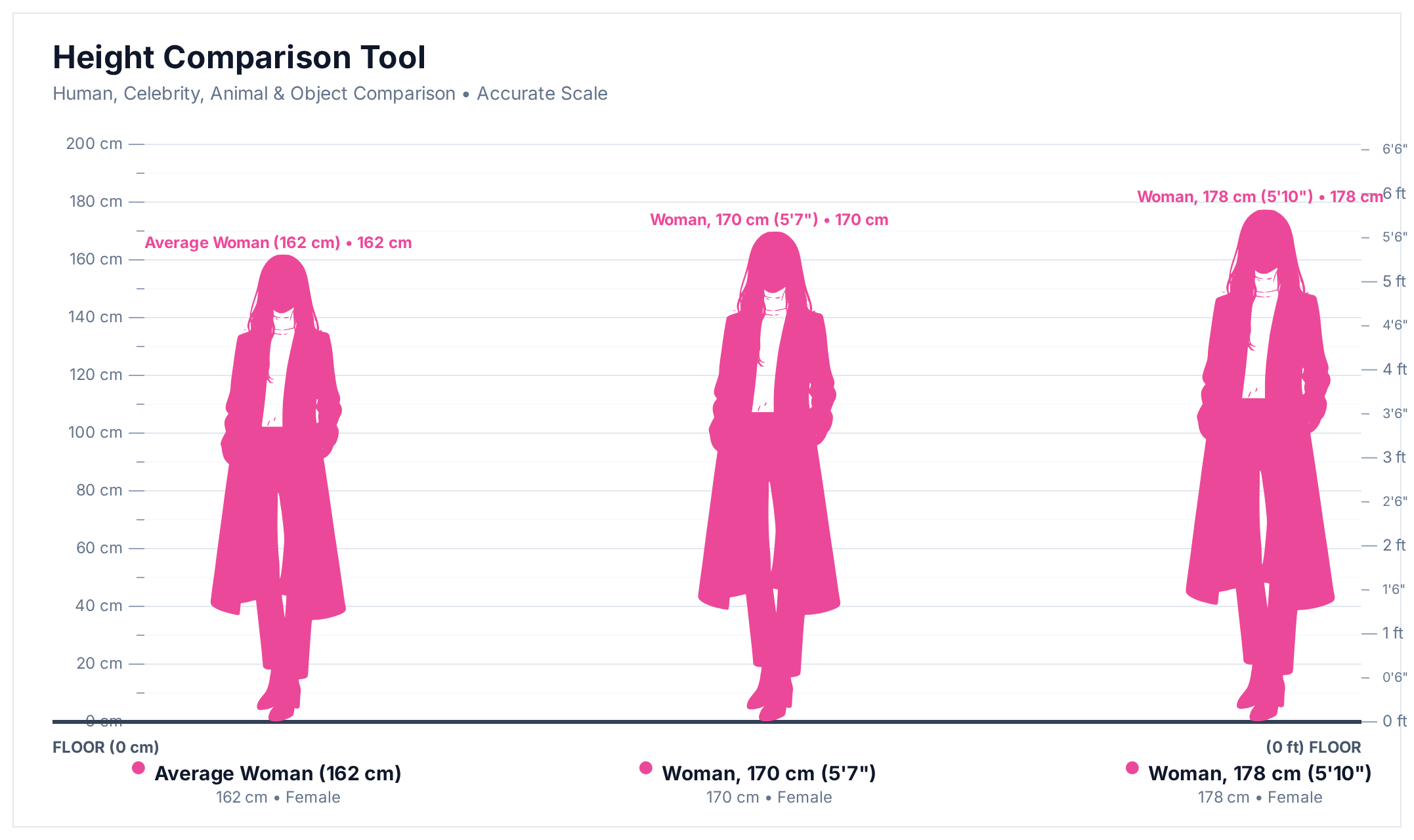
5’7″+ (170 cm+) ≈ 90th percentile = “tall”. 5’6″ ≈ 84th percentile = “tall-ish”. 5’5″ and under is above average but not tall.
Height Percentiles for Women, Explained
The full ladder from average to the top 1% — and why the middle of the curve matters less than you think.
A percentile tells you the share of a population you are taller than. If you are at the 90th percentile, 90% of women in the reference population are shorter than you. The reference population here is adult US women aged 20 and over, measured in the CDC’s 2021–2023 survey round. That gives the ladder in the table above: 5’4″ sits around the 55th–60th percentile (slightly above average), 5’7″ at about the 90th, 5’8″ at about the 95th, and 5’10″ at about the 99th.
Notice how unevenly the ladder is spaced. Between the 50th and the 84th percentiles — the whole span from average to “tall-ish” — there are only about 6–7 cm. Women’s heights cluster tightly around the middle: the standard deviation in the CDC data is roughly 2.5 inches (~6.4 cm), so most adult women fall within about 5 inches of the average. That tightness is why a couple of centimetres feels like so much socially: 5’6″ and 5’8″ differ by only 5 cm, yet one is “above average” and the other is “top five percent”. Small absolute differences, enormous percentile differences.
Two caveats keep this honest. First, percentiles shift slightly between NHANES survey waves and between sources, so every figure here is approximate — treat the ladder as accurate within a centimetre or so, not as scripture. Second, the reference population matters enormously, which is what the next section is about. A percentile is only ever a statement about a specific group of people; change the group and the same height tells a different story.
Because women’s heights cluster so tightly (standard deviation ~6.4 cm), the jump from the 84th to the 95th percentile is only about 5 cm — yet socially it is the jump from “above average” to “noticeably tall”.
Why “Tall” Depends on Where You Live
In Amsterdam, 5’7″ is just average — context is the whole story.
Height is always judged against the local average, and national averages for women span a striking range — from around 152 cm in the shortest countries to about 170 cm in the tallest. The Netherlands still holds the title of tallest nation: Dutch women average roughly 170 cm (5’7″), essentially the same height that marks the 90th percentile in the US. A woman who towers over the room in Manila walks around Amsterdam at exactly average height.
A useful rule of thumb used across the sources for this article: “tall” begins around 3 inches (7–8 cm) above your country’s female average. For the US, with a 161.3 cm average, that gives ~5’6.5″–5’7″ — exactly the consensus threshold. For the UK, where women average close to 164 cm, the threshold lands around 5’8″. For the Netherlands, it lands around 5’10″. The formula is the same everywhere; only the starting point moves.
Age and ancestry shift the local picture further. Within the US, average height varies across ethnic groups, and older cohorts average slightly shorter than younger ones — partly because each generation has been a little taller, and partly because women lose height with age (more on that below). So even the “national average” is a blend. The practical takeaway: when someone asks whether a height is tall, the only fair follow-up is “tall for where, and for whom?”
Roughly 3 inches (7–8 cm) above the national female average is where “tall” begins — in the US that is ~5’7″, in the Netherlands ~5’10″.
What 5’7″ Actually Looks Like Next to Everyone Else
A 5’7″ woman stands eye to eye with the average man — here is the proof, to scale.
Numbers on a percentile table are abstract; what they look like in a room is the thing people actually feel. The average US man aged 20+ stands 68.9 inches (175 cm) per the same CDC survey — so a 5’7″ (170 cm) woman is only about 5 cm shorter than the average man, and a 5’8″ woman is within 2 cm of him. In any mixed crowd, a tall woman will be taller than most of the women and level with — or above — a large share of the men.
This is where the social experience of being a tall woman mostly lives: not in being an outlier among women, but in crossing the invisible line into the male height range. A 5’10″ woman is taller than the average man outright. She is not “a little tall”; she is taller than roughly 60–65% of all adults. That is a genuinely unusual experience in everyday life — and it is why so many discussions about women’s height end up being discussions about height relative to men, not relative to women.
The chart below renders it directly: the average woman (162 cm), the average man (176 cm), and a tall woman at 178 cm (5’10″) standing side by side, to scale. She stands eye to eye with the average man — and looks down on the average woman by a full head’s difference.
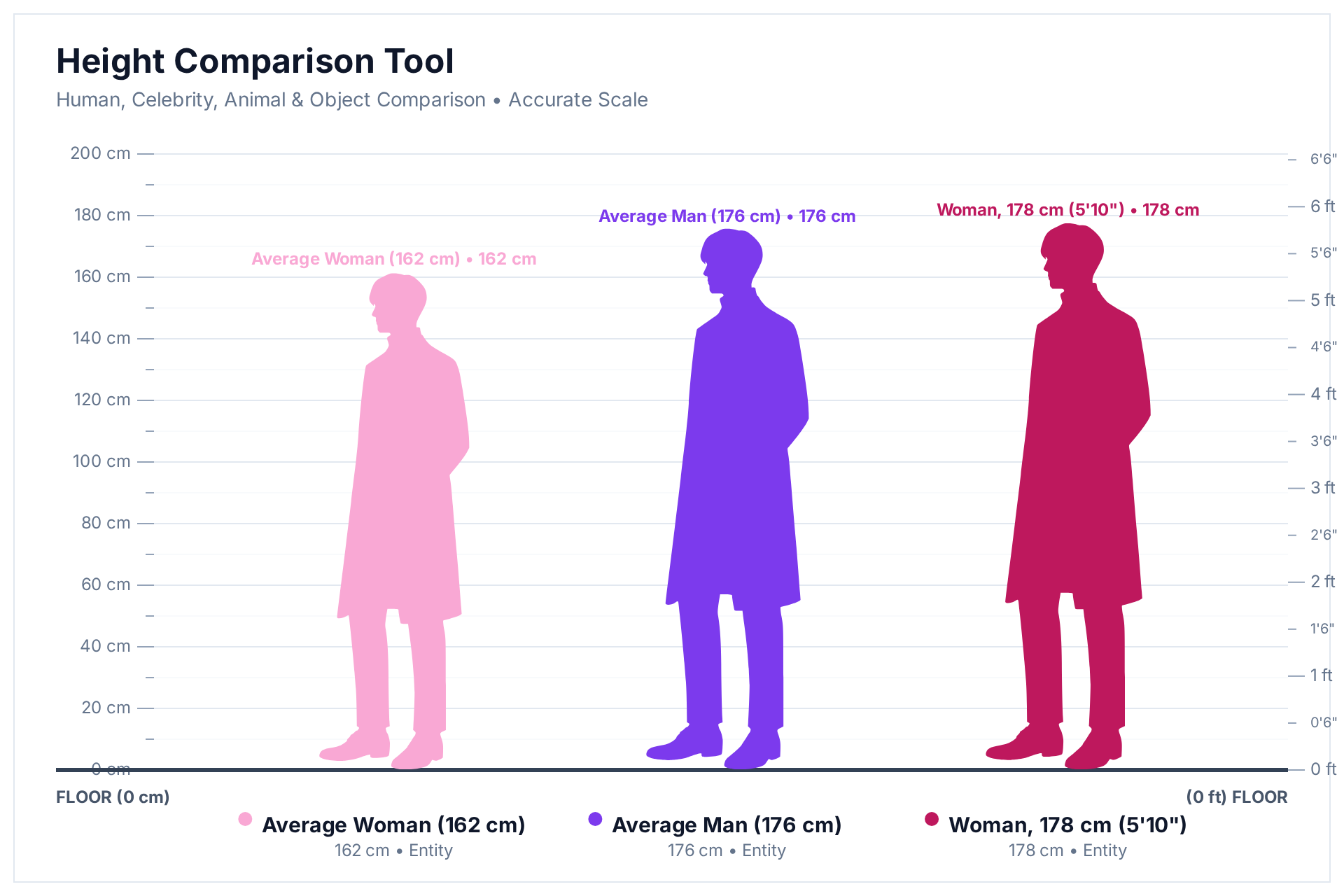
At ~5’7″ a woman enters the middle of the male height range; at 5’10″ she is taller than the average man outright. That is the real social dividing line.
Culture, Modelling, and the Practical Realities of Being Tall
From the 5’9″ model benchmark to trousers that are never quite long enough.
One number that comes up constantly is 5’9″ — the standard minimum for female fashion models (agencies typically ask for 5’9″ to 6’0″). It is important to frame this for what it is: a cultural convention, not a clinical one. The modelling world selects for height because clothes drape differently on a long frame and because uniformity across a runway line matters to designers — not because 5’9″ is where some biological threshold lies. Roughly 2–3% of women reach 5’9″+, so the industry is drawing from the top sliver of the curve by design.
The lived experience of being a tall woman tends to be a mix of advantages and annoyances rather than either extreme. The advantages are real and well documented: height correlates with advantages in sports like basketball, volleyball and rowing, and socially it reads as presence — tall women are disproportionately represented in leadership and on stage, and surveys consistently find height associated with perceived authority. The annoyances are equally real: standard women’s clothing is cut for the middle of the curve, so trousers run short, sleeves stop early, and heels add another few centimetres to a height you may already be self-conscious about.
Then there is the timeline. Most girls reach their final adult height by 14–16, as the growth plates fuse roughly two to three years after their first period — about two years earlier than boys, whose plates stay open longer. And height is not a lifetime constant even for adults: women typically lose 1–2 inches over the decades after 40 as spinal discs compress, and even day to day you are roughly a centimetre taller in the morning than in the evening. If you measured 5’7.5″ at breakfast and 5’6.75″ at night, both readings are real — which is another reason to treat any single threshold for “tall” with a little humility.
Fashion modelling draws from roughly the top 2–3% of women by height. It is an industry convention about how clothes look on a runway — not a medical definition of “tall”.